 Oh how I love Meruru. I discovered the Atelier series with Rorona. It became my favourite JRPG franchise with Totori, but Meruru is something else entirely; this is the perfect traditional, turn-based JRPG as far as I’m concerned.
If you haven’t played an Atelier game before, then you might as well start with this one. But I will give fair warning going in; here’s a game that has a weird focus for an JRPG. See, Meruru is a game that’s about cooking (sorry… alchemising) everything from bombs to healing potions, cake through to armour. Any loot you pick up through the game is nothing more than raw materials, which you then need to make into something useful in order to fulfil quests or get better equipment.
 I’ve spent most of my time in all three Arland games focusing on the “fulfil quests” side of things because one of the most delightful things about this series is that grinding through combat doesn’t really play much of a role. It’s there if you absolutely must go around bopping Punis (think Dragon Quest’s Slimes, only cuter) on the head, but Meruru and her sister games do give people the option to largely alchemise their way through the story. Meruru’s somewhat pacifist approach to the JRPG formula is such a refreshing change at a time when the rest of the JRPG genre turns ever more towards action-heavy combat and dark, epic, themes.
It’s not just in its approach to violence that Atelier Meruru successfully sidesteps the dark shadows its genre cousins often call into; this is one bright and bubbly game. The cheer doesn’t just come from the colourfully simple cel-shading that gives the game a bright and cheerful atmosphere. Nor is it solely a consequence of and infectious music score comprised of bright tunes mixed with some more soulful orchestral work. Both the visuals and soundscape help, but what really makes the whole Meruru experience so darned happy is the characters. Meruru is the kind of girl that has simply never had a bad day in her life, and given that her entire quest involves getting her father king’s permission to be an alchemist, there is a refreshing approach to narrative running through this game when compared to its genre peers; it’s simple, it’s focused, and pleasant. No global conflict, no apocalypse and no people-who-can’t-age-so-watch-their-loved-ones-die. Meruru is just happy. Sometimes, just happy is enough.
 There’s a wonderfully eclectic cast of characters supporting Meruru in her quest, including a bunch that make a return from previous games in the series, which is a nice little nod towards the faithful by GUST. Don’t worry too much if you haven’t played those first two games though because this game’s narrative makes perfect sense, but it’s like watching the Avengers having not seen the previous Marvel films compared to seeing it after seeing the previous Marvel films; the latter experience is just that touch more fun thanks to the character backgrounds. Whatever your experience with the previous games in the series those characters that are in Meruru are fun, charming, silly and irreverent thanks in no small part to the interplays between them. There’s a basic relationship system built into the game, and watching those relationships play out through the dialogue-heavy cutscenes helps greatly in building a set of characters that you genuinely care for.
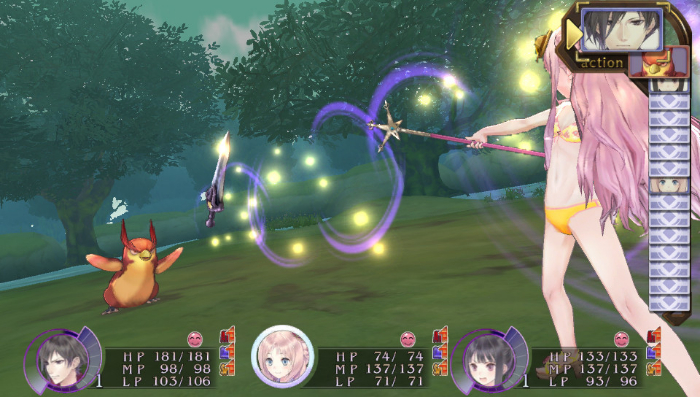
Now, Atelier Meruru, being a GUST game, is built with a certain audience in mind – the Japanese folks (mostly men) that hang around Akihabara in their spare time. Akihabara is that place with loads of Maid Cafes and a 7-story adult goods shop. As these games go (and there are a lot of them made every year, I can assure you – Akihabara is a lucrative little area for game developers) Meruru is perhaps the most accessible one ever produced. Let’s call it a “gateway drug” to otaku JRPGs, in the sense that it’s about as potent compared to some of the other games made for the Akihabara crowd is as caffeine is as a drug when compared to heroin. There’s just a whiff of fan service running through the game, and of course early adopters of the Vita game get to dress Meruru up in a rather fetching bikini, but compared to games like Hyperdimension Neptunia and games that have no hope of ever being localised, the content of Meruru shouldn’t offend anyone. This is a good thing, as I would hate for anyone to be offended by such an innocent game.
 All together, the narrative of Meruru shows confidence by GUST. Confidence in the character designs, the setting, pacing and tone, and confidence that the writers didn’t need to resort to gimmicks or hard-and-heavy material in order to draw a player’s interest. Both Rorona and Totori has moments where both the narrative, gameplay and fan service went haywire (and Rorona was a raw enough experience that GUST decided to completely remake it for a Vita release, rather than just port it), but Meruru is a near perfect example of good design working like clockwork. It’s so refined that I’m not sure GUST will ever top it; Atelier Ayesha, which came after Meruru and with the support and backing of a new parent company in publishing giant Tecmo Koei, isn’t able to quite hit the highs of Meruru.
It plays like a dream, too. As a princess, Meruru is not only an adventurer, but also able to build up her kingdom by investing in various public works projects. Players earn the points to do that by completing various in-game quests. It lends the formula a simple but entertaining simulation aspect that wasn’t present in previous titles in the trilogy and as the various buildings grant a range of boons there’s some light decision making to make over the course of the game that creates an additional layer of engagement. Rorona and Totori before Meruru both had a similar “scoring” system as quests were completed, but the effect of those scores were far more abstract, being little more than points that would rank up at certain thresholds and unlock a few new abilities. The rewards structure of Meruru feels more tangible, and so the game is more rewarding.
 As with all three Arland games, Meruru runs to a strict time limit. She has three years in which to prove to her father her ability to be an alchemist. Every action such as combat, alchemy and exploration takes up time, though time doesn’t progress when you’re not undertaking these actions. In other words, Meruru asks players to be smart with their time management, but not stressed by forcing them into a real-time structure. Three years is more than enough to achieve the minimum “win” requirements, but some of the optional achievements and best endings take substantially more work, and naturally there’s unlocks and costumes and things that make a second playthrough (and third, and forth…) all but mandatory.
The main challenge in Meruru from a time management perspective is balancing the alchemy, with the ingredient gathering and then with the exploration and combat if you’re so inclined. It’s impossible to succeed at the game by focusing on just one action, and it’s entirely possible that the first play through will be a write-off for the first year of in-game time as you work out where that ideal balance lies. Eventually the game settles down into a nice, steady rhythm, and it’s at that point where hours can be lost, as everything is paced just right to create the “just one more quest” response that any good player has to a well-made game. Three games in and GUST nailed the distribution of the ingredients for the various alchemical recipes, resulting in a supremely balanced and overwhelmingly fair game for both people that just want to get to the end, and people that like tackling the tougher optional side-quests.
 I’d be remiss not to mention something about the combat. The turn-based combat might not be the focus of Meruru (at least, for the way I play), but that’s not to say it’s poor in any way. In fact, it’s actually quite strategic. Meruru herself is not much of a physical presence, but after she’s used alchemy to prepare some bombs and cannons, she’s a glass cannon able to wipe the field in a single turn. Because she’s quite fragile by herself in terms of being able to take a counter-attack, Meruru is able to take a couple of friends with her. These allies can be drawn from a fairly large pool, which allows players to customise their combat teams based on their own combat strategy preferences. With that said, there’s very limited ability to customise how a character levels, with stats being auto-assigned and skills being dolled out at set levels. Combat is also Meruru’s ever-so-slight Achilles heel because while the game’s difficulty curve is nice and gentle, it is possible to accidentally wander into an area where the enemies are way too powerful for Meruru’s team from time to time.
That tiny issue aside, this is by far GUST’s best game, and one of my very favourite games of all time. The Vita port is spectacular with some extra content, rebalancing of certain boss fights and that earlybird costume. If you’ve got a save from the equally-spectacular port of Totori on the Vita, you’ll unlock some extra bonus items too.
Class package. Class game.

– Matt S
Editor-in-Chief
Find me on Twitter: @digitallydownld
Our Scoring Policy