

“Cry to save the world,” “’Classmate’ (i.e. breed) to save the world,” “Defeat a person’s deviances (sorry ‘distorted desires’) to save the world,” “Sing to save the world.” The JRPG genre is positively filled with these abstract ideas of turning a certain emotion or action into a mechanic to build the game around. I suppose we shouldn’t be overly surprised that there’s a “kiss to save the world,” game too. Enter Exstetra.
Exstetra was, originally, a PlayStation Vita and 3DS title, albeit one that didn’t quite drum up the same attention or prestige as Conception, Persona, Blue Reflection, or the Caligula Effect, Alliance Alive, and dozens of other niche titles that got released across both consoles (what JRPG powerhouses they both were). It was also a Japan-exclusive back then, which makes its re-release on console and PC a new one for us English speakers. Interestingly, it was also one of the first half dozen or so published by FuRyu, which has grown to become one of the more noteworthy Japanese developer/publishers for its willingness to embrace quirky and niche ideas.
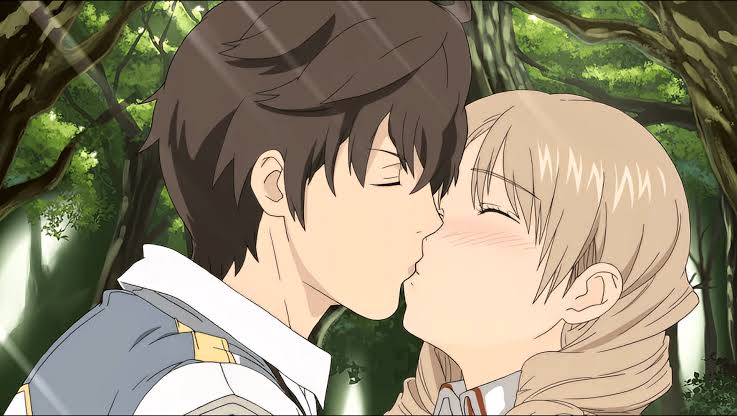
I highlight this background for a couple of reasons: Firstly, because it gives important historical background to a re-release of a game that many would think was too obscure to get one. Secondly, it should highlight why the game looks like it was produced on a tiny budget a decade ago (because it was). There hasn’t been that much work done to it to spruce it up for the newer machines, so it now looks a little basic, but it does have that quirky premise that makes it immediately charming in its own little way. Also, the little cutscenes that you get when it comes time to smooch up are cute.

The plot itself is very rote. You play as a dude with no memories who is tasked with saving the world (yes, really), and you’re doing so in a world that blends science fiction and fantasy aesthetics together. The thing is, though, that the game clearly knows that it’s not about to challenge the great works of literature for relevance and insight, and plays along with tongue firmly in cheek and zero pretension. Story sequences are brief and focus on making sure you know the characters enough that you want to get them to stick their lips together like you’re playing with dolls.
Of course, with such a silly concept as a person’s inner power being caught up with locking lips with another guy or girl (and it was nice to see that the game didn’t care about gender when it comes to who kisses who), it’s just as well that the game adopts that playful tone with itself.
Beyond the narrative scaffolding, Exstetra belongs to that era of JRPG where developers wanted to be seen trying to do something that looks different, but ultimately delivering fairly traditional turn-based combat systems. The best comparison I can think of to this game’s combat is (aesthetically, at least) another, now really very old game in Idea Factory’s Omega Quintet. Enemies are arrayed in rows, and you can move back and forth between rows yourself to affect when enemies your characters can attack and which characters are more likely to be attacked in return. Visually, it leaves the impression that it’s doing something relatively fresh, but it’s really just a different way of looking at Wizardry or so many other dungeon-crawling-style JRPGs.

The biggest original mechanic is the minigame that plays during those kisses. This is an exceedingly simple minigame mechanically (and, despite the topic, nowhere near as fanservice-heavy as some of the other Vita-era JRPGs), but it’s done in an interesting way. Specifically, it can actually affect the ending you get. So make out with your character of preference the first time (Akari, duh), but be aware that you’re probably going to want to keep some save states going so you can build up the kiss counter for some of the other characters and see other endings as well.
Dungeons are awfully dull examples of endless pathways, and outside of those dungeons you’re looking at little more than glorified menus and visual novel-style dialogue sequences. Exstetra was a handheld game from yesteryear, and that is very obvious in its level design today. There’s very little to do outside of that dungeon crawling, too…
However, I do have to say that I really miss games like Exstetra. It’s possibly the least “fan service” fan service game I’ve ever played and not a patch on the kind of cutscenes you saw in Conception, let alone the Compile Heart screen rubbing or boob jiggling specials, but they just don’t make these kinds of games any more. Perhaps it’s that the Japanese games industry is increasingly worried about Sony, Nintendo or Steam having rules that are increasingly arbitrary around this kind of game, and if you get them on the wrong day, the entire business’ financial health can be at risk. Perhaps it’s just that the market for these kinds of titles has shrunk to such a point that there’s no point making them. I really don’t know, but I do miss the heyday of Compile Heart, D3 Publishing, and horny Spike Chunsoft.

You’ve got to have a real love for the very deepest niches of JRPG fandom to enjoy Exstetra, but if that describes you, this is a treat. It’s such a product of its time that developers really don’t make these kinds of things any longer, and it has finally landed in English after 13 years. If you are the audience for it, don’t let yourself overlook Exstetra.