
When you think about the most influential games of all time, your brain will reach for Goldeneye, Doom, Final Fantasy, Super Mario Bros., Smash Bros and Super International Cricket (no? Just me?). You’re probably not going to cite Torneko’s Mystery Dungeon, though. Probably because the game was never actually released outside of Japan until now. So aren’t you lucky that Square Enix dropped Dragon Quest Heroes: Torneko’s Mystery Dungeon -Classic HD- out of nowhere? No more excuses now!
I’m not really exaggerating about the importance of Torneko’s. It was the first Mystery Dungeon title, and therefore you could argue convincingly that without this particular game, the roguelike would never have happened in the way that it did. Yes, that’s right. While Rogue itself created the “genre”, it was Torneko that really established what it was to turn Rogue into something else, and consequently it is to Hades what Sahelanthropus is to humans. That is to say that while the roguelike spun off in many different directions, as Sahelanthropus resulted in chimps down one family tree and humans down the others, the genre all comes back to Torneko’s.
And that wasn’t even the only reason it was so important. Torneko’s is also the first Dragon Quest spin-off, and without this game proving that there was more to that series than singularly focused, hardcore JRPGs, we may never have ended up with delights like Dragon Quest Monsters. So we have a lot to thank Torneko for.

Now, to be both fair and blunt, a lot of younger people are going to miss the progression systems that evolved into later species of roguelike. If Torneko gets defeated in a dungeon in this game, he loses everything – EVERYTHING – and will be starting the next “run” at level 1. Progression comes from getting better at the game rather than grinding up better resources to start a run with. It is fascinating how you’ll likely be defeated in the tutorial dungeon or, at best, early in the proper dungeon you graduate to after completing the 10 tutorial levels, only to find yourself getting progressively deeper on each attempt. You start out in the same state each time, but by learning how to better gauge enemy strength, the right risks to take with items, and how to best handle situations (such as when you’re surrounded by enemies), you’ll do better.
It’s equally interesting that a game like earlier roguelikes like Torneko are often criticised for this “start every run from level 1” reset when progress ends up flowing in the same way as a title like Hades. Each time you’ll do a little better, and then a little better again. But because the modern roguelikes facilitate that progression through retained items, experience and the like, they’re considered fairer on the player than the more abstract classic roguelike, where progress is the result of a nebulous, impossible-to-quantify quality (skill). There’s probably an essay in there for anyone who wants to study philosophy in game design.
My point in saying all of that is that Torneko is laser-focused on a grind that resets itself with every run, and if you’re not used to that, it can be exhausting. It doesn’t help that the narrative is paper-thin (though, impressively, and without giving anything away, if you do get to the bottom of the deepest dungeon level, you’ll find that the point the game is making is actually pretty thought-provoking and even profound). This is a game where you’re expected to connect with a very limited loop with little to engage with outside it. That’s not going to matter to people who are used to earlier Mystery Dungeon titles, but it really does need to be emphasised that this is a challenging kind of experience for younger players in a way that some other SNES-era titles don’t struggle with.
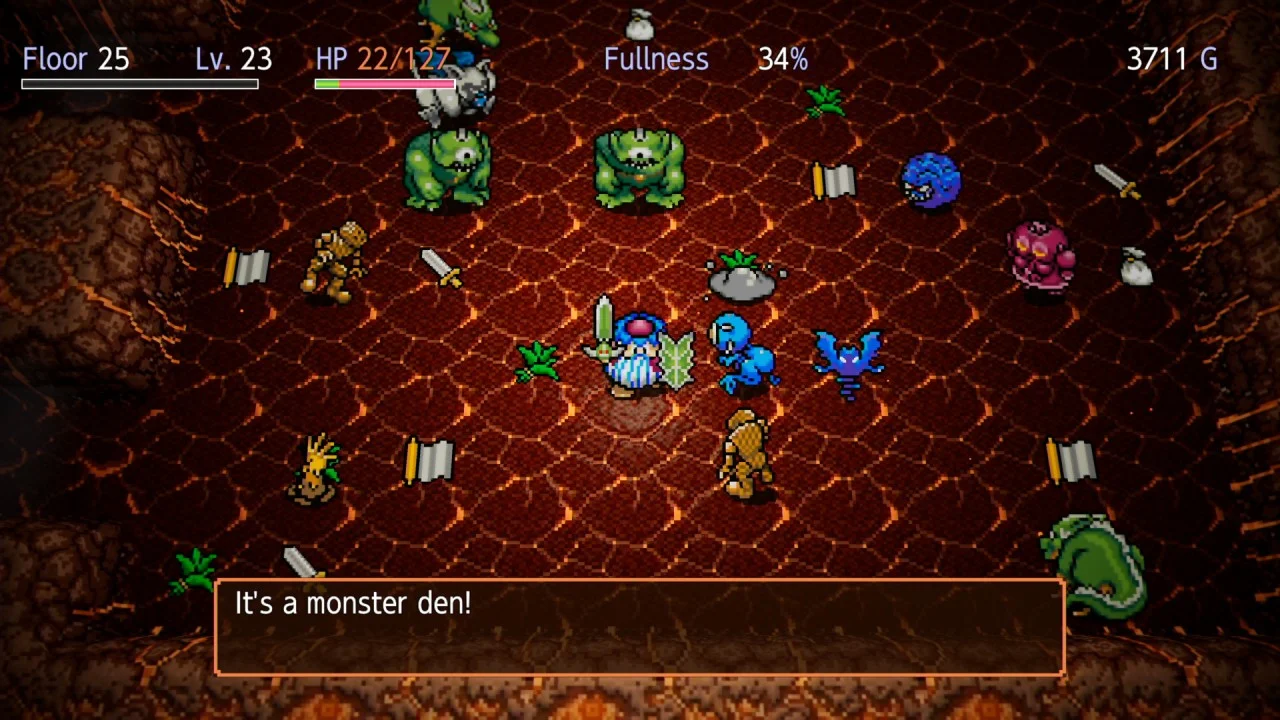
On the other hand, I firmly believe that people should not only play these earlier titles, but learn to appreciate them for what they are and not what they are not. Furthermore, Square Enix did recognise that younger players might want to moderate the experience a little, so they have included the ability to toggle everything from gold and experience acquired, to item drop rates and enemy numbers. You can make Torneko’s adventure very easy if you want to. I would argue that that’s missing the point, especially given what happens in the end, but if that means the adventure won’t frustrate players, so much the better.
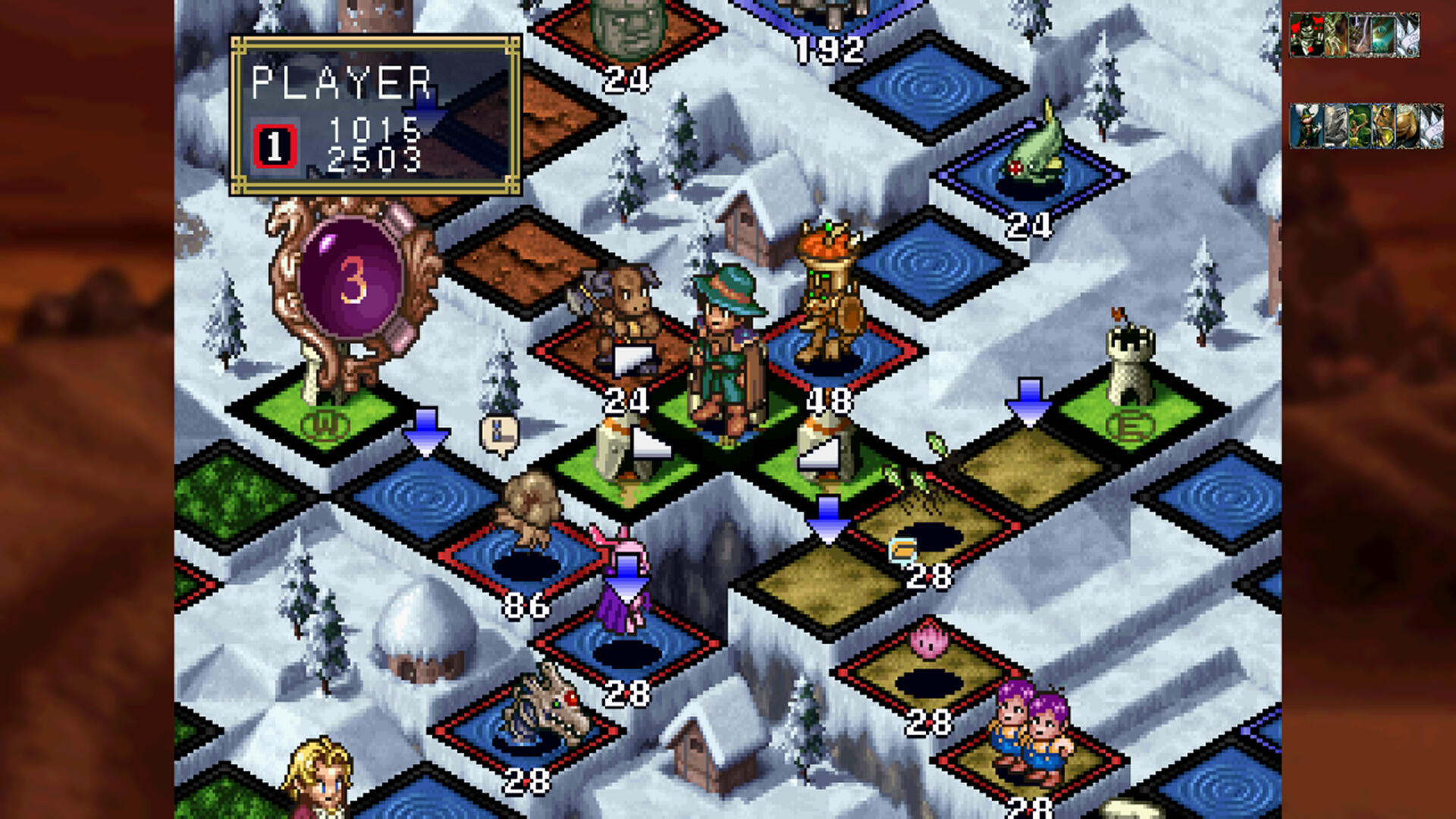
The other area where there’s been some significant work done is the art. Square Enix has opted to maintain the sprite aesthetic, but apply the HD-2D engine to it. I actually didn’t really notice that this was THE HD-2D engine, as the visual effect is far less overt than in the utterly stunning Dragon Quest 1-3 remakes, but as I played I found myself appreciating it for what it is. The Dragon Quest series has always had delightful monster art in particular, and this is also very true of this game.
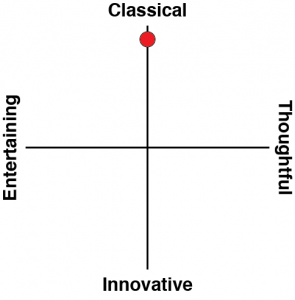
It would be easy to dismiss Dragon Quest Heroes: Torneko’s Mystery Dungeon -Classic HD- as being too archaic for the modern audience, even with the quality-of-life changes and HD-2D visual treatment. The narrative and gameplay loop just aren’t the way modern development would consider “best practice.” On the other hand, we learn to appreciate literature that was written hundreds of years ago and modern books aren’t written like that. We recognise the quality of classic cinema without needing Citizen Kane to be part of a “universe,” have action scenes done in front of green screens… or even be in colour. Perhaps it’s time that the games industry stopped marking down influential masterpieces like Torneko’s – and Torneko is categorically an influential masterpiece – without expecting it to also be the games that followed on from it.