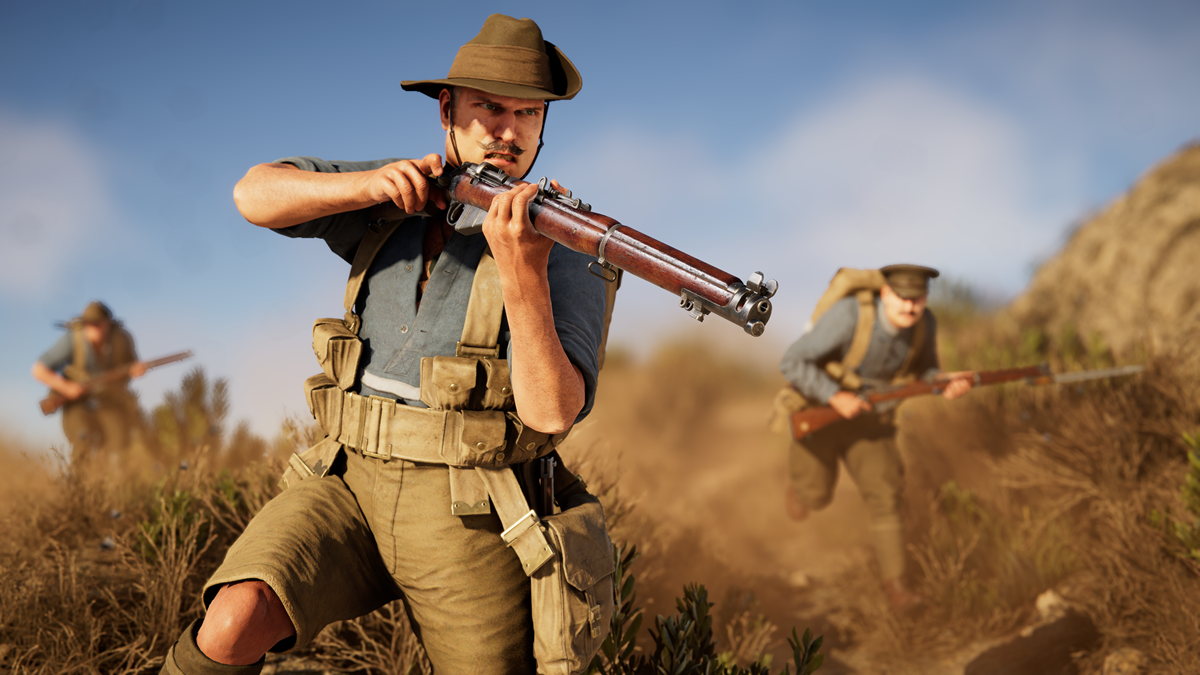


“Gallipoli Review: Beautiful, Brutal, and Fun.” This was IGN’s breathlessly enthusiastic title for its coverage of the recent Gallipoli game. It does my head in that, at a time where American military adventurism has it engage in illegal, utterly immoral warfare in Iran, destabilising the entire planet in the process, the leading video game criticism website runs totally uncritical coverage for a game that, whether intentional by the developers or not, is manufacturing consent for the conditions that allows America to continue to do this to the world.
Is Gallipoli fun? Who the hell cares? What is far more important is a question that we would ask of artists in any other field: Is this depiction of Gallipoli responsible? There’s not a single hint in the review that the critic even once asked that question.
For the record, the actual Gallipoli was not fun. The actual conflict, I mean. It was also not beautiful. Not in the way that word is being used in this context. It was a famously messy strategic blunder by Dear Empire Britain that resulted in Australian and New Zealand soldiers sloshing around in unhygienic trenches, scoffing down crappy cookies (sorry, Australian RSL clubs, biscuits), and waiting for the horn to be blown so they could go up and over the trenches and throw their lives away in a meat grinder, attacking an effectively unassailable position that the terrain granted the Ottoman forces.
And all for stupid political reasons. Australia and New Zealand had no reason to even be there in the first place. If you’re going to do a game dropping people into Gallipoli, the only way to do it is to depict it as a nightmare on the ground, and to express fury at the British for treating its empire and people like that. That’s it.
But no, this is video games, and in video games, we celebrate the military adventurism. Our boys (and girls, if the developer is suitably “progressive” enough) are heroes in the hands of the gamers enjoying the gamefeel of it all, carving heroic swaths through the dastardly enemy ranks to capture the flag, and that’s as far as the analysis of the game should go. When you can play as the other side (as is the case with this game), then they also get to be heroes, again without any further context applied. Is it FUN to press the buttons? That’s all that matters!
There is a fundamental disconnect between how this industry almost always presents military conflict, and the actual conversations around war as a tool of certain nations that we as a society need to be having. Yes, sure, the game might depict a battlefield as a violent and “brutal” place to be – congratulations on understanding that people get limbs blown off when guns shoot them, game developers – but it’s always within the context that 1) you’re fighting the good fight and 2) the people doing the fighting are beyond criticism. You’re winning for your team and that’s the end of the conversation.
Video games aren’t entirely alone in this. The film industry and community frequently lauds films like Saving Private Ryan for its “realism” that had “huge respect and reverence for those that served.” The reality is that while the correct side won that particular war, thanks to films like Saving Private Ryan, people now have a very warped understanding of the conduct of the American soldiers who fought it. Saving Private Ryan never bothers to point out that the heroic American soldiers also were notorious for other things while on their little adventure in Europe, as just one example, and they had the tacit support of leadership. A nuanced perspective on the war would understand that the winning side was full of humans, and humans, in wartime conditions, are not infallibly heroic. Fighting on the morally just side of a war does not confer moral purity upon the people fighting it. Properly representing that context matters, because it shapes how people view the military and its mission today.
Instead, the film reached for the flags.
But at least in the film industry there are also plenty of publications and critics willing to counter the celebration of such propaganda with an acknowledgement that it is propaganda. And for every film that does celebrate military adventurism, there is another that criticises it. As the Splice Today article notes: “Apocalypse Now sends a killer out to assassinate a former colonel. Saving Private Ryan sends a schoolteacher out to save a private. Apocalypse Now subverts the military ethos. Ryan praises it.”
Meanwhile, we don’t have that function in the mainstream games media or game development anywhere near the depth that we need. You have to go all the way back to 2012’s Spec Ops: The Line to find critics meaningfully deconstructing a meaningful attempt to deconstruct military adventurism in games. Otherwise, you’ll only find exceptions to the rule. Within game development, Kojima’s out there with his Metal Gear Solid series, though to this day people are more invested in poking fun at long cutscenes than actually analysing what those cutscenes have to say about war. Within the games media, Six Days in Fallujah drew criticism for how it depicted an extended war crime, but the likes of Call of Duty got away with positive reviews despite actively revising the history of war crimes like the Highway of Death from the Gulf War.
Outside of those fleeting examples of awareness, meaningful discourse around the way that games behave as propaganda for Western military interests is incredibly thin, and the gamers, who plague comment sections and only ever want to lol over buttons pressed, are actively hostile to anyone who tries to take this stuff seriously. Six Days in Fallujah turned the controversy into closing on 10,000 positive reviews on Steam. There’s nothing gamers enjoy more than turning serious criticism into a culture wars salvo.
But it does need to be taken seriously, even if it upsets the feelings of the precious gamers. If we dared use video games to explain conflict in its proper context, then the social tolerance for the nonsense that the now fascist America is pulling would be even less than it is now. Even among those who are critical of Trump, there is the pervading sense that the soldiers over in Iran, or the ones blowing up boats in the Caribbean as America gears up to do to Cuba what it did to Venezuela, are heroes. There is simply not the awareness that these people are doing utterly horrific, unconscionable actions like blowing up schools and civilian infrastructure in service to American imperialism. Because popular entertainment has conditioned us to never question them.
We even have an extensive and exhausting long list of examples of where – and this is of obvious relevance to Gallipoli – the armed forces of America and its allies outside of the battlefield while on campaign is also, to put it mildly, unacceptable. This Gallipoli game doesn’t bother mentioning that Australian soldiers burned down half of Cairo in a riot after they were displeased with the city’s red light district while on leave time, for example.
Here’s another example: During the Allies’ occupation of Japan, Allan S. Clifton, who was there as an intelligence officer, wrote Time of Fallen Blossoms as a memoir of his experiences, which was not complimentary of the behaviour of Australian soldiers in particular. We’re talking about gang rapes of young girls and banditry here. That book was inconvenient to the Australian and US military, so Clifton was branded a communist (he was not), and his book was “discredited” without investigation. Meanwhile, it took a former Army lawyer, willing to spend time in prison (and to date the only person who has seen prison time despite his leak of some particularly heinous war crimes), and some brave journalists willing to risk defamation suits to bring the Ben Roberts Smith story to the public. Who knows what the ADF would have concluded without the pesky civilians getting in the way of its investigation. Given the way this case has panned out, you would have to say that the book should be considered in a different light today.
The point here is that it’s in the interest of these militaries to paper over anything inconvenient. And in video games, they have that. To almost all developers, all that matters is the heroics of the soldiers. Hell, the Call of Duty series has the actual US military consult on it.
Countering and criticising propaganda matters. As long as video games continue to treat war as an entertaining playground for heroics, and fail to consider the full context, from the political motivations of war down to the actual conduct of the soldiers, then games are going to continue to be part of the social license that nations – America in particular – can rely on to galvanise people behind it. It’s not coincidental that the one war where the population stopped buying into the propaganda and refused to see heroics in the military adventurism, is also the one time America, as a society and culture, has shown any capacity for self-reflection on its role in the world.
And the video game media really needs to stop acting like it’s enough for these pieces of propaganda are innocent fun and button presses. They’re not, and the very least that they could do is put the proper context in if the game developers won’t.





This article completely misses the point of the war video game genre.
Nobody plays a game about Gallipoli because they think war is “fun” in the literal sense. They play it because video games offer something that books, photographs, documentaries and even film simply cannot: **the ability to step into a historical event and experience a tiny, simulated piece of what it may have been like to be there.**
That doesn’t mean you’re celebrating the war. It means you’re engaging with history through an interactive medium.
And ironically, that is precisely why games like this can be so valuable.
Games such as *Battlefield 1* brought World War I to an enormous audience who may never have picked up a history book about the conflict. *Battlefield V*, *Call of Duty*, *Medal of Honor* and countless other games have done the same with World War II. They introduce younger generations to battles, locations, weapons, uniforms, technology and historical events they otherwise might never have encountered.
Are these games perfectly historically accurate? Of course not. Are they entertainment? Absolutely. **But entertainment and education aren’t mutually exclusive.**
The author seems to believe that unless a game constantly reminds the player that imperialism is bad, soldiers committed atrocities and governments made morally questionable decisions, the game is somehow “propaganda.” That’s an absurdly narrow standard to apply to an entertainment medium.
A game doesn’t have to lecture you every five minutes to have historical value.
And there’s an enormous difference between **depicting soldiers fighting in a war** and **endorsing the political decisions that caused that war**.
A player can enjoy the gameplay while simultaneously understanding that Gallipoli was a catastrophic military campaign in which thousands of young Australians and New Zealanders died. In fact, for many people, playing these games is what prompts them to ask questions and subsequently learn more about the real history.
That’s one of the great strengths of the medium.
The irony is that the author complains that gamers aren’t taking history seriously enough while seemingly dismissing the very reason historical games have become so popular: **they make history accessible to people who might otherwise never engage with it.**
War is horrific. Gallipoli was horrific. World War I was horrific.
But creating an interactive representation of those events doesn’t automatically glorify them.
Sometimes the most effective way to make people interested in history isn’t to lecture them about it.
Sometimes you put them on the battlefield and let them discover the history for themselves.
“This article completely misses the point of the war video game genre.”
Not as badly as you missed my entire thesis and then proceeded to misrepresent almost every sentence of it.
“That doesn’t mean you’re celebrating the war. It means you’re engaging with history through an interactive medium.”
Weird how they all talk about how much fun the game is and not what history they learned from it, huh.
“And ironically, that is precisely why games like this can be so valuable.”
I never said they couldn’t be valuable. I’ve written entire articles on how valuable games are at introducing people to history. But it has to be done responsibly. I don’t know how you somehow missed it (other than the likelihood that you didn’t actually read the article), but I was talking about these games being made irresponsibly. Not questioning the value of having history in games.
“Games such as *Battlefield 1* brought World War I to an enormous audience who may never have picked up a history book about the conflict. *Battlefield V*, *Call of Duty*, *Medal of Honor* and countless other games have done the same with World War II. They introduce younger generations to battles, locations, weapons, uniforms, technology and historical events they otherwise might never have encountered.”
All great examples of the utterly irresponsible approach to history that I was talking about. Those are all pieces of revisionist, outright propaganda, claiming historical authenticity while promoting a highly dishonest, jingoistic version of events and the people involved in them. These are absolutely appalling takes on history, and if the people that played those games spent the time to go and learn the actual history, the world might be less ignorant and eager for World War 3 than it is today.
“Are these games perfectly historically accurate? Of course not. Are they entertainment? Absolutely. **But entertainment and education aren’t mutually exclusive.**”
Anyone who learns anything from the games you mentioned is learning a propagandised view of history and being indoctrinated into a lie. So it’s actually worse than learning nothing at all.
“The author seems to believe that unless a game constantly reminds the player that imperialism is bad, soldiers committed atrocities and governments made morally questionable decisions, the game is somehow “propaganda.” That’s an absurdly narrow standard to apply to an entertainment medium.”
That’s not what I said at all. Again I find myself believing that you didn’t even read this article, much less try to understand it.
“A game doesn’t have to lecture you every five minutes to have historical value.”
I’ve written extensively on the value of games that have historical value that don’t “lecture you every five minutes.” The difference is that those games don’t promote a dishonest version of history while trying to pass themselves off as authentic.
“And there’s an enormous difference between **depicting soldiers fighting in a war** and **endorsing the political decisions that caused that war**.”
Sure. There’s also an enormous difference between acting like soldiers are heroes and showing the reality of who those soldiers actually were.
“The irony is that the author complains that gamers aren’t taking history seriously enough while seemingly dismissing the very reason historical games have become so popular: **they make history accessible to people who might otherwise never engage with it.**”
No. They lie about the history and present a distorted, highly propagandised revision of the history. This is worse than no history at all because it acts as disinformation and indoctrination and is the kind of thing that History 101 students learn is the most irresponsible, unethical thing you can do to history.
That’s what I actually wrote, by the way. Not your wild mischaracterisation of my article.
“But creating an interactive representation of those events doesn’t automatically glorify them.”
Correct. But when you create an interactive representation of war that glorifies war you have glorified war.
“Sometimes the most effective way to make people interested in history isn’t to lecture them about it.”
Yes. But also in 100% of cases, the absolute worst thing you can do is teach people bad history. Because in a lot of cases, people playing these games DON’T unlearn what the game teaches them, and then believe the candle in the darkness lie.
It feels from this comment and your article that you have a bone to pick with any war game but the ones from the WW1 Game Series. Serious question: did you actually play Gallipolli (or Isonzo, Tannenberg, or Verdun) before writing this article? Your critique of war games and their embellishment and propagandisation of the military and imperialism could still hold – that’s kind of subjective but fine for an opinion article – but it seems like this article is purely based on the IGN review of the game and not the actual game.
Yes, I played a couple of games of Gallipolli after reading the IGN article. Not enough that I’m going to write a review of it (and I won’t be playing it again, having now said my piece on the topic), but I am aware of what the game is and how it plays.
This all seems spot on to me sir.