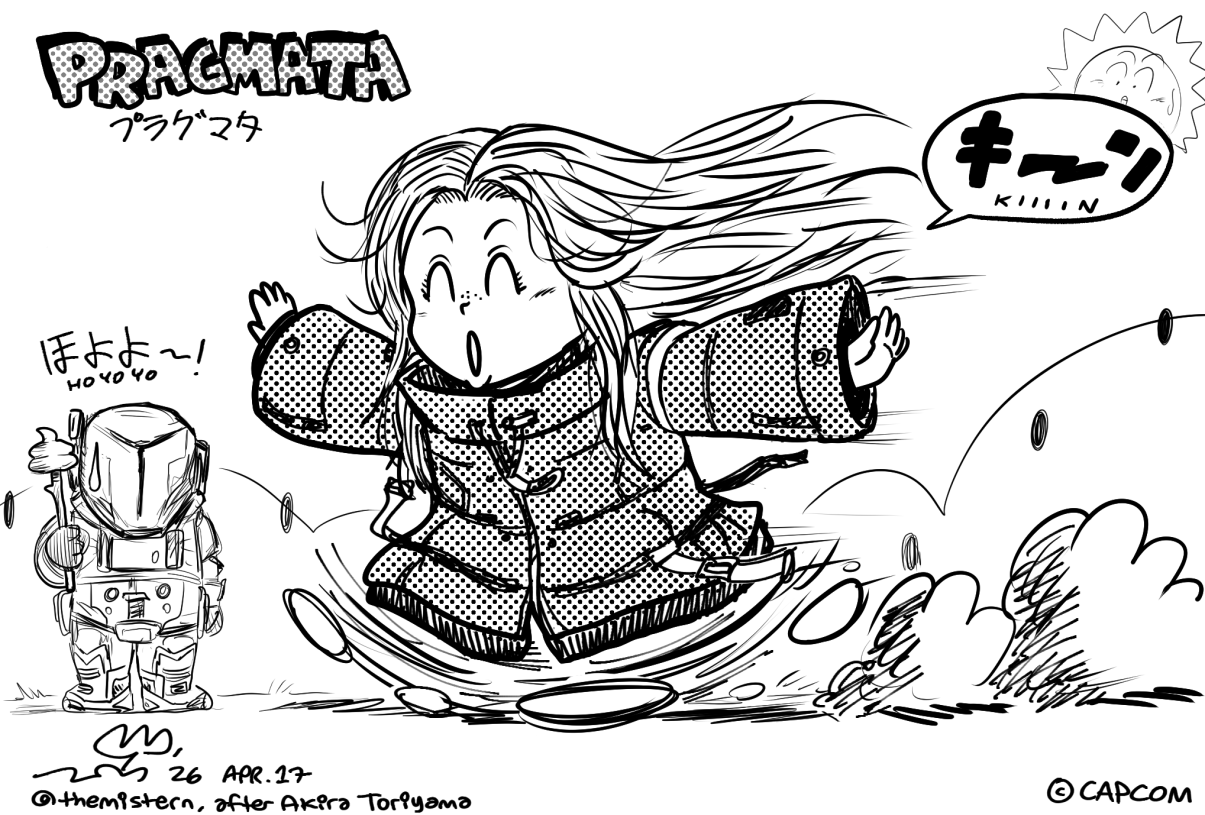


(Many thanks to Ray N. for letting me use his art of Pragmata’s Diana for this piece. It was too cute and funny not to share to balance out how miserable the material this article deals with is)
Pragmata is a very good, intelligent, emotional and meaningful game. Unfortunately, you can’t talk about it without the most rancid culture wars nonsense we’ve seen in the games industry (and that is saying a lot) completely overwhelming that discussion.
And people still argue that video games are a legitimate art form. Half of what legitimises an art form as an art form is people treating it like one, and this latest crime against intelligence stands as yet more proof that way too many people have a lot of growing up to do before that’s going to happen for video games.
Let’s try to break the nonsense down into a single paragraph, because I don’t think I could write more than that without being hit with a migraine that would make an ice pick to the eyeball welcome in comparison:

One of the two protagonists of Capcom’s latest title, Pragmata, is a little girl (well, actually an advanced AI robot, but she looks like a little girl). This, as you might imagine, is appealing to a certain horrific corner of the Internet for all the wrong reasons. In addition to those examples of human scum, the right-wing loser grifters of the Internet, apparently noticing the response from the horrific corner of the Internet and figuring they have a prime opportunity to farm engagement by being oh-so-edgy, have decided that their approval means the game is a coded pushback against the “wokes.” Some of the more edgy of the keyboard warriors have figured out that there are a lot of retweets in arguing that the game is, in fact, an enormously clever way to increase the birth rate by making the men playing the game want to have children.
I really wish I were making this up.
Meanwhile, the liberal end of the culture wars have discovered, with no small glee of their own, that they too can now talk about how this game (or potentially is, if the person is “cleverly” trying to frame a blatant position as an open discussion) is the new Lolita (though unlike Lolita, which was a satirical criticism of… well, all the crap that has become the discourse around this game, the media seems to think Capcom is actively pro-Humbert Humbert). Make no mistake, having a carte blanche excuse to unleash moralistic righteous anger is something the liberal types will never stop relishing, and in this case, they found that excuse by arguing that the game appeals to the creeps because it clearly must have been made for them.
So, with the usual battle lines drawn, we now have a never-ending cycle of the most toxic discourse, with the right wing, for some reason, gloating over how a tiny fraction of the absolute worst excuses for humanity are behaving over the game, and the supposed “other side” indulging their discussion points by acting like these people are the game’s player base and Capcom’s intended market.
(Unfortunately, that was four paragraphs and now I’m looking for my ice pick while I finish writing this thing).
You know what is somehow lost in all of this discourse? NONE OF THAT CRAP IS IN THE GAME AT ALL. I can’t think of a single piece of media I have ever watched, read or witnessed that has a young girl in it that has gone to greater lengths to avoid any situation where anyone with a working brain might interpret it as “sexualised.” The story itself is as wholesome and earnest as I’ve ever seen in a horror-adjacent experience, offering a vastly more sincere and engaging paternal bond between a father and surrogate daughter than we ever saw in The Last of Us. This isn’t like a Leon the Professional or Interview with a Vampire situation, where you’re meant to feel uncomfortable with how the relationship between the two protagonists develops. It is genuinely surreal to have played something this downright innocent in both intent and execution, and then click on over to either social media or the supposed professional games press and see that instead of discussing what’s actually in the game, people are discussing whether any man who plays the thing is a closet deviant because of some fan art some loser drew in some dark corner of the Internet.
If there was even so much as a hint of anything sleazy in Pragmata it would be one thing, but to be blunt, after seeing this response to Pragmata and the way it, specifically, handles a young girl character, I am convinced that there is simply no scenario where a major video game can have such a character without the discussion around it degenerating into this kind of culture wars nightmare. Indies, sure, but overwhelmingly, the 0.1% of gamers who wander into itch.io to find things to play are the people who do see and treat games as art. When Steam banned indie darling HORSES for having (a very artistic and sensitively handled) nude girl in it, the general sentiment was in sympathy with the developers. But the culture warriors can’t hit their engagement numbers fighting over games with that small of an audience. In the mainstream, where the lowest common denominator for intellectual thought seems to drop further every year, developers who want to avoid watching their game being trashed by a culture war salvo (i.e. anyone sane) can clearly no longer tell a story that involves a young girl. At all. In any context.
Just think about what that means for the 99.9% of the video game industry, as the shepherds and participants in an alleged art form. An entire age group of one entire gender is effectively off limits to any game developer who doesn’t want to turn acknowledging that you’d played the game (much less enjoyed it) into defamation bait. Imagine how the developers must feel, having spent years working on this game, only to have the entire conversation about the game become a series of conspiracy theories, all of which make them seem like the most vile people alive.
Imagine being the writers and creative directors who clearly poured something very personal into Pragmata. They have now got a game that has sold a million copies, which no doubt they’re thrilled about, but almost no one is digging through its rich themes or emotional core because they’re all too busy having a feral meltdown in one direction or another. That’s got to hurt anyone who genuinely cares about the work they’ve done.
Anyone in the games industry who participates on the creation side feels these tensions, I assure you. My own visual novel isn’t going to sell a million copies and will, thankfully, not be relevant to anyone outside of the 0.1%, but even still, I’ve re-written it so many times from a deep paranoia that people are going to accidentally, or deliberately, misrepresent what I’ve said and done with it.
It’s not like the real art forms are immune to these blowups on the mainstream end of them, but I believe, admittedly with a bit more distance from these art forms than I have with games, that ultimately the community rallies around the idea that the value of an artwork should not be determined by the culture warriors screaming at it. It’s why we oppose book burnings and censorship. And we don’t blame, say, horror films, horror filmmakers, and horror film fans when the cops break down the door of a serial killer to discover he has a shelf full of them. Or, well, we don’t blame them any more for that. People grew up and started treating cinema as an art form.
Hell, one of Studio Ghibli’s most beloved films, Totoro, is generally regarded as a masterpiece despite having a scene where the father bathes with his daughters. Again. Creeps exist, and I guarantee you there are creeps creeping for that scene. Go to those same dark corners of the Internet and there will no doubt be fan art that would make you vomit for that film. We somehow cope with this reality without letting it affect how we see the film, filmmaker, or the fans of that film. As a culture, we’ve managed to recognise this film as a masterpiece and engage with it as art rather than a vector for individual or social pathology.
I am angry, and frustrated, at the games industry yet again. But it’s not the people making the games. Yet again, they are the victims, and their only crime was trying to do something meaningful with the “art form”. It is, as usual, the community that is, collectively, too dull to appreciate it. What angers me is the way we talk about games, in the media, on social media, and in general. It’s what we look for in games, the way we analyse them, and the responses that we have the moment a game is a little challenging. And it’s the way this entire industry continues to act like and indulge the bottom feeders, grifters, and trolls as though they’re the baseline for what passes for “intellectual” discourse around games.



You know, looking at jackasses like these, it’s kind of astonishing just how little some people have to do with their time, isn’t it?
Yeah that would seem to be a big part of it. Some people really do need to get offline and go see the real world for a bit.
Yeah the only reason I’m even here is bc I was reading the reviews on my Xbox and someone said don’t listen to the left wingers saying disgusting things , I’m like what is this dude talkin about I haven’t seen any discourse at all. So yeah there are a few lefties here and thier saying some dumb things, but that doesn’t mean the right is any better, bc in my opinion they are actually worse. You never saw this culture war bs before 2016. We all know who started all this crap. I got problems with both sides, but I’ll never forgive the right for acting like it’s cool to hate ppl in Jesus name. They do all these diff things in Jesus name, and they are all things that Jesus himself would never have done or said. It’s not our job to play god and try to be the executioner. It’s not our job to pass judgement on the sinner. We are supposed to love them. Love the sinner hate the sin, the right doesn’t seem to understand the concept of that for some reason. He who throws the first stone, so why are y’all always throwing stones smh. America first, oops I lied, I meant Israel and Russia first, why don’t y’all keep that same energy with Ukraine smh. Ohh the reason why the economy is so bad is bc of all these illegal aliens taking our jobs, ok…. So after close to 2 years of deportations, what a coincidence, the economy is getting worse. The construction industry is up in flames, I wonder why, my entire life I remember going by construction sites seeing ppl building large buildings and it was always like 80 percent Hispanics out there working. Same with the farming and agricultural industries, if you take away all of the skilled workers in the country, it is GOING to have a negative affect on the economy. You can’t just replace them all with black and white dudes. Maybe they plan on having AI take over those industries too with robots or what not. Wouldn’t surprise me as trump and Elon are ALL IN on AI and are doing everything in their power to stop the government from regulating it. That’s bc they want to take advantage of US, the ppl, and in my opinion, it don’t matter if your right or left, AI is coming for ALL of us, and if we want any chance of stopping it, and it’s probably already too late, we must come together and take a stand against any politician that supports putting up data centers all over the country. First step is for you righties to accepted fact that your hero loves the concept of AI
I’m sorry but I’m very confused here. Do… do you think I’m a right winger or something?
Lmao that’s all you got, go see the world. Smh that’s what ppl say when they don’t have anything constructive to say
All I know is if you take a look around, like at what the very conservative state of Virginia just voted in favor of, or the abysmal approval rating of our so called leader, it’s fairly clear the majority of Americans have buyers remorse. I think people should be proud of themselves for having the humility to even admit it. Nothing better than seeing the truth trigger yall
Nothing is softer than a magat
This piece puts into words something I’ve felt for a long time but couldn’t quite articulate. The frustration isn’t with the game or its creators — it’s with a culture that reflexively reaches for the culture war lever the moment something even slightly challenging appears. Pragmata sounds like it deserves far better than the discourse it got, and the Totoro comparison really drives the point home. Until games are collectively treated with the same interpretive good faith we extend to film or literature, this cycle is just going to keep repeating itself.