

I suppose it was inevitable that at some stage, some indie developer would look at Scrabble and think to themselves “Roguelike!” After all, that r-word seems to be perennially glued into the indie developer mindset these days. Despite my growing hesitancy to touch anything with said r-word in the feature set (there is too much of a good thing), I did load up Beyond Words, because PQube generally has a good eye for the interesting and quirky. I wasn’t disappointed. This game is word crack.
Beyond Words is what it promises on the box. It is, on the one hand, Scrabble, in that you’re tasked with making words that earn you points. Just like Scrabble, if you have the kind of vocabulary and attitude that results in you using “canine” where most people would write “dog”, you’re going to be inherently good at Beyond Words… with the added benefit that this is a single-player game, so you’re not going to annoy everyone around you for being a pretentious twat.
(Incidentally, did you know that “pretentious” is a bit of an ironic word to use in Scrabble? It’s all those letters and a big word, but it’s actually only worth 13 points!)

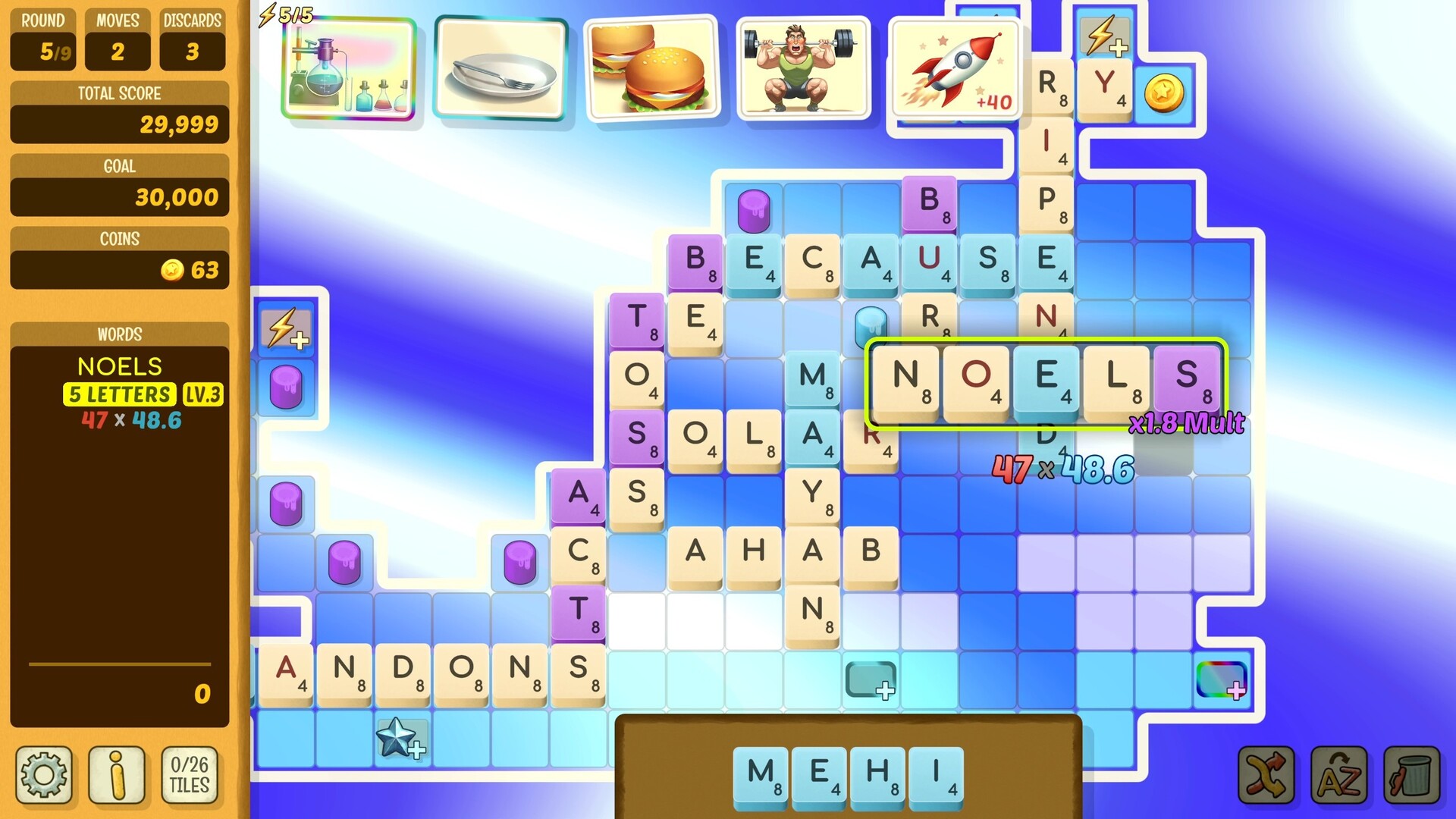
The roguelike side of things manifests itself in several ways. Firstly, each level is made up of a number of stages. Each stage requires you to get a certain number of points within a certain number of turns to pass it. In the early stages, the point requirements are low enough that you can dog and cat your way through. That doesn’t last for too long, however, before you’ll need to expand out into New York Times crossword territory to keep up with the score requirements.
As you play, you’ll earn coins, and this is where the second roguelike element comes into play: When you successfully hit the points objective, you’ll have the opportunity to purchase items ahead of the next round. These items help to manipulate the board in all kinds of ways, with the ultimate result being that you’ll accumulate multiples of points more quickly. Some items require you to play certain letters. Others have a big effect but a percentage chance of breaking each time you use them. Others have a smaller but ongoing and cumulative effect. On the one hand, it is impressive that the developers have managed to cram so many different items and effects into a simple word game.
On the other hand, if I have any one criticism of how Beyond Words is structured, it’s that it takes a game that is beautiful precisely because it is elegant in its simple complexity, and throws an almost overwhelming level of complexity over the top. If you’ve seen The Big Bang Theory (sorry for bringing that show up, I know…), there’s an episode where Sheldon “improves” chess by adding all kinds of pieces to it. The end result is a game that is so obtuse it is decidedly not an improvement on chess. Beyond Words does come right up against the event horizon of tipping into that particular black hole.
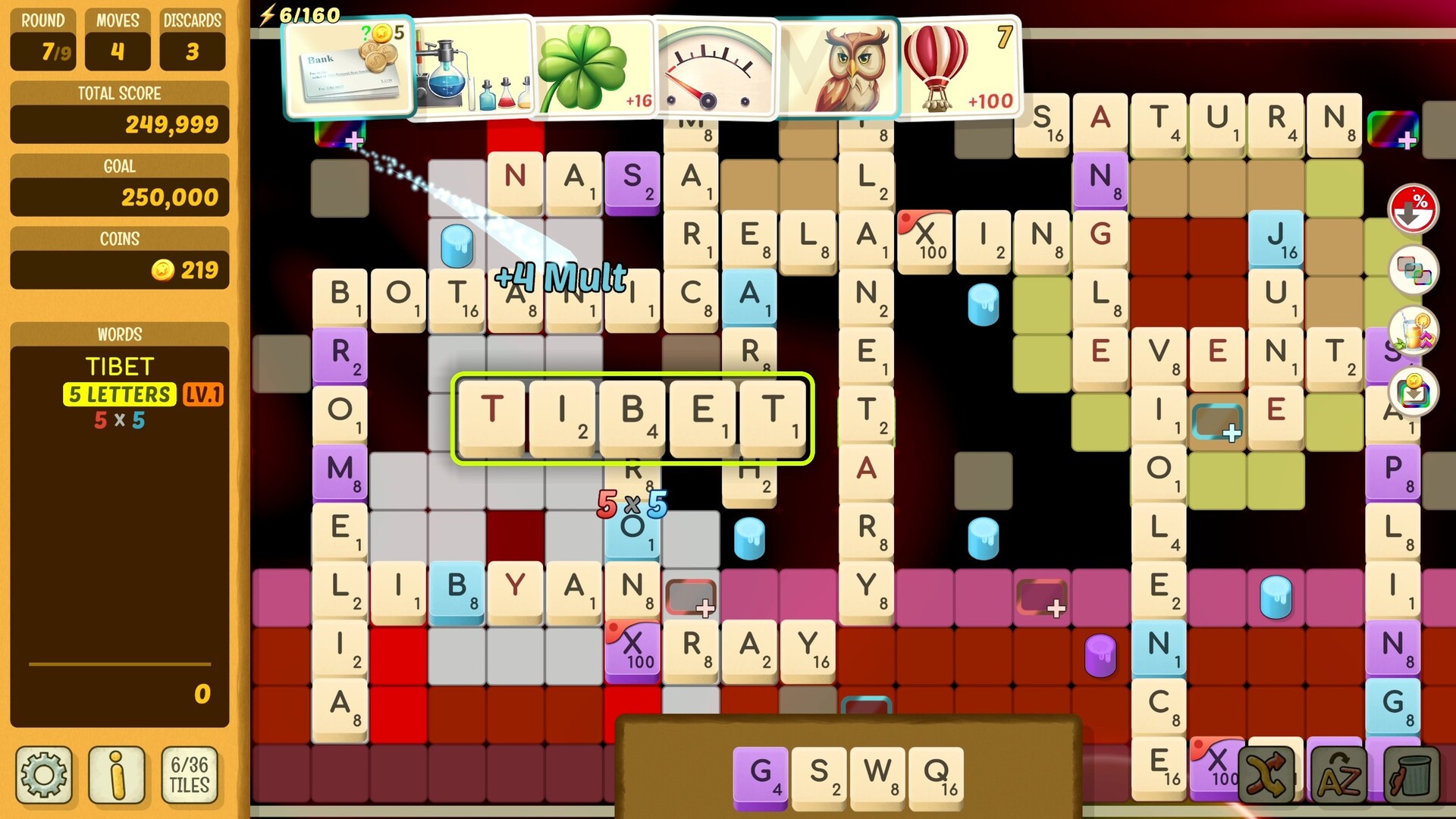
Thankfully, it avoids it – just – and once you come to grips with the depth of what the item system offers, it makes each “run” both more exciting and potentially more frustrating. Just like with any roguelike, the random nature of the items – and the fact that they’re so important to the strategy of the game – means that sometimes you’ll be ruined by a useless draw. Then again, there are also times when the luck seems to click in, and you have a dream run, which is incredibly entertaining. Swings and roundabouts, though fundamentally, I would prefer for success in my word games to come down to skill.
Beyond Words has a massive range of levels, and each of those levels involves a different board layout, and different conditions. Some boards have challenging designs that make placement of tiles critical for being able to access the entire board. Other boards have existing pieces placed down, special squares and so on.
These board designs are the single biggest challenge with Beyond Words, because they’re universally small in scope, given how many stages there are in a “run” and the fact that the words don’t go away, meaning that around 75% of the way through, you’re going to be really scratching for space to spell out the big point words. I used to find the Scrabble board size restrictive, but this is another level entirely.
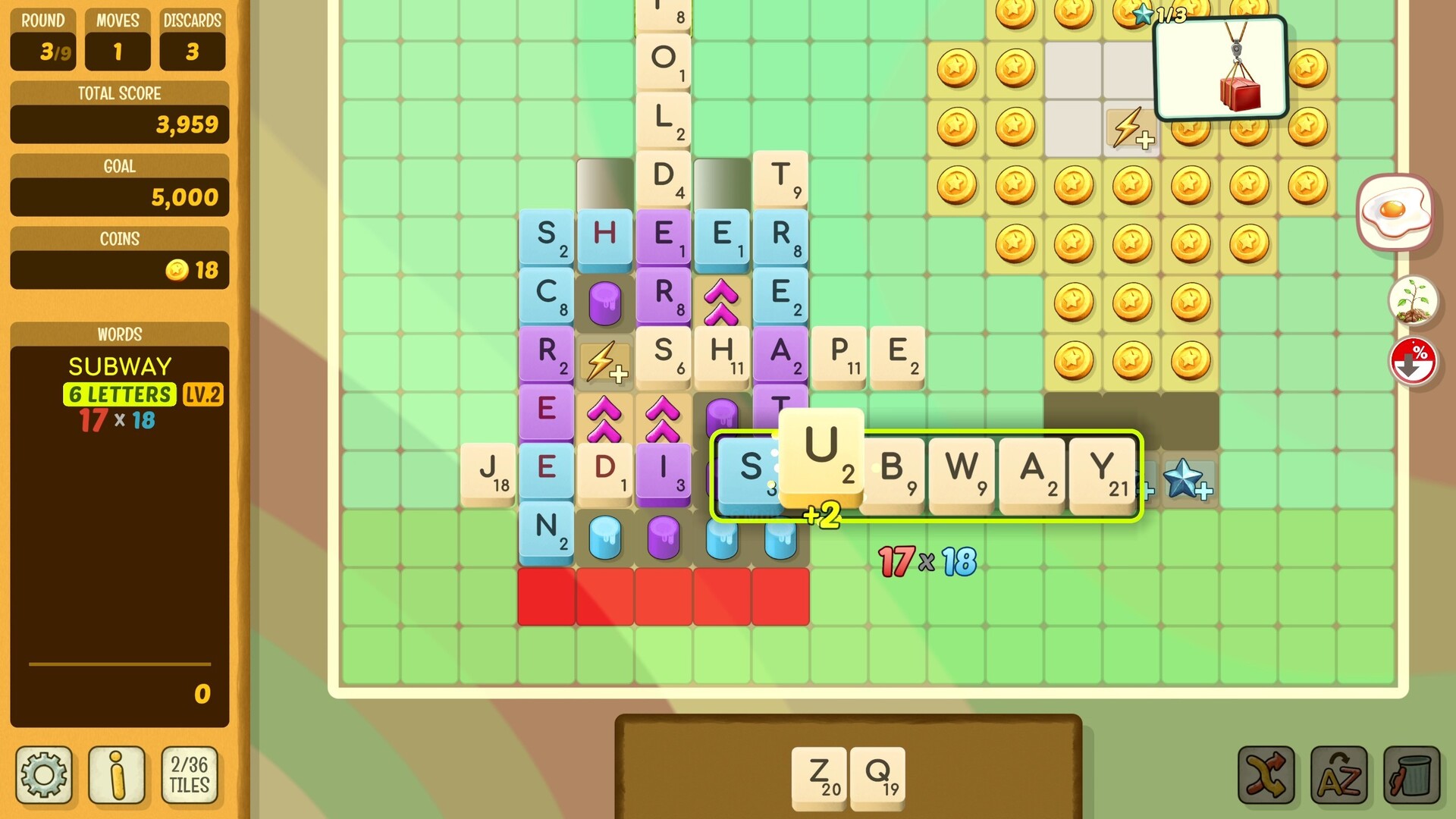
Overall, though, the game’s main challenge is that it’s combining two things that are fundamentally at odds with one another. Scrabble, despite being a game where you draw letters at random, is not a game of chance. It’s a game of great skill and knowledge, and playing well within a simple system. Roguelikes, meanwhile, are about a combination of luck and manipulating a system to maximise the points. Playing a three-letter word like “dog”, under the right circumstances, can be a vastly superior option to playing a complex and lengthy word. You could argue that there’s some strategy involved in recognising that, but, still, for a word game, it seems at odds with what the intended brief should be.
I haven’t been able to put this game down, though, because through its weaknesses, it is a clever spin on the basic idea of Scrabble, and thanks to all those items and board variations, a nearly endless variety to make each new game its own experience. It might not be the “level up” on Scrabble, I imagine the developers went into the project aiming to make, but they certainly have come up with something that is perfect to pair up with a coffee on a Sunday morning. And I do love my Sunday morning coffee games.