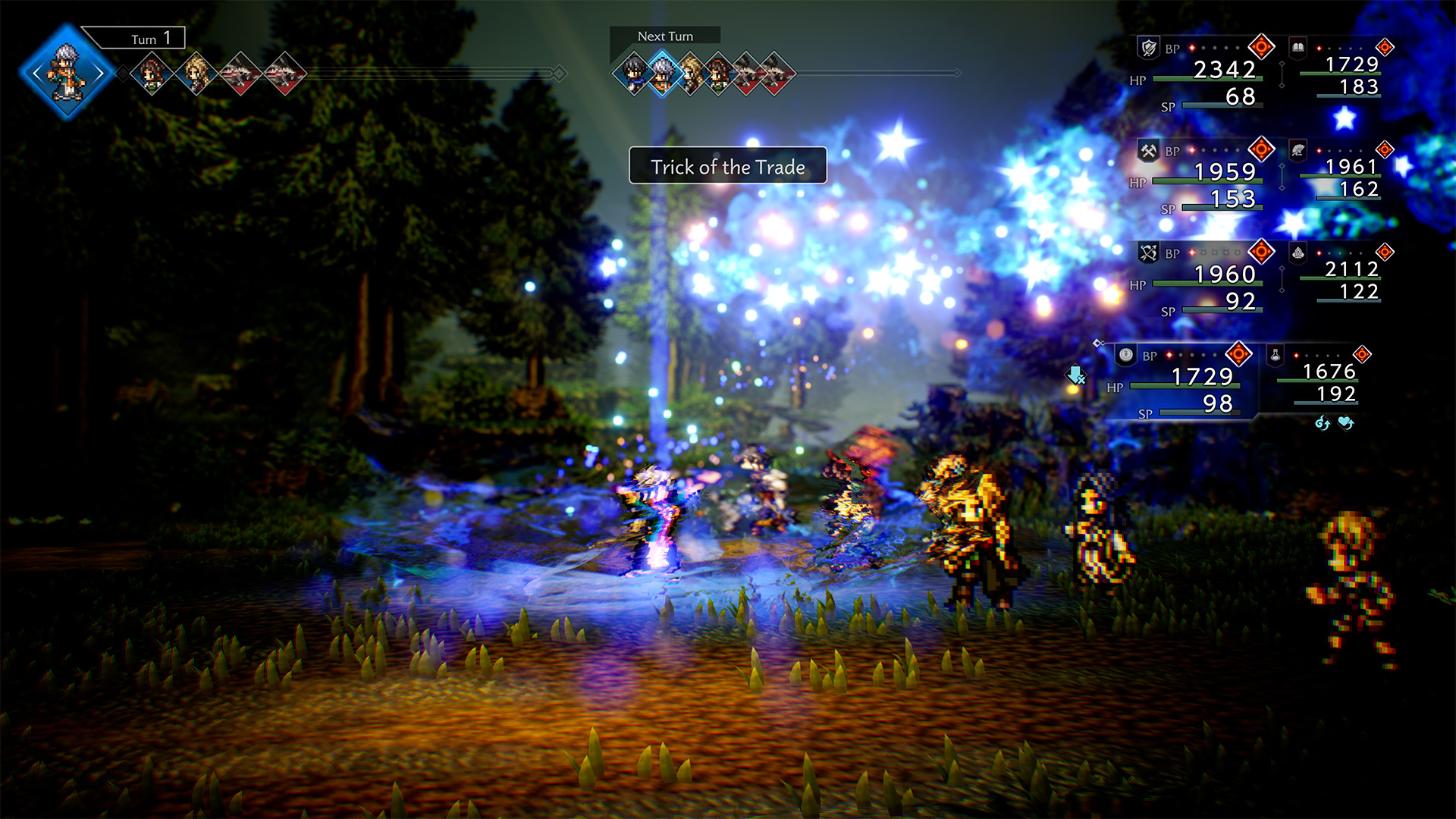


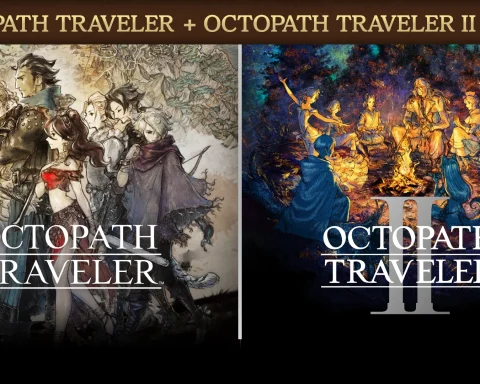
Last year, in writing a review of Octopath Traveler 0, I wrote an offhand comment that the game had “sprite art as a form of poetry,” and while I didn’t think too much of it at the time, I’ve since had a few people tell me that they rather liked the comment. Which got me to thinking and now I want to expand on it, because it does explain why I prefer good sprite art over just about any other video game aesthetic.
What makes sprite art so beautiful, when it’s done well, is that, like with poetry, it’s an inherently limited approach to art. You need to create an aesthetically appealing abstraction of a person, monster, or object using a mosaic of just a few tiny squares of colour. And then you need to give those creations personality and make them interesting to the audience, even though you don’t have the ability to present subtleties and depth within the animation. Sprite work, by definition, is a rare skill like a theatre actor is a different skillset to a film actor: the sprite artist needs to understand how to project and enunciate to the proverbial “back of the room” without being able to rely on microphones and close up shots to capture something that a person in the back of the room will never be able to see.
Final Fantasy VI’s Kefka’s laugh would have been seen as cringeworthily over-the-top were, say, Heath Ledger adopt it for his performance as The Joker (just to compare two utterly nihilistic and unhinged forces of total evil). But the art team of Final Fantasy VI would never have been able to work the subtle manic ticks and piercing eyes of Ledger’s incredible performance. Kefka works because the team found an utterly brilliant, memorable way to convey that same level of intense sociopathy into that little mosaic of coloured squares that shakes with such violence every time the character breaks out into his laugh.
The point here is that sprite work is an exercise of working within extreme limits, and (to bring it back to poetry) that is how that entire art form works. Where novels are creatively open, poetry has all kinds of rules. Rules that can be tested and even broken, yes but structural rules that tie the art form together. In some cases, such as the Japanese haiku or the Shakespearean sonnet, these structures and restrictions are extreme.
And yet within those limits, Matsuo Bashō crafted some of the most breathtakingly beautiful words committed to paper. Edgar Allan Poe’s best-known work, The Raven, is such a masterpiece because it uses poetic rhythm to create a dark, Gothic ambience that is so thrilling to read. And of course, the epic poems of Dante, Malory, and whoever wrote Beowulf carried an exquisite depth of meaning that a novel would take many times as many words to craft.
Limitations unlock creativity: it’s one of the “secrets” of the arts that artists understand well, but those from outside the art world tend not to. One of the reasons I find generative AI so repugnant as a creative tool is that its entire premise is the removal of limitations from creation. Unlimited access to actors, unlimited retakes on shots, unlimited words, all for a tiny fee.
This is the expression of a specific ideology. Modern Silicon Valley leans libertarian (in the sense that it’s leaned so heavily it’s fallen face-first into it), and that philosophy shapes how it approaches creative work. Art, in this worldview, is just another market inefficiency to be disrupted. The constraints that artists work within, including budgets, time, material limits, the years spent developing craft, are reframed as friction, as gatekeeping, as barriers between the consumer and the content they want. Generative AI is the logical endpoint of this thinking: anyone can create anything, instantly, and the messy human labour that once stood in the way has been optimised out of existence.
The political consequences of this frictionless generation have been predictable and severe. Fascist movements have always understood that propaganda is a volume game, flood the zone, overwhelm the discourse, make it impossible to distinguish signal from noise. What they lacked was production capacity. AI solved that problem. The same tools that let a hobbyist generate concept art for a game let bad actors produce endless disinformation, fake imagery, and manufactured outrage at virtually no cost. The technology’s designers may not have intended this, though looking at certain examples, such as the son of a South African mine magnate, suggests it was entirely deliberate. Either way, it’s not an unforeseeable accident for those that aren’t Elon, either. When you build systems explicitly designed to remove all friction from content creation, you cannot act surprised when the people most eager to produce unlimited content turn out to be those with the worst intentions.
What all these groups fail to understand (largely because they have no respect for it) is that when you strip away the political dimensions, the creative problem remains: with no limitations, there’s no meaning left in the creative process. Kefka’s laugh was a deliberate solution that was no doubt workshopped, prototyped, tested, rejected, and then tested again, and at each point in the process it was the development team looking for a way to work within the limitations of the form. There isn’t a single AI-generated moment that has been as memorable or impactful.
Now, I’m aware that AI prompters don’t simply type a prompt and accept the first output. They iterate (or keep hitting the “generate” button until they get something they like). The better ones combine, refine, and sometimes even bring some real art into the process. But this is precisely where the constraint argument bites hardest. The iteration happening in AI workflows is selection rather than creation: the human is curating from a field of machine-generated possibilities rather than solving the problem of how to express something within strict limits. The thinking happens after generation, not through it. The practitioner might reject a hundred outputs before finding one that works, but they never had to confront the question that the FFVI team faced: how do we make a 32-pixel figure communicate unhinged sociopathy when we can’t show the player the intensity of his eyes, have limited ways to animate his face, and can’t do anything subtle with body movement at all? That confrontation with constraint is where the creative meaning lives.
Sadly, because these movements are increasingly mainstream, it is becoming counter-cultural to create art that works within constraints.
Unlike poetry, sprite work, and so on, AI also doesn’t challenge the audience. Because these things exist within strict constraints, and are highly abstracted as a result, we, as the audience need to fill in the gaps. We have to build a picture of what Kefka looks like, beyond the little dots that give us hints of his colours. When we read a poem, we need to visualise what the author is describing in just a few, key words. The gaps in these works of art are as much of the point as what is there. The collaboration between author and audience is critical to the resonance of the artwork. Meanwhile, AI generations are an effort by a machine to literally recreate a prompt, and anything else that wasn’t prompted is a product of random generations with no meaning behind it. There’s no collaboration in this system. The prompter creates, the audience consumes.
I am sure that there are people out there prompting out sprite “art” and there will be games that are churned out with these generations. But I think that the real humans working on pixel games will have an advantage here because, firstly, AI systems have a horrible understanding of working within limitations, and secondly, the people doing the prompting don’t get it, either. Because sprite art is abstract like poetry, it requires a certain level of interpretation and literacy for the form to fully interpret and be able to appreciate, but for those who can, there’s a depth of human creativity and emotion that goes into this art that the biggest and most expensive blockbusters – even GTA VI itself – cannot compete with.

Since I played silent hill 2 remake, I’ve been playing a lot of PS1 games. Some of those abstractions are also present in their graphics. When making new games with a retro look became a thing, I never thought a low polygon count, PS1 look, would be as good as pixel work. Now that we started the PS1 nostalgia era, I realize my short tightness.
Some philosophical stuff: if fascism wants a deluge of information, benefitting from chaos and misinformation, the only way to propagate truth is with focused, clear, directed messaging. You can’t out produce fascist propaganda, that just add to their excess, increases confusion. You need to be poignant, precise, specific. And you need to connect with the audience’s reality. Fascist can just form a simulated reality by feeding too much reality. Think incels, q anon, trump truthers, people waiting for the rapture in late 2025. Let’s remember capitalists have the added benefit of owning the means of production in mass media.
Recently there was a study saying the UK needed to start a green energy transition, it would be way cheaper. News sources took that study and published articles saying ‘green energy will cost trillions of pounds’, effectively scaring people off from reducing public spenditure on energy.
There’s this interpretation that fascism wants rigid, established definitions. No ambiguity, no negotiation of terms. Maybe because they set out from an idea in their minds and then try to force reality to fit with those ideals. That’s why they don’t like abstractions, because most of the time those abstractions leads to something different from the ideals in their minds? They certainly take issues with art all the time.
I have to imagine AI is bad at pixel or low poly art. They are somewhat niche, there can’t be billions of images to train AI, right? then again, they had the ability to copy studio ghibli, so Idk.