

Jen Williams has seen the future, and like many of us, she’s worried about it.
The studio lead at Cherrymochi, the Japan-based indie outfit behind the cult hit Tokyo Dark, spent the early 2000s working with Hewlett-Packard on GPS-triggered gaming experiments in Bristol. Back then, everyone was certain they were building a utopia. “This is the future and this is going to be in glasses,” she recalled her colleagues enthusing, years before smartphones existed. Two decades later, Williams has channelled that disillusionment into Dusk Index: Gion, a visual novel published by Bushiroad that spans modern-day and Meiji-era Kyoto, weaving a murder mystery through themes of technology, memory, and the haunting weight of history.
The game arrived somewhat unexpectedly, even for its creator. Cherrymochi has spent the past several years deep in development on Exit Veil, an ambitious 3D occult JRPG funded through Kickstarter. When a producer at Bushiroad, who had admired Tokyo Dark, reached out with an invitation to pitch new IP, Williams saw an opportunity she couldn’t pass up. “We’d be crazy not to,” she said, laughing. She already knew what she wanted to explore.
At the time, Williams had been immersing herself in the writings of Mark Fisher, the British cultural theorist who coined the term “hauntology.” The concept describes a culture paralysed by nostalgia. “We’re haunted by our past, and we’re living in a world of lost futures,” she said. “There’s no culture of looking forward. A lot of our culture is to do with looking back.” Alongside Fisher, she had been absorbing The Caretaker’s Everywhere at the End of Time, the landmark ambient project that slowly deconstructs 1930s ballroom music across six albums to evoke the progression of dementia. Williams described it as “a devastating piece” that crystallised her preoccupation with being trapped in the past. Once Bushiroad gave her the chance to pitch, the direction was already clear.

What makes Williams’s perspective on technology so compelling is that it comes from genuine optimism that curdled. She spent years excited about overlaying fictional worlds onto reality through GPS and augmented systems. The shift happened gradually, then all at once. “Right up to the last six or seven, maybe eight years ago, I thought to myself that, in fact, there’s no utopian future. It’s incredibly dystopian. It’s incredibly controlled,” she said. “The power of being immersed in someone else’s world to that extent, now it terrifies me.”
The arrival of generative AI has only sharpened her concerns, both as a working artist who hand-crafts all of Cherrymochi’s art and as someone watching an industry in crisis. She is blunt about what generative AI represents: “At its core, it’s constructed from exploitation.” And yet, Dusk Index: Gion refuses to be a simple polemic. “I didn’t want to make a piece that’s completely nihilistic and dystopian, because I don’t think that helps anybody,” Williams said. “I think it’s too easy to point to something and say, this thing is bad. I’m trying to find where the hope is, or what are some different ways we can look at this.”
She is equally wary of the retreat into denial she observes in some circles. “I see quite a few very leftist friends whose response is almost like, okay, well, we can go back to an almost Amish state,” she said. “That’s a lost future. The cat’s out of the bag.” This refusal to accept easy answers gives Dusk Index: Gion its intellectual texture, and it is why the game is structured episodically, each chapter examining a different facet of how technology reshapes society and the people within it.
Structurally, Dusk Index: Gion is a kinetic visual novel, a departure from Tokyo Dark’s more interactive point-and-click approach. Bushiroad wanted the project focused purely on narrative, with extensive voice acting bringing each character to life. Williams notes that within Japan, the result plays almost like a visual audio drama, with every line performed. She would have loved more time to tinker. “I would have loved six more months,” she admitted, “but we were down to the wire on delivery deadlines.”
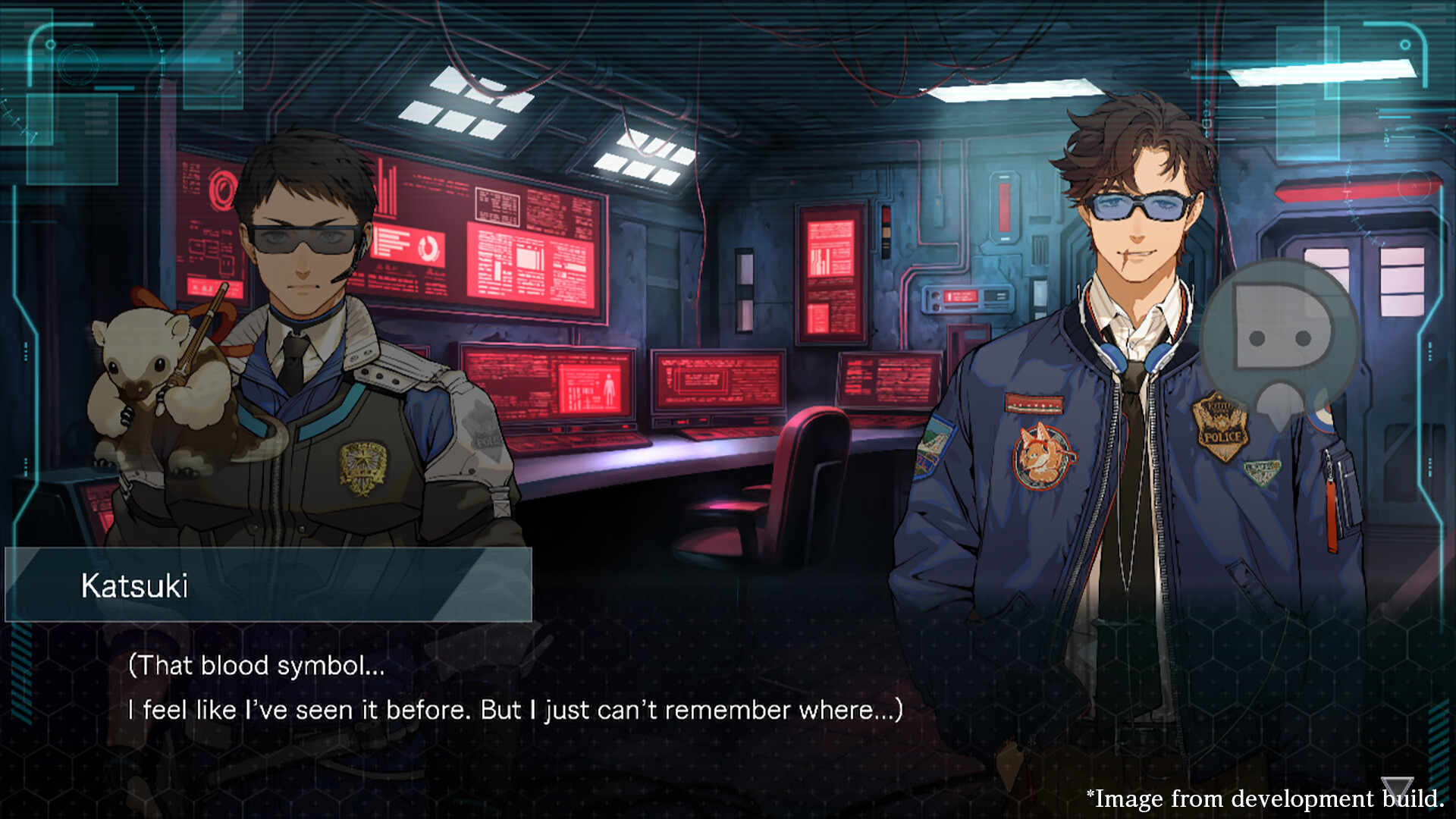
The production involved an unusual arrangement. With Cherrymochi’s small team fully committed to Exit Veil, and Williams firm in her principle of honouring crowdfunding obligations before splitting focus, she collaborated with Mebius, the studio behind the Tokyo Dark: Remembrance ports. Williams wrote the script and handled design, while Mebius produced the final product.
If Tokyo Dark was relentlessly bleak, Dusk Index: Gion carries more light alongside its darkness. Williams acknowledged the tonal shift reflects where she is personally. Nine years have passed since Tokyo Dark’s Kickstarter campaign. “At the time, I was suffering from a lot of depression,” she said. “I was in a really nihilistic place.” The years since have brought transformation. “A lot has changed in myself. A lot has changed in how I interact with the world, and how the world interfaces with me.”
The core motif threading through every creative decision in Dusk Index: Gion is change. “Every single decision that we made was: what does this say about change?” Williams said. “What is this character’s thought on change? How does this character handle change?” She sees it reflected everywhere, in how some people flow with transformation while others resist fiercely. Living in Japan, she has also drawn on Buddhist conceptions of impermanence, folding those philosophical underpinnings into the game’s texture.
Despite her conviction in the work, Williams was genuinely nervous about its reception. Dusk Index: Gion is heavy, literate, and demanding. It includes five mini-essays on physics and deals with difficult emotional territory. “We occasionally thought, does anyone want this?” she laughed. “Does anyone get what we’re trying to do?” The response from Japanese outlets has been reassuring, with reviewers reaching the end and wanting to revisit it immediately. “I was so relieved,” Williams said. “Seriously. So relieved.”

When asked whether she considers herself a storyteller or a game developer, Williams reframes the question. “At its core, I see myself as an artist,” she said. She points to the hand-illustrated tarot deck for Exit Veil as evidence that her creative identity transcends any single medium. If the games industry collapses under the weight of AI-generated content, she will find another way. She released a music EP last summer and is planning shows around Tokyo. “I have to get what’s in my brain out in one way or another,” she said.
What concerns her most about a future dominated by generative content is the loss of creative friction. “You can’t be shocked by things that you know and feel comfortable about,” she said. “When you come across something new, a lot of people’s first instinct is to feel uncomfortable. AI won’t give you that. Once you get past that friction is where there’s joy in exploration.” It is a sentiment that could serve as the thesis for Dusk Index: Gion: a game that asks its audience to sit with discomfort, grapple with questions that lack clean answers, and find something meaningful on the other side.
Williams has learned to stop being confident in her predictions. Five years ago, she was certain AI could never produce art. She was wrong. Rather than mapping a single path forward, she has chosen hope. “Just try to be hopeful,” she said. For an artist who has spent years thinking deeply about hauntology and lost futures, it is perhaps the most radical position of all.