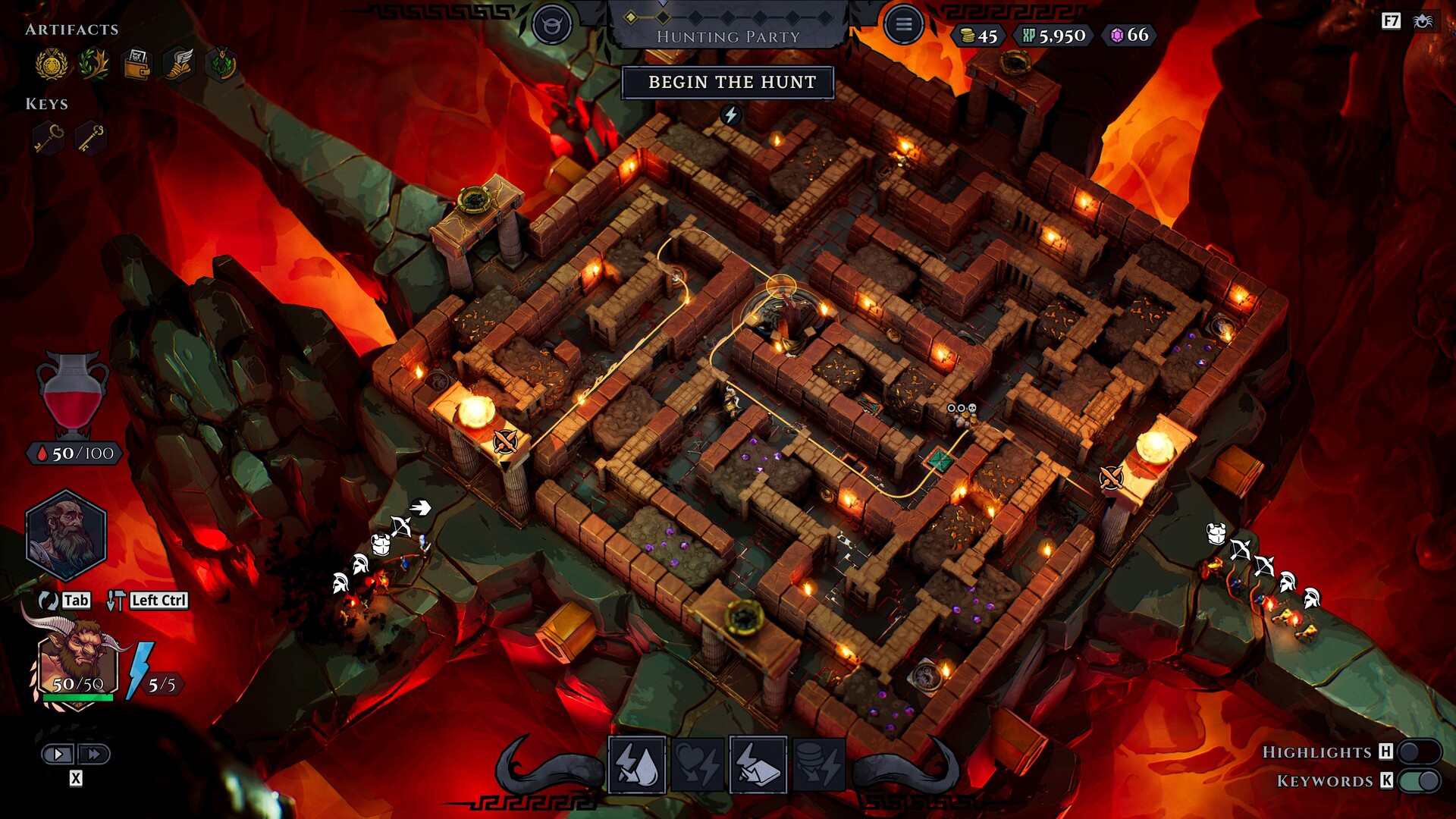


Did you know that, while mazes are designed to confuse and confound you by messing with your sense of direction and location, there’s actually a very simple way to escape from any of them? Put your hand on the left side wall and don’t take it off. Eventually, you’re going to get to the exit. It might not be the fastest path, but it’s a guarantee. If I ever get my shot at a season of Survivor, I so have the maze challenge licked.
Anyhow, Minos is a game about building mazes and then filling them with traps.
Superficially, Minos is like the excellent Dungeon Keeper or Dungeons series. Enemy hordes will make their way into your labyrinth, and by using the walls and doors to force them into a certain direction around the dungeon, you can lay down all kinds of nasty traps to kill them before they reach the inner sanctum. Think of it like a reverse Dungeons & Dragons, where you need to stop the heroes from saving the day.

However, that’s only the surface-level parallel. By the time you’ve finished the first level of Minos, you realise that rather than a blend of RTS and simulation – a city builder if every building was deadly – Minos is instead a roguelike tower defence game. On any given level, you need to square off against a number of “waves” of enemies. Early waves are only going to consist of one or two dungeon-crawling peons, but later levels will send a veritable horde into your lair’s depths.
Between each wave, you’ve got two jobs: Firstly, to construct the labyrinth. You do that by creating and destroying wall pieces, and the game will provide you with a projection of the path that the enemies will take based on what you’ve done. The enemies will always take the shortest possible path, and you’re free to create and destroy walls at will – including the ones you’ve already created and destroyed – to adjust for the fact that each level will have multiple entrance points, and on every wave, different types of enemies will enter from different entrances.
Secondly, the fun bit: You need to construct traps. Lots and lots of traps. Traps that have a truly shocking variety of ways that they can kill enemies. From mundane spikes and ballistas, through to pressure plates, demon doors, rolling boulders, siren statues and Medusae heads, the tools of torture at your disposal are beautifully grotesque in their creativity.
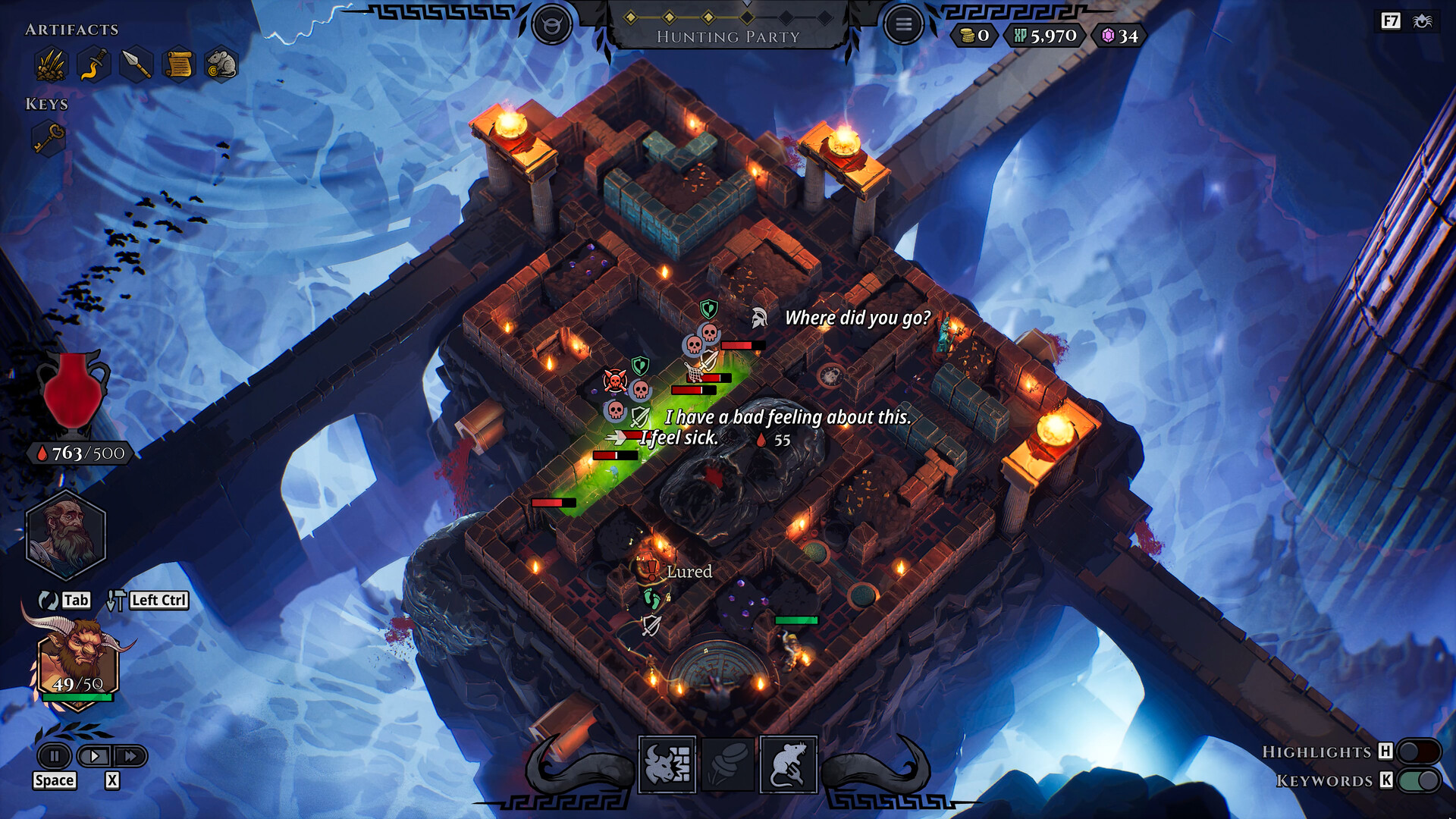
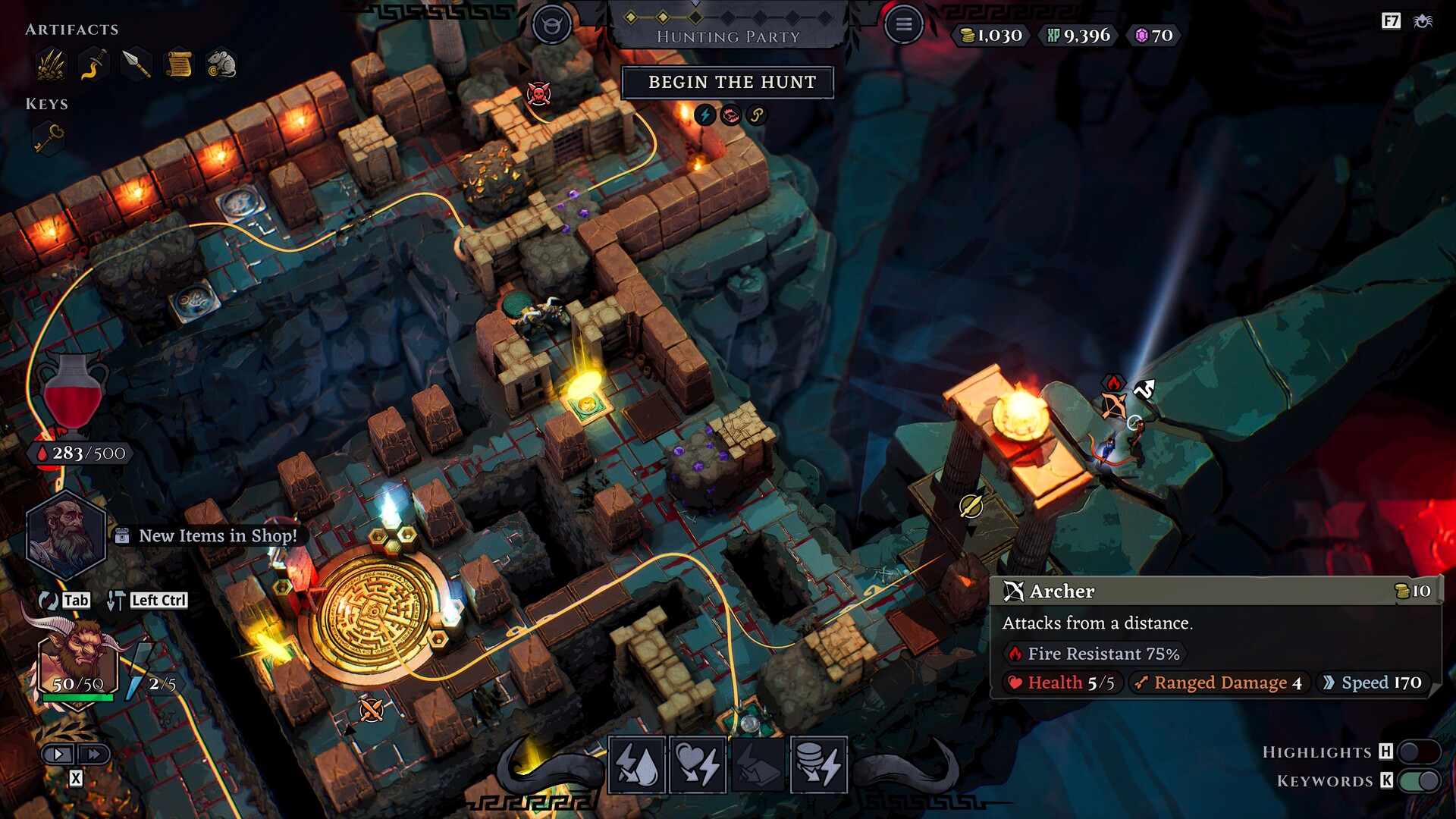
Different enemies are vulnerable to different traps. For example, you’ll learn early on that archers aren’t killed outright by siren statues (but soldiers are), so you’ll need to lay out the traps in such a way that you’re not wasting those siren calls on the wrong enemies. As the levels go on it becomes more and more complex. You’ll need to use pressure plates that mean a trap won’t activate until the third or fourth enemy steps on it because the lead enemies aren’t vulnerable to it. You’ll want to make sure there’s a variety of different traps placed at each route and that you’re cleverly using locking doors and other environmental features to either bunch enemies up or spread them out… depending on the dooms you have prepared in front of them.
The first few levels of Minos come across as very mundane, with straightforward enemy patterns and equally straightforward, 1:1 solutions to those patterns. Each enemy needs one trap placed down for them. Done. Mission complete.
It’s when the enemy patterns become too complex for simplistic solutions like that, and you need to start making use of combinations of traps, terrain-altering features and timing-based traps to ensure that each enemy in a wave is meeting their biggest nightmare that Minos becomes a beautifully dark symphony of sadism. When it all clicks, and you craft the perfect answer to a wave, watching the horde decimated before they even get close to you, you’re going to feel particularly clever. The flip side to that is that Minos is also punishing, and if you’re not able to think creatively in finding ways to have a dozen enemies killed by fewer than one trap per enemy, you’re going to be facing the game over screen quickly.
Thankfully, as far as roguelikes go, Minos is pretty generous, as you can keep your experience levels and various unlocks from one run to the next. These make a run significantly easier the next time, and indeed you unlock the ability to levels that are too low level to be challenging at a very quick rate. Progress through the game is relatively fast by the genre standards, though it can also grind to a halt when you start hitting the really elaborate enemy patterns, because there’s only so much you can do to brute force your way through those if you’re struggling to master the intricacies of the trap system.
As someone who is becoming increasingly jaded with games bearing roguelike qualities, I found that Minos side-stepped a lot of the complaints I have about them. The random nature of roguelike levels and the loot dropped didn’t feel like it was undermining the skill involved, and despite the levels being randomly generated, I found the base mazes that I was given to work with to be interesting and almost feel like they were designed rather than randomised.
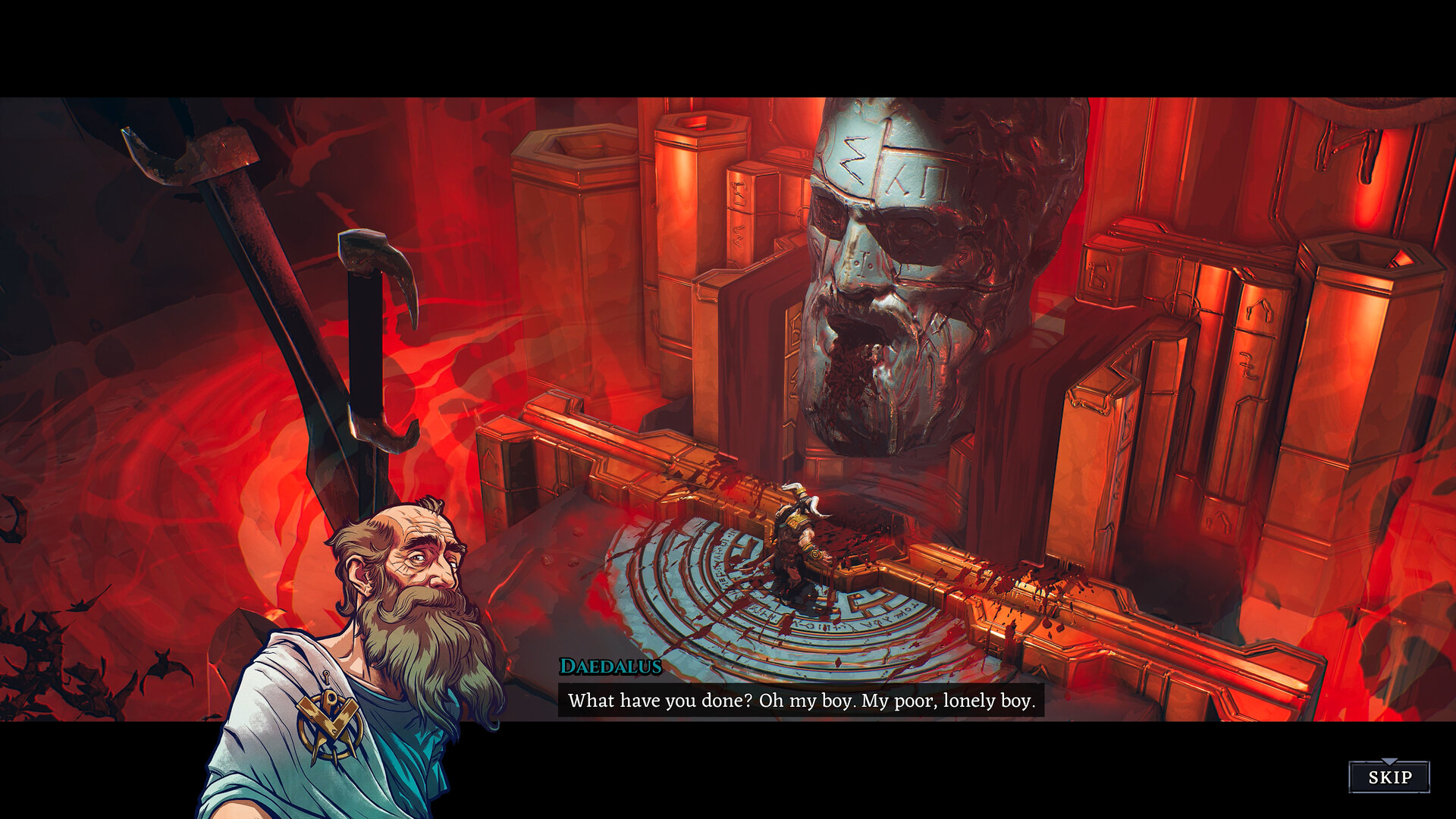
However, one thing I did find disappointing was the narrative. Like with so many roguelikes (especially since Hades landed), Minos’ narrative is drip-fed out every time you hit a certain milestone in terms of the number of levels completed. That’s fine and all, but it does mean that between those narrative moments, you’re playing through levels that seem to be barely linked to the story at all. One of the benefits of not relying on procedural generation and actually designing the levels, like what happens in the Dungeons games, is that the developers can weave the narrative into the “gameplay bits,” because they have greater control and know what the player will be experiencing as they make their way through a level.
Mind you, Minos’ narrative isn’t overly engaging in the first place. It’s a riff on the story of the minotaur and his efforts to escape the labyrinths that he’s confined to. There’s nothing really wrong with how it’s written or delivered, it’s… just that in a world that is filled with games based on either Ancient Greek or Ancient Roman mythology, Minos isn’t really saying or doing anything with its plot, and I don’t think anyone’s going to care for the generic result.
Of course, Minos’ fans – and the game deserves to have a lot of them – will tell you the plot isn’t important. What is important is its creative sandbox and gleefully gory approach to what is essentially a tower defence game. And on that I would agree with them. Minos is really difficult to put down once you start finding yourself daydreaming about new ways to combine your trap arsenal together.