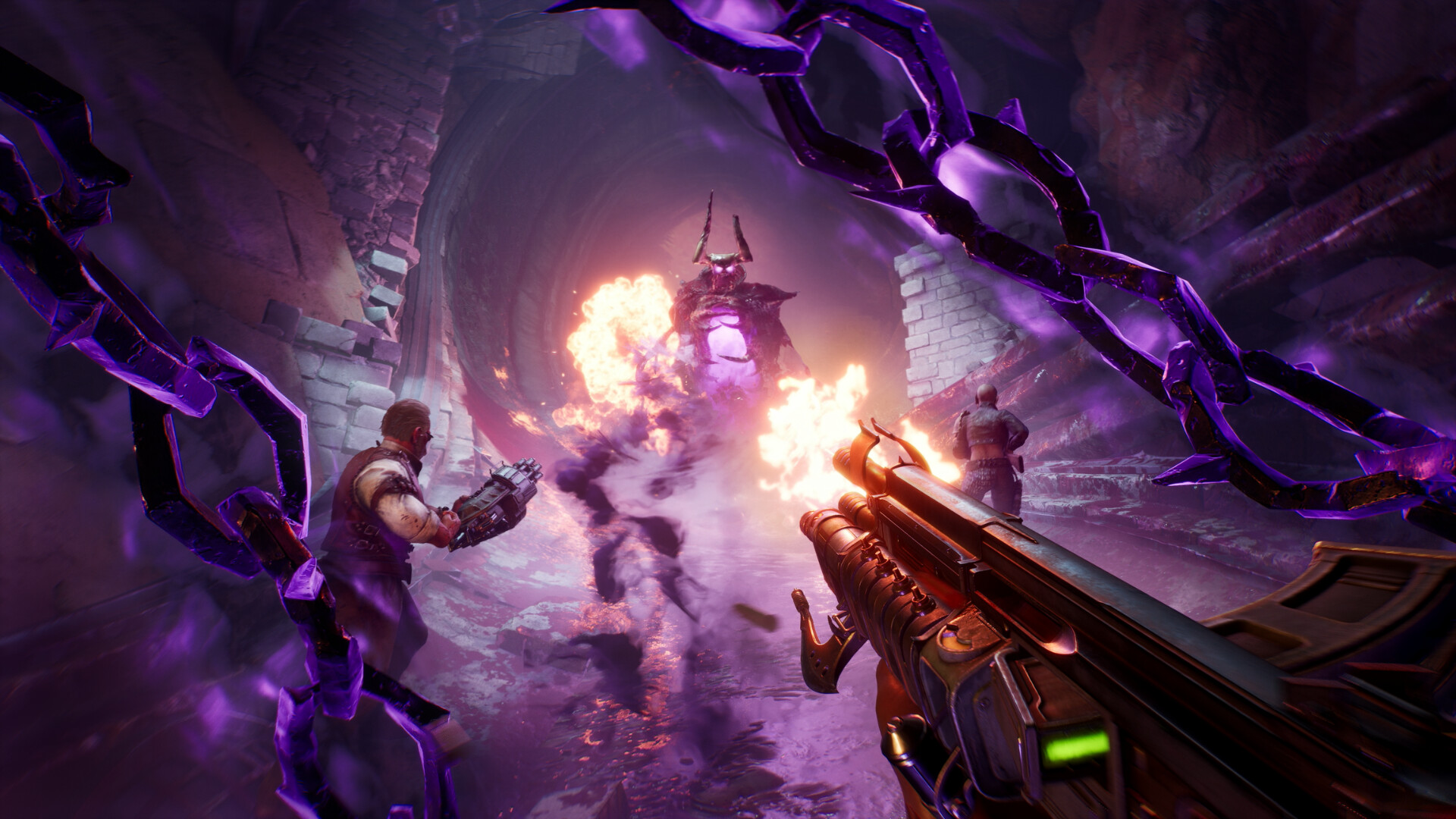


I’m not the world’s biggest fan of first-person shooters, but People Can Fly’s Painkiller is one of the exceptions to that rule, thanks to its grim, gothic theme, great monster design, and furious pacing. It was like the developers blended Hexen (another of my small list of beloved shooters) and Serious Sam (that would be the other one). It was well known for being a quality multiplayer experience, but I never really engaged with it on that level. For me, it worked perfectly fine as a single player run-and-gunner in every way that this reboot totally trashes.
The game is set in “Purgatory,” though it seems more like the developers played the Doom reboot’s take on hell and then just made a boring version of it… Okay, fine, that actually does describe Purgatory well enough, but it doesn’t make for a compelling setting from the outset (and the original Painkiller’s Purgatory was far more vivid). God’s second-hand-man (Metatron, for those who aren’t up with Christian mythology) tells them that they need to defeat Azazel (a fallen angel, not Lucifer, who ended up being cast out from Heaven because he had an insatiable lust for human women). To do that, they need to kill an awful lot of demons and undead things.
There is potential in that set-up. I’m a sucker for Christian mythology and, for example, stuck through both Dante’s Inferno and even Agony to fully explore the respective developer’s vision of Christian hell. Sadly, in this case, the concept never really goes beyond that because the developers decided that, rather than provide a cohesive narrative like the Doom reboot, they would instead focus on the multiplayer with raid-style “mission” structure.
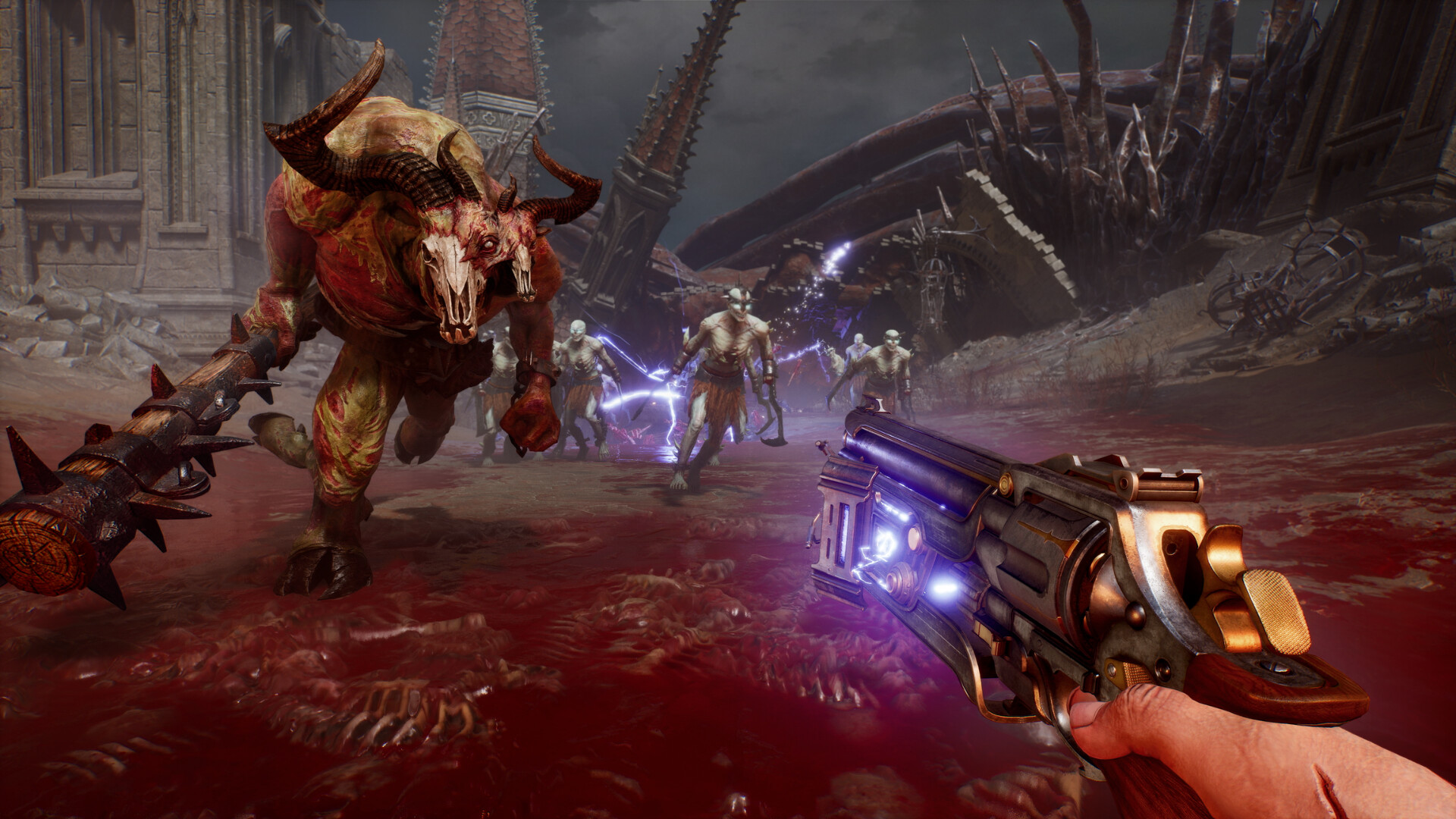
There are nine raids and a roguelike mode (which doesn’t do much for the narrative either). Each of the raids takes about half an hour to play through, and the action is certainly intense from start to finish. Basically, you’ll be dragged by the nose through a gauntlet of monsters, and occasionally be given a task that involves doing something while mowing down a gauntlet of monsters. Dropping batteries in power sockets, for example. Carrying objects from point A to point B… with the catch being, of course, that when you’re carrying something, you can’t be using your weapon.
All of this is built around a co-operative experience, and it’s mandatory. If you can’t get a group of friends together, the AI will fill in with bots that do a decent enough job of coordinating with your actions. With that being said, as a co-operative experience, Painkiller is incredibly shallow, with the strategy and teamwork not really extending past designating who’s going to be the non-combat mule for carrying items when that’s an objective. Otherwise, everyone’s going to be focused on gunning down their little horde of enemies, occasionally checking in to see if anyone needs healing or revival.
Because there are so few raids to actually play, the rewards in Painkiller come slowly, and you’ll find yourself needing to replay each raid several times to really start to power up your character. That being said, with each of the raids blending into one another and the roguelike mode just being a blend of existing levels, it probably doesn’t matter too much if it is a giant grind, as the few people that are going to play this long term won’t be in it for the level design or narrative, but rather the simple moment-to-moment action.
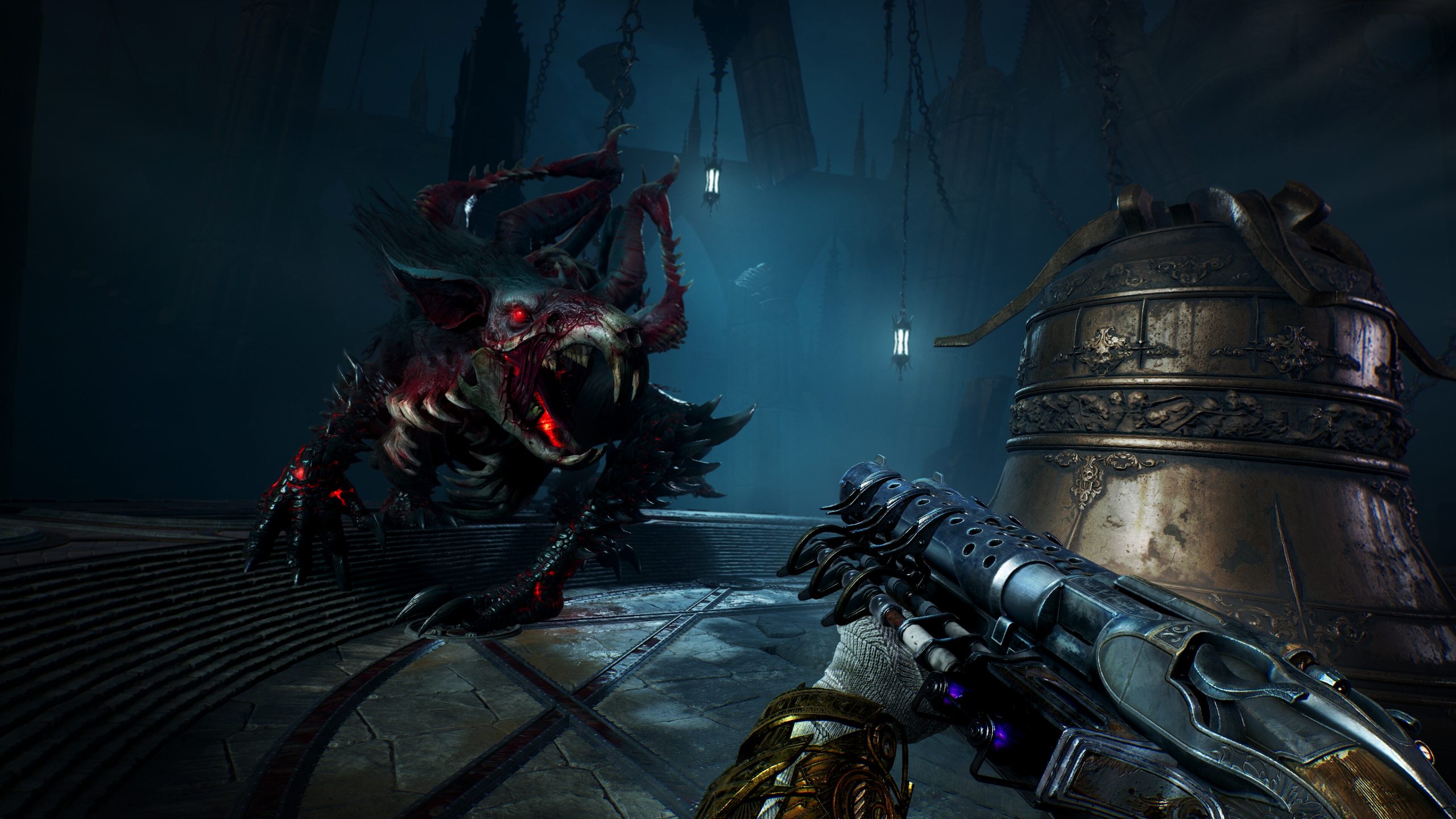
In fairness to Painkiller, that moment-to-moment action is good. Gameplay is slick and smooth, and as generic as the soundtrack and aesthetics are, they do provide a convincing background for the bloody carnage that you’ll be focused on. Guns feel good in the hand, and the iconic Painkiller (which I like to think of as a handheld fan that splatters everything around you) gets a good workout as an effective tool for recovery and crowd control. Those guns are upgradable and you can end up customising your experience to your personal preferences, though again the developers missed the boat by not encouraging deeper “classing” and specialisations to encourage more collaborative, co-operative play.
The visual engine handles things well, and while I found environments and enemy designs to be completely uninspired, on a technical level, the level of detail in Painkiller is impressive. It looks up to the standard of the likes of something like Killing Floor, even if it’s a pace or two behind the Doom reboot.
Frankly, being competently made isn’t enough. Not for a genre as loaded as this boomer shooter one. The original Painkiller had an identity and personality. It wasn’t meaningfully different in how it played compared to its peers at the time, but it had something about it that allowed it to stand out for itself. This Painkiller is a generic multiplayer shooter with a generic Christian horror-themed setting and aesthetics, and none of it is memorable.

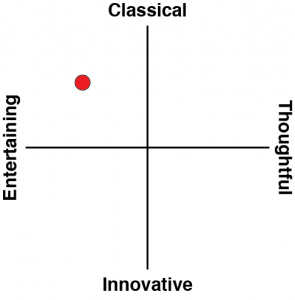





Aw, man. A new Painkiller should be such an easy win with how popular “boomer shooters” (ugh, hate that term) are these days, but everything about this sounds both awful and antithetical to the excellent original games.
Also I had no idea this was even in development, which probably says something in itself.
Yeah they really snuck this one out with no fanfare. A blatant effort to cash in on the property without doing anything meaningful with it. Such a pity.