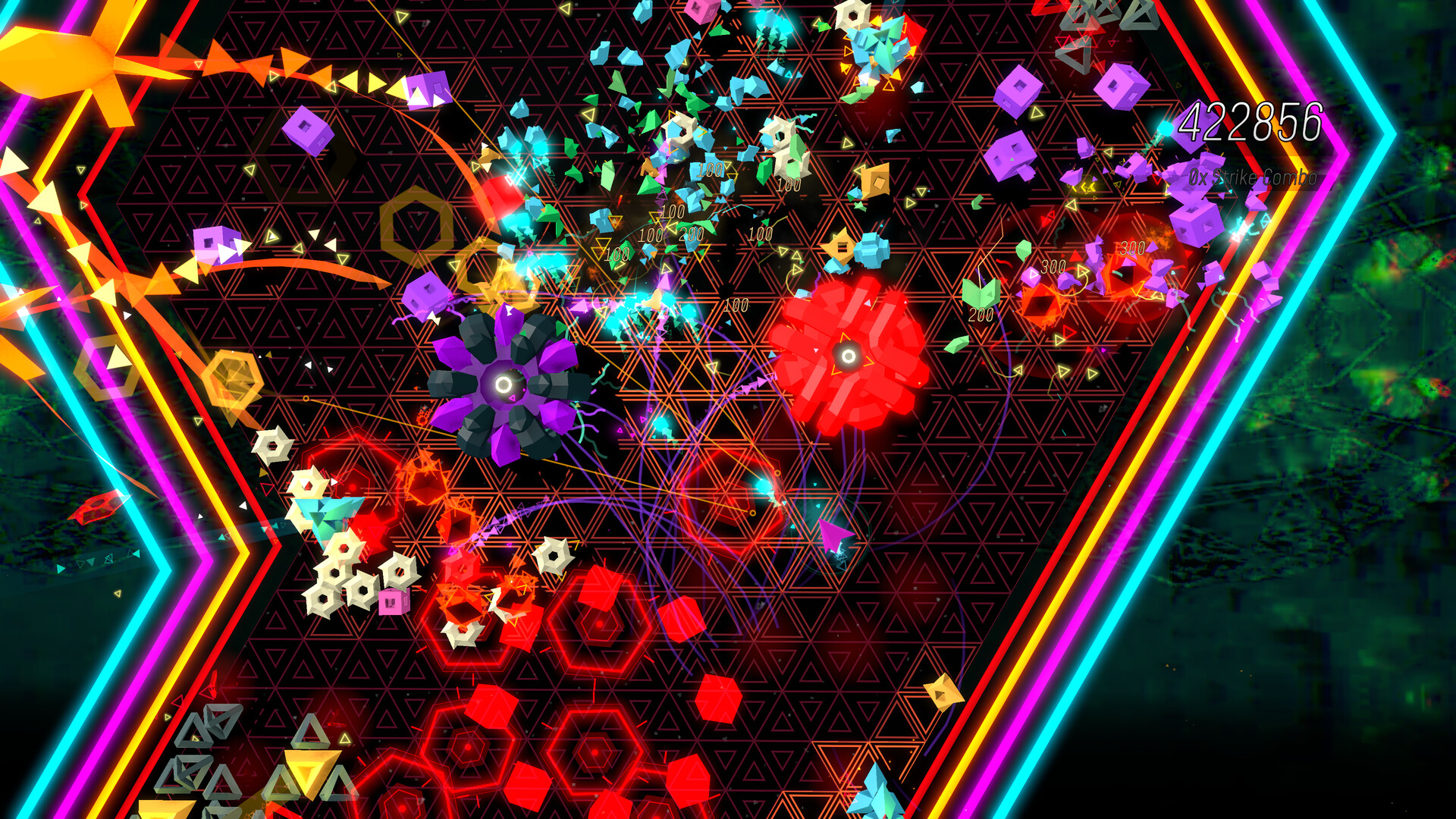


I am so bad at Sektori, but I love it so much.
Originally released back in 2025, to some blistering good reviews, but only some (for some weird reason, the game has largely missed critics and audiences alike), Sektori is finally available on the Nintendo Switch 2, which I would argue is a far better platform for a game like this. Here, too, the game has an almost shockingly thin number of reviews. It’s one of those real hidden gems as a result.
Do you remember Geometry Wars? It was a mild hit around 20 years ago now (God, I’m getting old), and a great example of a simple concept done well; it took the basic top-down, dual-stick shooter from the arcades and focused on offering fast, slick action with a retro-neon, trance-like vibe. The game had a real pulse and heartbeat and was very difficult to put down once you got going with it, as limited as it was in practice.

Sektori is what Geometry Wars probably would have looked like today if it were still an active franchise and Activision hadn’t killed it. It too has a retro-neon, trance-like vibe, and is also a twin-stick shooter that focuses on slick, fast-paced action. But it has several additional features that make it both significantly more complex and challenging, and even more engaging.
First, the stage itself is a dynamic space in Sektori. Every couple of seconds, the stage changes, with walls dropping down and disappearing at random. At times, the play field will be split into sections, and at other times, those walls will cause the endlessly moving enemies to change patterns and force you to slip through tight spots. Before you even take into account the variety of enemies, the endlessly shifting play space alone makes for a challenging experience that, to master Sektori, you really need to be hyper-aware of and adaptable to.
Another thing that you need to keep a close eye on (despite never really having the time to do so) is the level up system. As you defeat enemies, you’ll build up experience points. When you hit a certain number, a little icon will step up a “ladder”. The lowest rung of the ladder allows you to up the speed of your avatar, which is itself useful, and with a press of the button, you can accept that level up and start zipping around a little more quickly.
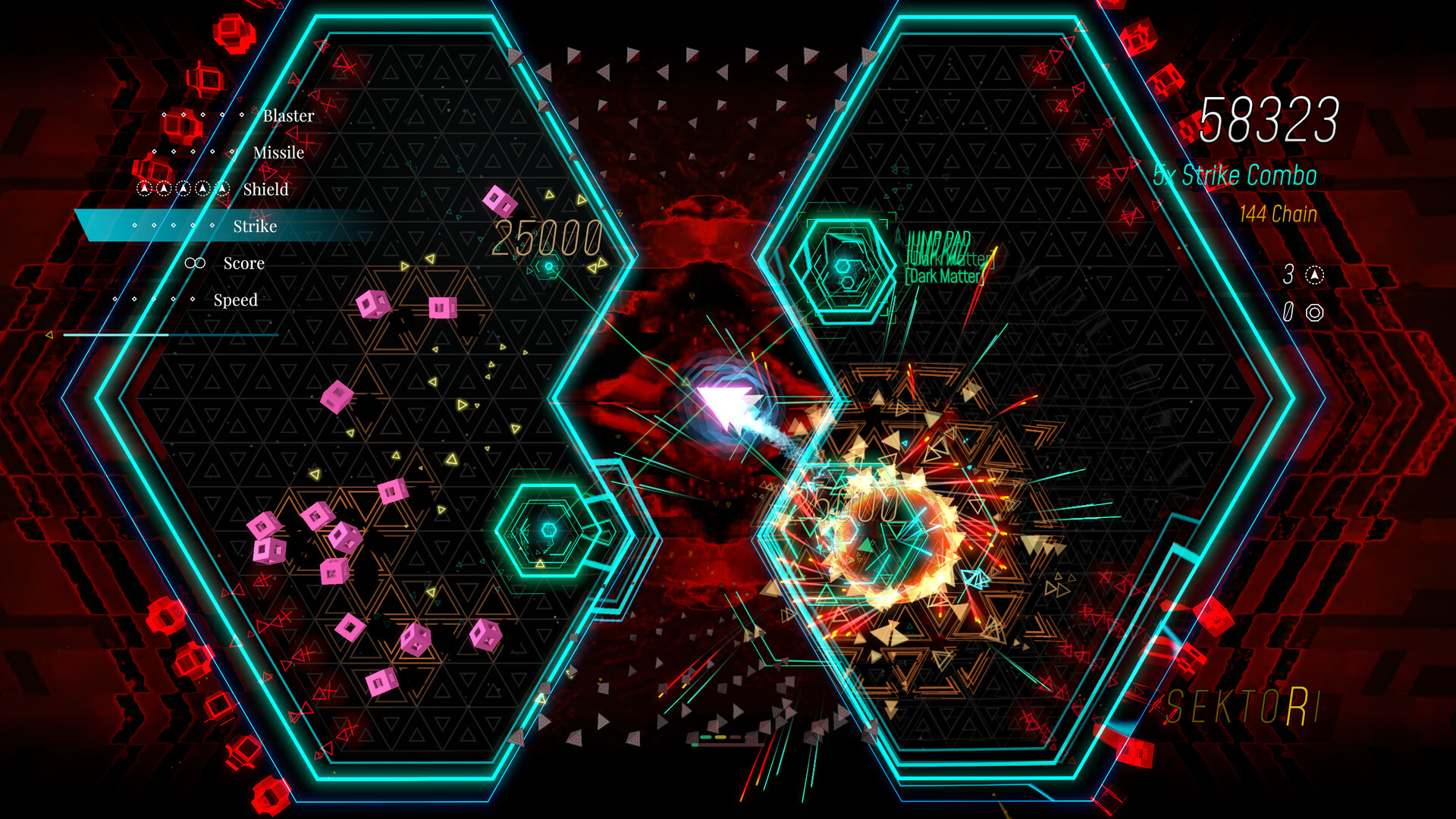
But you can instead choose to stock points up, and on the next “level up” move up to the next rung of the ladder (a score increase), and so on across several more levels, each time offering a more powerful effect – boosting shields, or adding missiles to your shots, for example. There’s a very clear tradeoff here, because if you’re not levelling up you’re leaving yourself at a disadvantage against the ever-more deadly swarms of enemies being thrown at you, but the benefit from waiting for those higher-tier awards can give you a bit of breathing space if you can survive long enough to take advantage of them.
Every so often, you’ll have a boss thrown at you, at which point Sektori becomes a true bullet hell in the way it behaves. Those bosses tend to be monumental challenges, no matter how you’ve loaded out your avatar leading up to them, and the sense of reward for overcoming one is particularly high.
Even getting to the first boss will take some time, though, because Sektori has a habit of punishing even the slightest error. The number of enemies on the screen at once is frequently overwhelming, though brilliantly designed so you’ll never really lose sight of where your avatar is in the thick of the action.
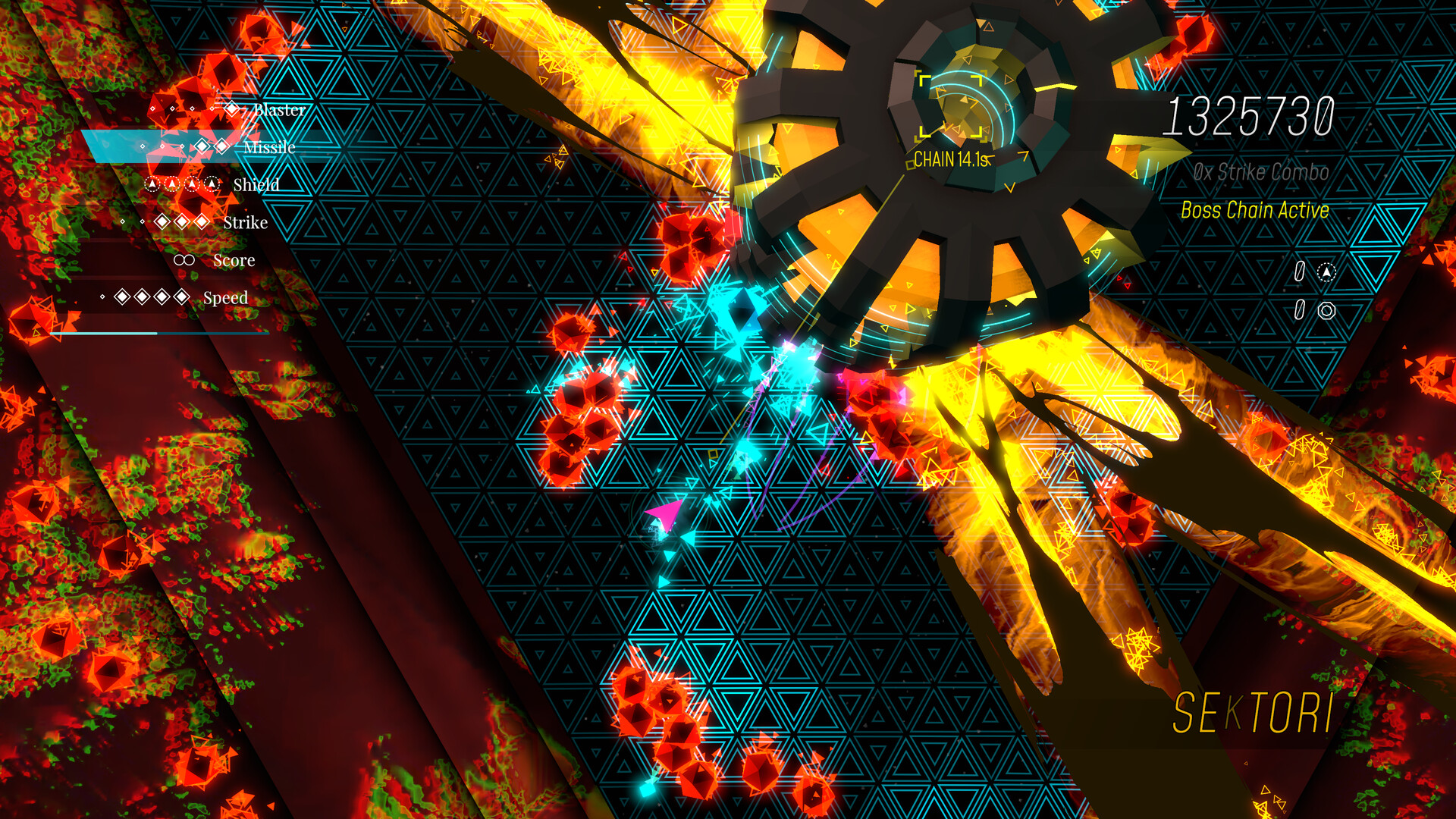
There are even roguelike elements thrown in via “cards” that you can earn from destroying certain enemies and grabbing certain powerups that are left on the screen. These can significantly change how your avatar moves and fights, and can really add to the fireworks. If I were going to be critical of anything with Sektori it’s that you generally look to these kinds of systems to add to the strategic depth, but here it’s just yet another power-up mechanic, but, the game pulls it off with such verve that it’s hard to mind.
This is one of those games where the leaderboard dominates the experience, and Sektori’s scoring is complex and nuanced enough to reward true expertise in play. Whatever position you earn on that leaderboard is entirely earned. In my case it’s a very low place indeed, but I can’t stop playing and trying to beat my own score, let alone anyone else’s. I might never reach the top of Sektori’s leaderboard, but I can recognise the utter design brilliance that has gone into making this game. I can’t believe that so many people are overlooking this thing.