 Opinion by Nick H.
I really enjoyed the original Dead Space a great deal. The graphics were excellent, the sound design was appropriately creepy, it told an excellent story and gave you a reason to care about what happened to the lead character, Isaac. I am a huge fan of horror games, having thoroughly enjoyed older titles like Silent Hill, Resident Evil and Fatal Frame, despite their somewhat clunky controls. Newer titles like Amnesia: The Dark Descent also gave me a few good scares. Some spoilers to the series will follow, so proceed at your own risk.
Dead Space did several things very well that other horror games did not. For starters, the overall theme was that of a sci-fi adventure, getting the player out of haunted mansions or foggy roads and putting you in space, much like the Alien movies. It is a different kind of horror, but it worked because you often felt alone and isolated, despite occasional communication with other characters throughout the story. Isaac still plods fairly slowly, though not anywhere near as tank-like as some of the older games I mentioned above. He cannot jump and his run is only a marginal increase in speed, but he is armed and dangerous.
Excellent puzzle solving was built into the game, using new abilities like stasis and telekinesis. The environment is important, and Isaac is forced to be resourceful. Excellent lighting and use of sound really help to ratchet up the tensions throughout the first game. So what about Dead Space 2? More of the same – except even better. The voice acting is excellent, the storyline engaging and the added element of Isaac’s dementia keeps everything even more tense throughout.
By the end of that game Dead Space was an established franchise. What seemed like a healthy risk with the release of the first game managed to spawn a spinoff (Dead Space Extraction) and a sequel, both of which were well-received by fans. That is where I think things started to go wrong, and why I use the term “devolution” the the title of this piece. The word means the reverse evolution of a species, and here I felt as though Dead Space took several steps back in the third game.
 At first glance, all seems well. The graphics and music are better than ever, and the voice acting is excellent. However, in the first two games, and even Extraction, there is this element of isolation and hopelessness instilled almost from the beginning. Here, the game starts with Isaac living in an apartment in an anything-but-isolated city, having had a relationship go bad, before he is confronted not with horrifying aliens, but soldiers. In fact, that early level is spent fighting almost nothing but human soldiers. Not only has the threat changed, but also the way it is dealt with, because the key word from before is ‘fighting’.
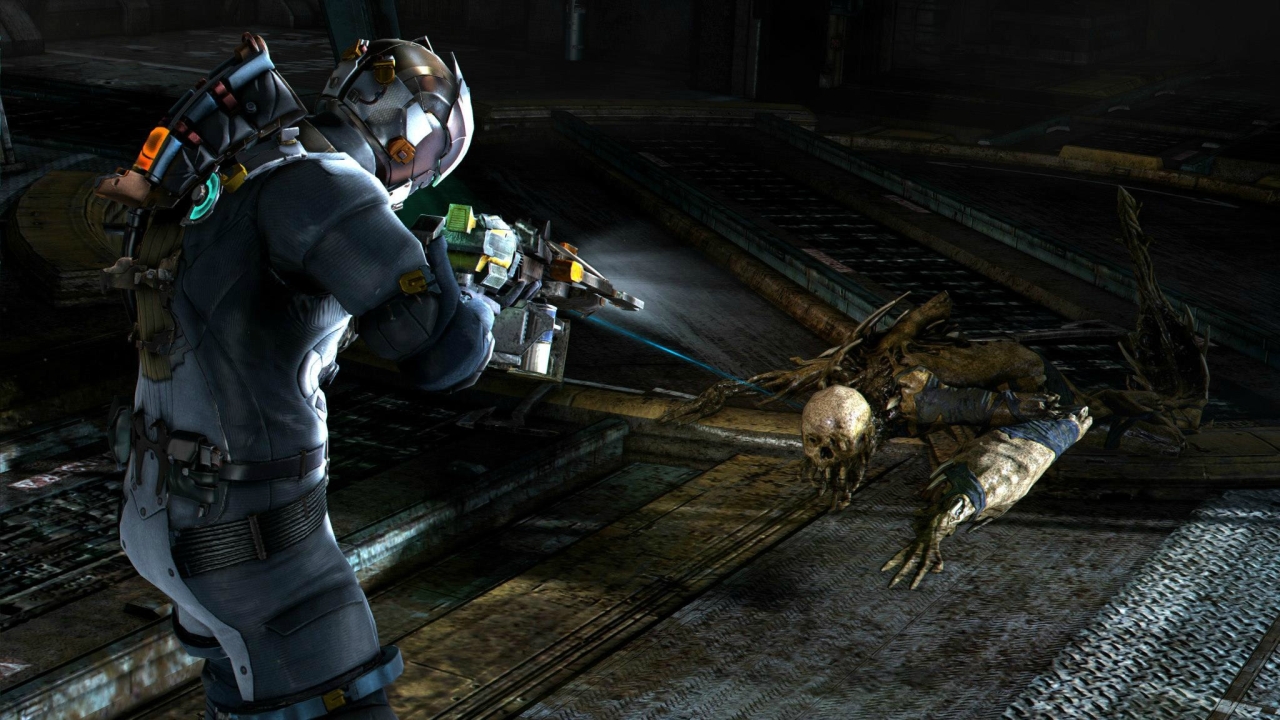
The first couple of Dead Space games were all about survival. Dead Space 3 is all about combat. The weapon customisation is undeniably cool, and playing the game with my son in co-op mode was entertaining enough, but it was lacking in atmosphere. You no longer felt isolated. I no longer felt afraid to walk around. There were a couple of shock scare tactics, like opening up an elevator and having a monster dart through at me, but these are cheap. Everything is faster, and I suppose it is the same approach found in movies such as 28 Day Later where faster enemies means greater danger.
However, something gets lost in translation. You do not get much time to take in those creepy sounds. You do not often worry what might be around the corner, because odds are it and a dozen friends are ready to barrel at you. Instead of clipping a leg to slow a single frightening enemy down, you are using a rocket launcher to do splash damage to three full sized opponents and a bunch of little bug creatures. Instead of chillingly possessed necromorph infants, you are blowing up bugs. Instead of being teased with dementia-induced panic attacks which may or may not be followed up by a monster’s attack, if you hear sounds down the hall, you are about to get rushed by a horde.
My son really liked the first two games, but as a fourteen year old boy, he thought the storyline to the third game was ridiculous. Another friend online said he gave up on the Dead Space 3 around chapter six, because despite the fact he was a huge fan of the first two games, he just got tired of mowing down waves of enemies. Another friend of mine at work said that the experience felt wrong, even if he could not put a finger to it.
It all reminded me of when Resident Evil shifted from horror to shooter. Adding a co-op element to the proceedings only further enforced that notion. That is not to say Dead Space 3 was a bad game – I had some fun with it, but it was a hollow sort of immediately forgettable fun. The first two games stuck with me, while the third – the one I most recently played – will probably fade sooner than later.
I was concerned back in June of 2012 when I read a quote from Fank Gibeau of EA’s quote that “In general we’re thinking about how we make this a more broadly appealing franchise, because ultimately you need to get to audience sizes of around five million to really continue to invest in an IP like Dead Space. Anything less than that and it becomes quite difficult financially given how expensive it is to make games and market them.”
I had several concerns about this. For starters this was more than what either Dead Space 1 or 2 moved in retail. To my mind, if this is what you need to be successful, then perhaps there is a need to examine how the game is being made.
 I realise that Extraction already took Dead Space in a new direction, creating an on-rails shooter based on the game’s world. However, Extraction went out to purposely do something different. This is a core entry to the franchise. This unfortunately has all of the markings of why people are upset with EA as a company. Worst company outright? No, of course not. However, this game featured a cliffhanger ending set up for DLC, day one DLC and tried to broaden the game’s appeal to harness a larger audience while losing much of what made the original games great. Unfortunately the only ‘scare’ tactic produced from this game was in telling customers that the game had to reach incredible sales or the series would be put on hold.
And it didn’t even meet its sales targets anyway. Perhaps, just perhaps a smaller game built for the core fanbase would have been the wise direction to take here.