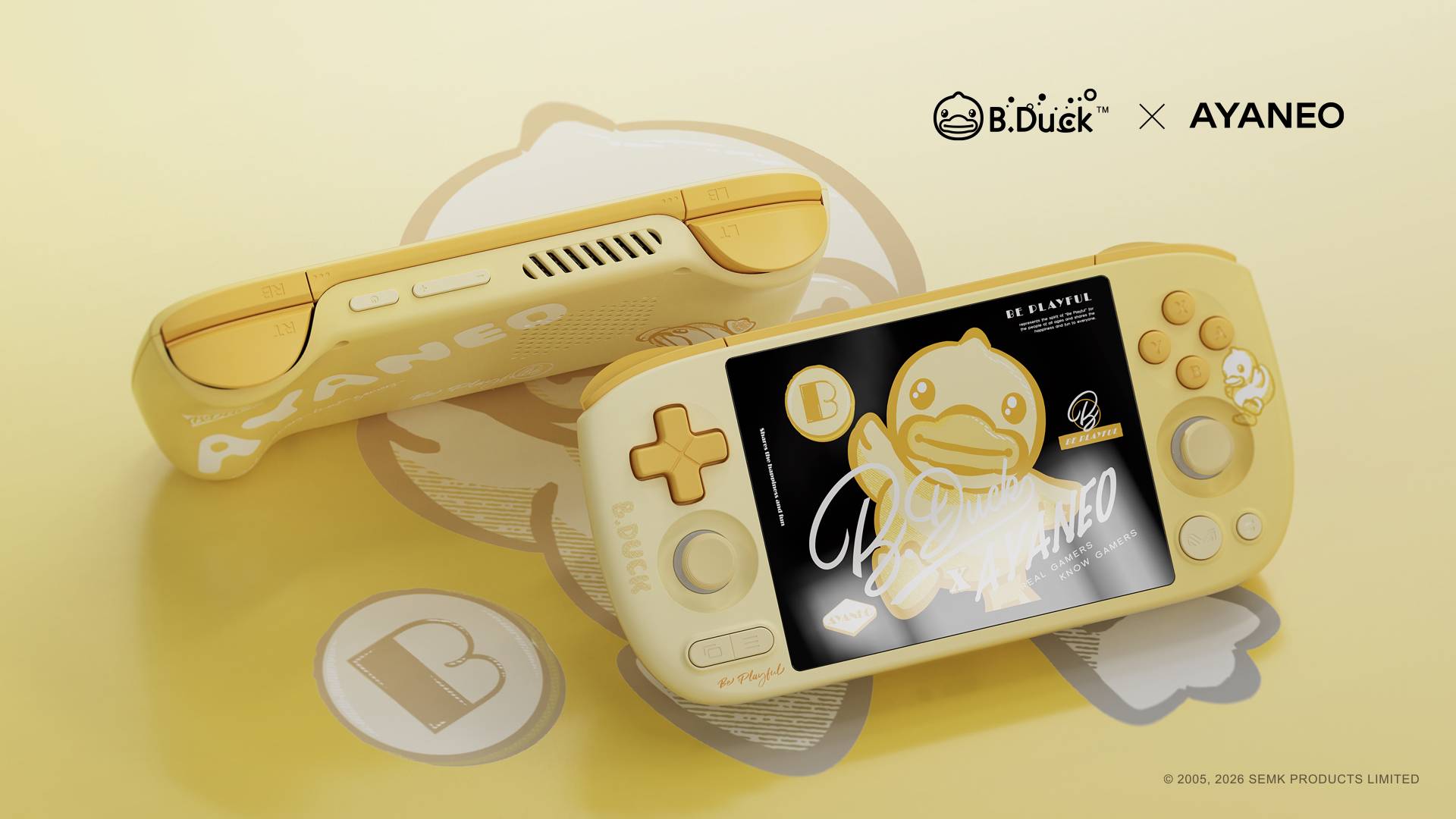


Squint hard enough, and the AYANEO Pocket AIR Mini x B.Duck Limited Edition looks like a Chocobo limited edition. That was a good enough reason for me to buy one. It’s actually my first AYANEO device, and I can certainly see the appeal of them, sitting in the growing pool of “Anbernic/Retroid Pocket but premium” category for emulation consoles.
I have a theory about these emulation devices, and most of my review will be a digression, but I’ve reviewed so many of these things now that I’m running out of things to say about them as hardware devices. I will get on to the relative merits of the Pocket AIR Mini soon, though. My theory is that the entire reason we’re seeing the stores of the “official” Nintendo, Sony and Microsoft stores flooded with “official” retro compilations and re-releases is because of the pressure placed on publishers, developers and rights holders by these devices.
Before they exploded on the scene, emulation was a messy business. For one thing, it was locked to PCs, and those weren’t typically the kind of console experience that enamoured many players to these games. Especially back then. Things are a bit different now thanks to the likes of RetroArch, but for the longest time, the property owners could sit on their retro IP because the experience of getting the (often buggy) emulators and ROMs lined up to play on the static computer which might or might not have played nicely with the controller that you owned was a dull enough one for many not to bother with.
After all, new games were being released on consoles that were a joy to play with all the time.
But then the early pioneers like Bittboy and Anbernic came along, and that started to change. While those early devices were primitive and often had their own frustrations in getting set up (Linux-based operating environments and all that), they did allow you to load up all those ROMS (for games you totally legally owned, of course) onto a device that had the look and approximate feel of the “official” consoles. Suddenly, the barrier to reliving all those classics in an enjoyable manner was being stripped away. And it suddenly looked like IP owners were going to lose control if they continued churning out lazy ports of old games, or sitting on properties and never re-releasing them for modern hardware.
These emulation console manufacturers are two things: quick learners, and they work hard. Each new “generation” of Anbernic – and there are like two or three of those “generations” every year is a step up in terms of power, ease of use, and experiential quality. More consoles can be played on these devices with emulation that is ever closer to a full native experience. Competition from newer entrants in that space, like Odin and AYANEO is further pushing the entire sector to improve. Android has become the default platform, and that makes messing around with the operating system to get the games working no more complex than using a smartphone. Now, many of the devices really do push up against the likes of Nintendo for their quality.

And because of all these, the developers and publishers of retro games have been forced to, firstly, make their old catalogue available. Publishers and rights owners have become more willing than ever to loosen the chains in order to make the games available again. Consider how Konami has been suddenly able to re-release Teenage Mutant Ninja Turtles games – a license it no longer owns – so there could be a TMNT collection. Or how Hamster has been able to get Arcade and console licenses from Namco, Koei Tecmo, and lord knows how many other publishers for games that they wouldn’t release themselves.
Or even how Evercade has been able to build itself into a hardware brand of its own, specialising in combining “official” retro game compilations from almost all the publishers on exceedingly high-quality hardware.
Secondly, the quality of these “official” retro re-releases is increasing rapidly, because publishers need the “value add” that lifts them above the quality of the emulated titles. Digital Eclipse has found itself a new business model in creating “museum” experiences that combine playable games with developer interviews, timelines, history and documentaries. Others are following suit.
All of this is healthy for video games as an art form as more is being done now to preserve and celebrate the history and heritage of the games industry, and I really do firmly believe that competition, driven by these predominantly Chinese developers of emulation hardware.
I used to buy a lot of these devices, but have greatly slowed down given that, firstly, most of the retro games I like playing are now “officially” available on something, and secondly, I already have devices that play just about every console I care enough about to consider “retro”. And I have handheld PCs for the rest. But it’s a sign of just how far this sector has come that we’re now getting emulation consoles partnering with mainstream IP. B.Duck is a major mascot character that isn’t so far off a Hello Kitty or Rillakkuma for overall popularity. It’s almost surreal seeing him emblazoned on what, just a few years ago, would have been considered questionable hardware to the mainstream.
AYANEO has done a great job with the aesthetics of this device, giving it a warm yellow with a nice shading gradient from one side to the next, and a couple of cute B.Duck prints on the surface to really sell the collaboration. The hardware build is good, too. I’m not usually a massive fan of soft buttons, and the face buttons on the Pocket AIR Mini are extremely soft, but they’re pleasant to press down on here, and the shoulder buttons feel far more robust and comfortable to press than anything Anbernic has ever produced.
Meanwhile, the analogue sticks have a near-perfect balance between resistance and give, and are built beautifully so that there is no moment where they’ll be uncomfortable to press. The Pocket AIR Mini has an exceptional build quality in terms of both robustness and ergonomics, and I can see why AYANEO has built such a fan base, despite its devices prior to the Pocket AIR Mini being at such a premium.
Screen quality is fine, albeit unremarkable, and the guts of the device are less than what you’d generally want to see from this era of emulation console – the Pocket AIR Mini is only really reliable for consoles up to the N64/PSP/Dreamcast. If you’re only looking for one single emulation device, you can probably find something that can do a bit more than this elsewhere.
The lack of HDMI out is also disappointing since, as an Android device, you can pair Bluetooth controllers to it. HDMI out has been almost standard for Anbernic for generations of its hardware, for example, and it is nice to be able to play on the big TV when you’re at home in front of it.
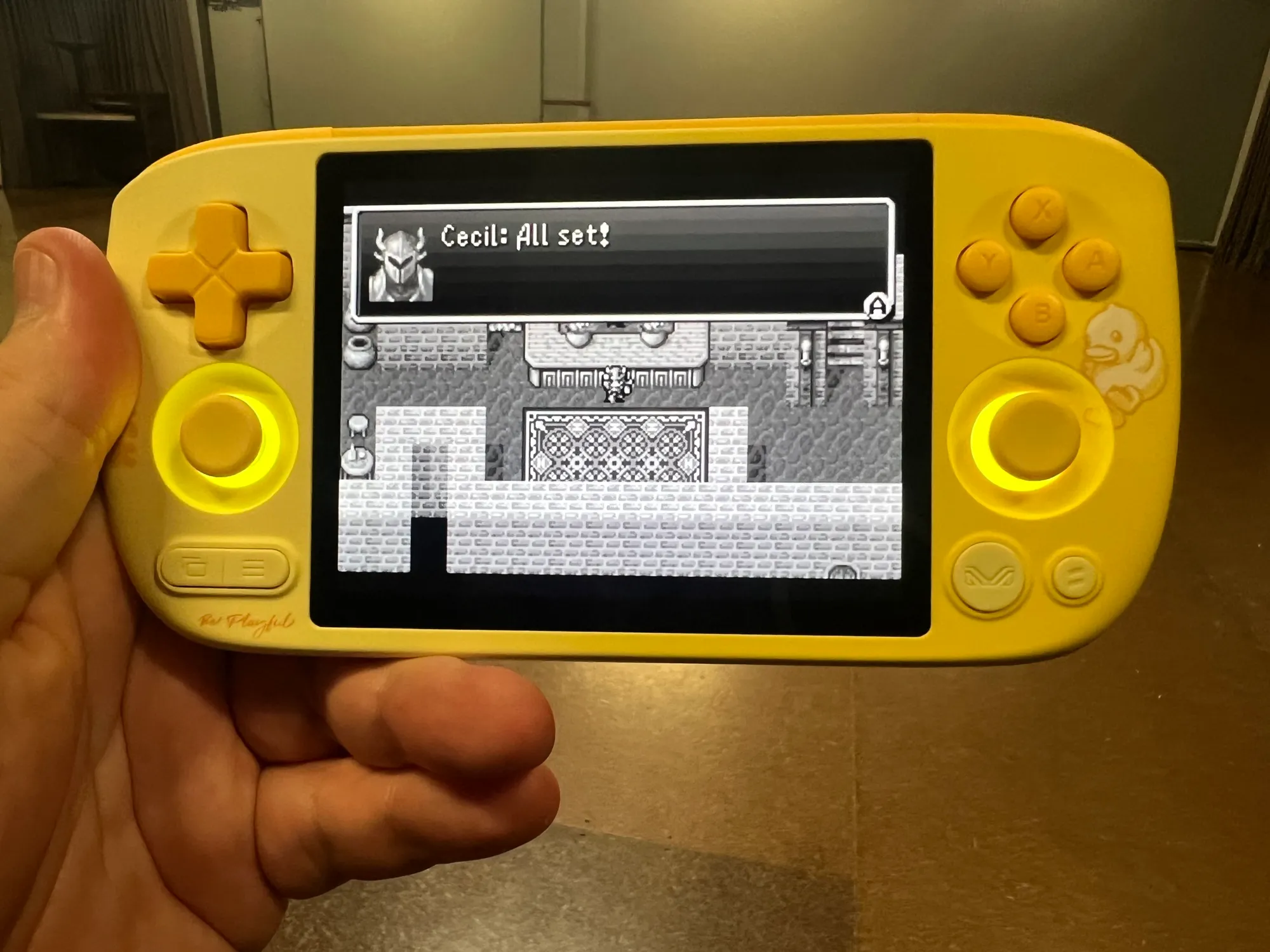
But it is such a delight to actually play, with such character and personality, that I find myself reaching for B.Duck even over my Switch 2 at the moment. There are some things that you can do with the emulators, like make your GBA games old school black-and-white (see photo, above), which you can’t do with the “official” ports and hardware, and it’s a lot of fun to play around with these features for the different experience they provide.
Collaborations with B.Duck surely demonstrate that companies like AYANEO are emerging from being a mere thorn in the side of the big players to having a genuine place in mainstream gaming culture. It’ll be interesting to see how the incumbents and rights holders respond to this escalating competition to maintain their edge. Interesting and, hopefully, even better for the preservation and playability of retro games.