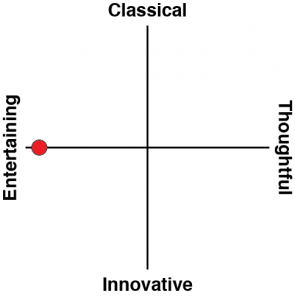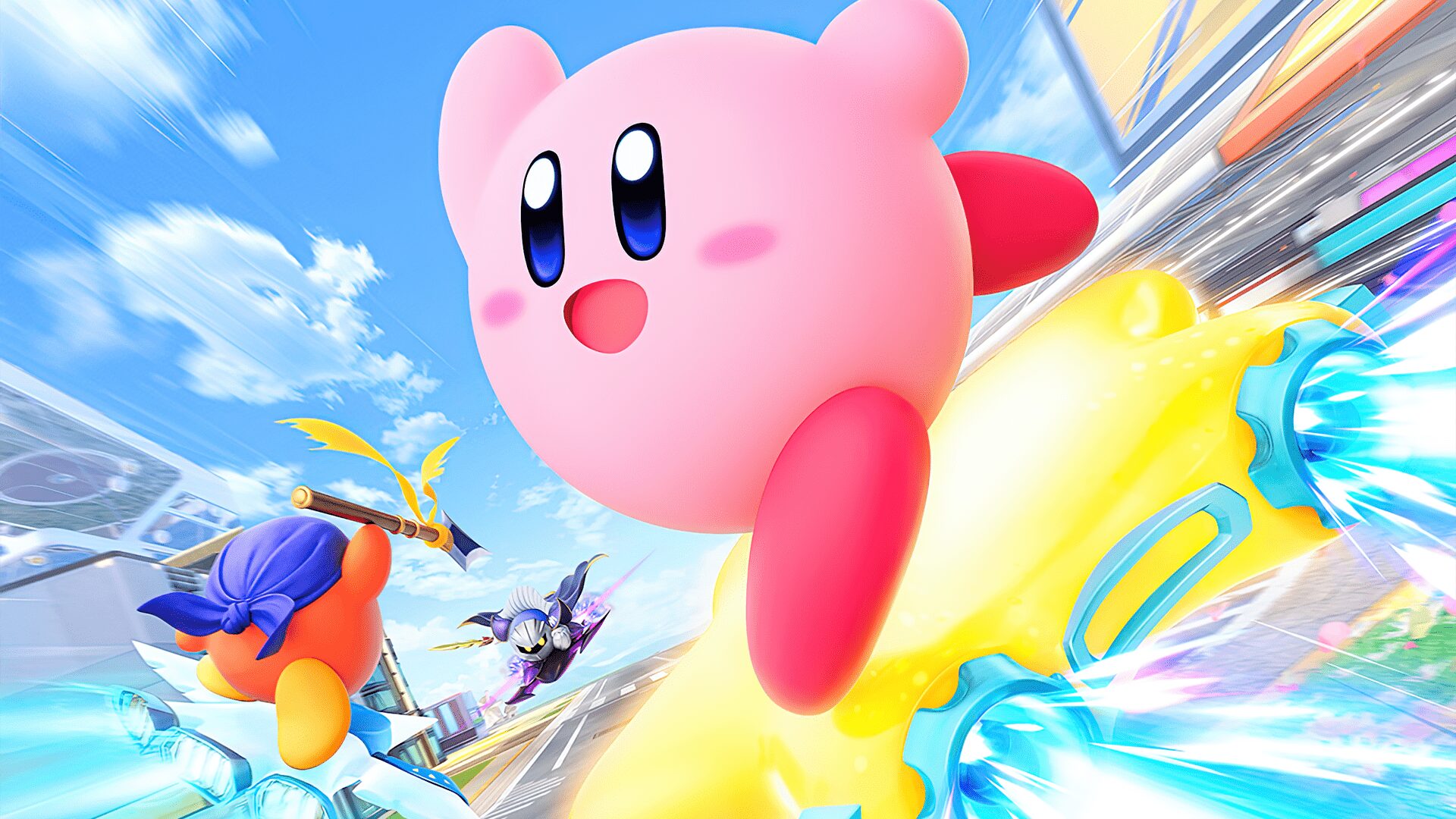


Kirby Air Riders is fun. It’s not any more than that, and it’s clearly filler for Nintendo to pad out the all-important first Christmas for the Switch 2. With Metroid coming soon, Kirby’s there for the younger ones to also have something under the tree. And it’s fun.
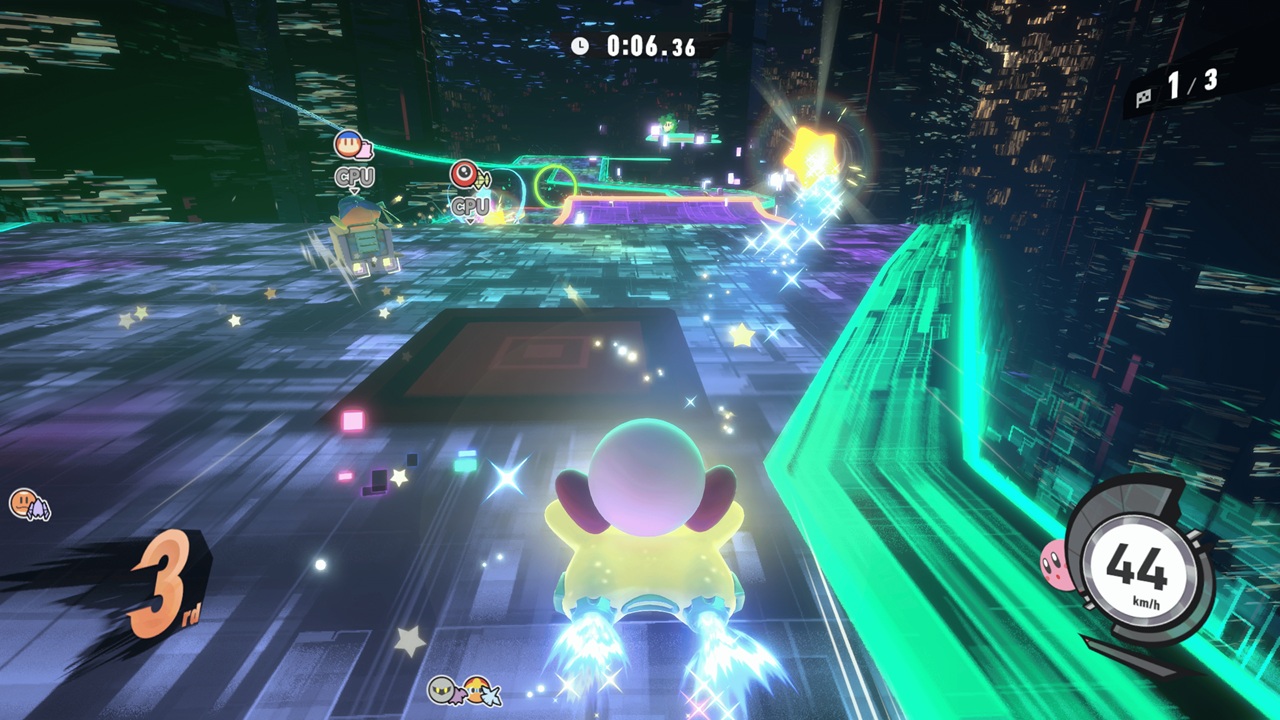
The basic principle of Kirby Air Riders is that it’s an on-rails racing game. Kirby (and pals, as there are 19 other options if you’re not in the mood for pink marshmallow) accelerate all by themselves. Your job is to hit the right racing line and then make good use of the “boost” button, which slows you down while powering up a power bar, with Kirby & pals getting their speed boost for maximum results if you release the power-up buttons just as your racer slows to a stop.
It’s a little challenging to get the rhythm down at first, and I found myself slowing down way too by being overeager with the boost button. Once you start to get the hang of it, however, your racer does move around the track nicely, and you’ll find a surprising amount of depth for a racing game that is, effectively, played with a single button (there is a second button for special abilities, but you won’t be pressing that so often).

Of course, it wouldn’t be a Kirby game without the ability to suck in and fire enemies, or transform into them via the “copy” ability. This effectively replaces the item block system of other racing games, while having the added consideration that the item blocks can also attack you and get in the way. Neat. Though the lower difficulty races are very sedate, Kirby Air Riders is at its best when the fast and almost twitch-like gameplay kicks in.
There’s a good range of gameplay modes and variety beyond that base formula. For solo play, there’s the really quite excellent “Road Trip” mode, where Kirby (and friends) set out on a long journey down a linear road. At various intervals, you’ll have the choice of one of three challenges, which will reward your character with level-ups and additional power that will help you with the eventual races against the bosses.
I came into this game having just finished reading Stephen King’s The Long Walk, and watching the film adaptation of it, and I couldn’t get that headcanon out of my head as I was playing this. It was darkly amusing stuff. But more seriously, this is a good mode that blends in conventional races with all kinds of weird and wonderful minigames, and that really shows off the breadth of what Air Riders offers.
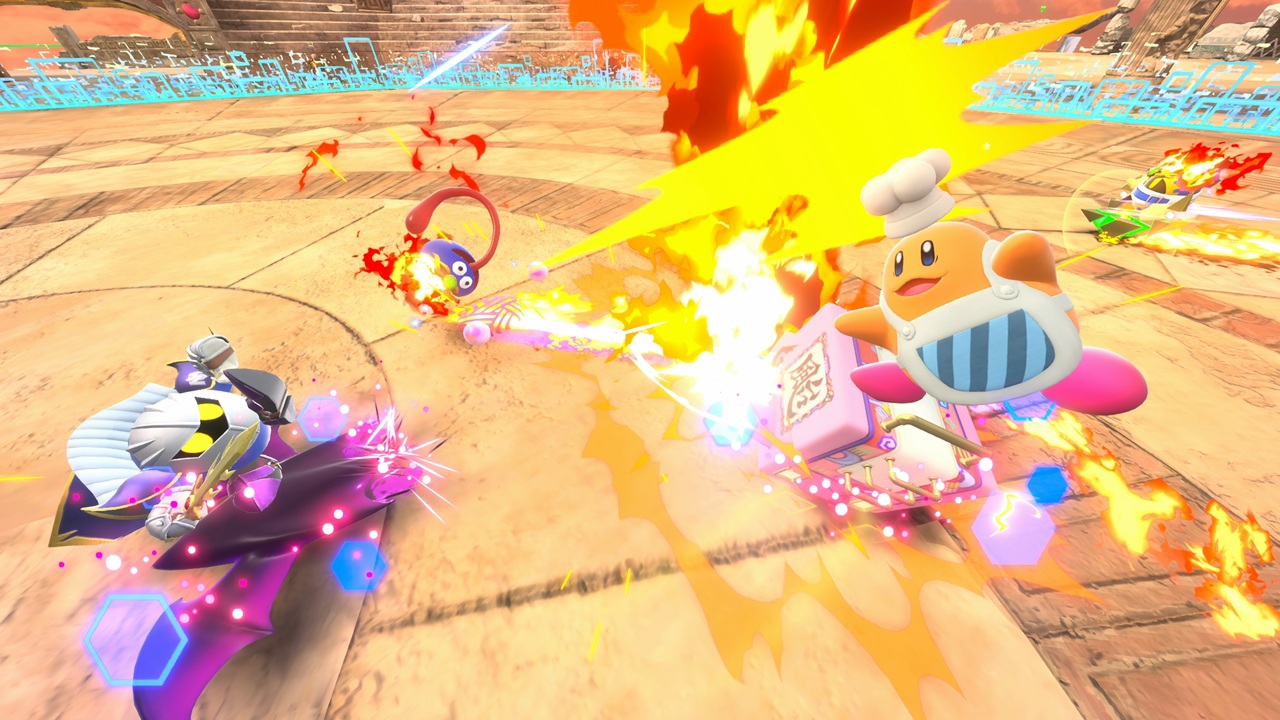
For more retro racing fans, there’s a mini-racing mode which plays from a top-down perspective, like the Super Sprint games of yesteryear. This is hardly a headline mode (and indeed it’s surprising that it’s a main menu item), but it’s an entertaining little minigame that will test your mastery of cornering and boosting in particular. There’s also a City Trial mode, which I think might become the main way to play for most people. In that mode, you start out with a totally underpowered vehicle and need to drive around a thriving city environment to collect powerups for a few minutes before squaring off against everyone for a final race. This mode rewards tactics, as well as those who take the time to really learn and master the maps, and overall has the most depth within the game.
Indeed, it’s that City Trial mode where it becomes most clear that the producer of Kirby Air Riders is the same one as the Smash Bros. series (Masahiro Sakurai). It has that same chaotic energy that practised players will be able to carve their way through comfortably, and a learning curve that heavily weights towards rewarding dedication and training over brute luck or twitch reflexes. The players that do best at it are the ones that can calmly focus on their own play even as everything explodes into bedlam around them, and it’s the perfect application of this game’s limited-by-design gameplay.
Likely the biggest trouble this game is going to have is to convince people that, firstly, it’s not just for the young ones (though they will absolutely enjoy it and be able to play it), and that secondly, it’s not just a second-tier Mario Kart. It doesn’t take long in playing to realise that while there are some superficial similarities in the visual design, this is a game with a style (or really,a series of styles) all of its own.
With that being said, it does start to feel like a project in search of its reason to exist. The City Trial, Long Walk, Kirby Sprint and the standard race are all fine on their own, but they all feel like cutting-room material from other games that were given a Kirby coat of paint to stick into this collection. It’s not the most cohesive or coherent project that Nintendo has worked on, and it does suffer from that “throwing darts and hoping one sticks” approach.
Still, while Kirby Air Riders won’t be remembered in the countdowns of Nintendo’s greatest games, and certainly won’t have the longevity that Sakurai brought to Smash Bros., it’s a fun distraction and the kind of thing that you’ll pick up every six months or so for a quick blast and laugh. And sometimes that’s all a game needs to be.