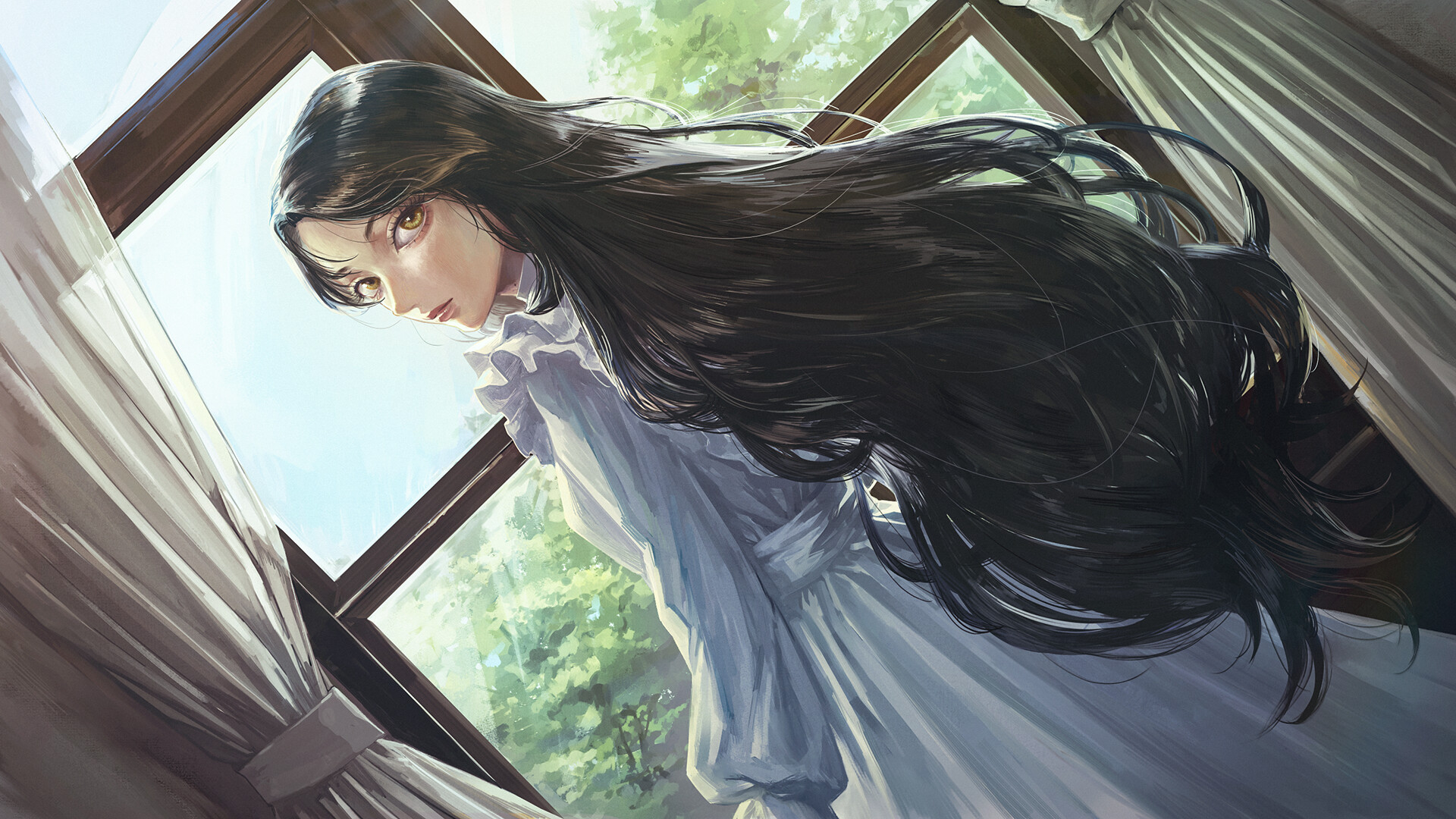


Iwakura Aria caught my attention for several reasons: It’s a MAGES visual novel, and as a big-time fan of Steins;Gate and the rest of that series, I’ll play anything MAGES attaches its name to. Secondly, the project was being compared to The House in Fata Morgana, Raging Loop and Umineko, and as a big-time fan of all those titles, I’d play anything else that plays in the same ballpark. Thirdly, the art is gorgeous. So I went into it expecting a dark mystery, and got that and so much more.
I had no idea that Iwakura Aria was a sapphic romance (i.e. a story about romance between two women), for a start. Far from a sweet story about youthful love, however, this VN has some really dark edges to it. It starts with a young woman from an impoverished family being recruited by an obscenely wealthy widower to be a live-in maid and servant for the man’s doll-like daughter. At first, the daughter is hostile to the new maid, who is absolutely terrified of being fired over it. Enter the first key theme – running underneath so much of Iwakura Aria is a quiet criticism of the power that the wealthy have over those that they exploit. It’s not heavy-handed about this, but it’s very comfortable with the observations that it makes about the excesses and inhumanity of the elite.
The daughter does eventually decide to accept the maid, though, and from here the romance starts to blossom. At the same time, however, right from the outset, there’s a dark mystery to both girls, as well as the father. The story encourages you to let your imagination wander to some truly creepy areas, before the big reveal about halfway through, with the rest of the narrative then dwelling on the fallout and consequences (as well as leading to one of around ten endings).

Obviously, I can’t give any spoilers here, however, I’ll let the Steam content warning speak for itself: “It includes strong language, violence and blood, themes of suicide and self-harm, and sexual content, including reference to sexual violence.” As you can see, the narrative goes to some very dark places indeed. Importantly, however, it’s not gratuitous about it. Iwakura Aria is unashamedly mature and adult, but with a poetic purpose to it.
It’s also written beautifully, though I do wish that I read it in its native language. The localisation is competent, but perhaps a bit hurried and flat as a result. While I don’t have the Japanese original, many of the spoken lines imply a kind of evocative, gothic romantic use of language that the translated script could have perhaps captured with more verve. With that being said, the translation never gets in the way of properly articulating the many high-impact moments throughout the story.
At around 15 hours to play through, Iwakura Aria is one of the few visual novels that I actually felt could have been longer, however. While 15 hours is substantial, this particular story covers a lot of ground and ends up touching on a few of its themes in a too-brief manner to fully explore them to the depth deserved. The top-line story hooks of romance and mystery flow nicely, but Iwakura Aria has such a literary quality to it at times that it’s difficult not to want it to do more as well. I know I’m being vague here, but again, I want to avoid spoilers, which start coming in within the first few hours after the set-up. What’s disappointing about this narrative isn’t the quality of the writing. Quite the opposite. The people who wrote this are clearly capable of weaving a story that hits both intellectual and emotional beats, and it would have been good to see them do more of the former. You’ll still be left pensive after playing Iwakura Aria, but you’ll also be left wondering what else it could have to say.
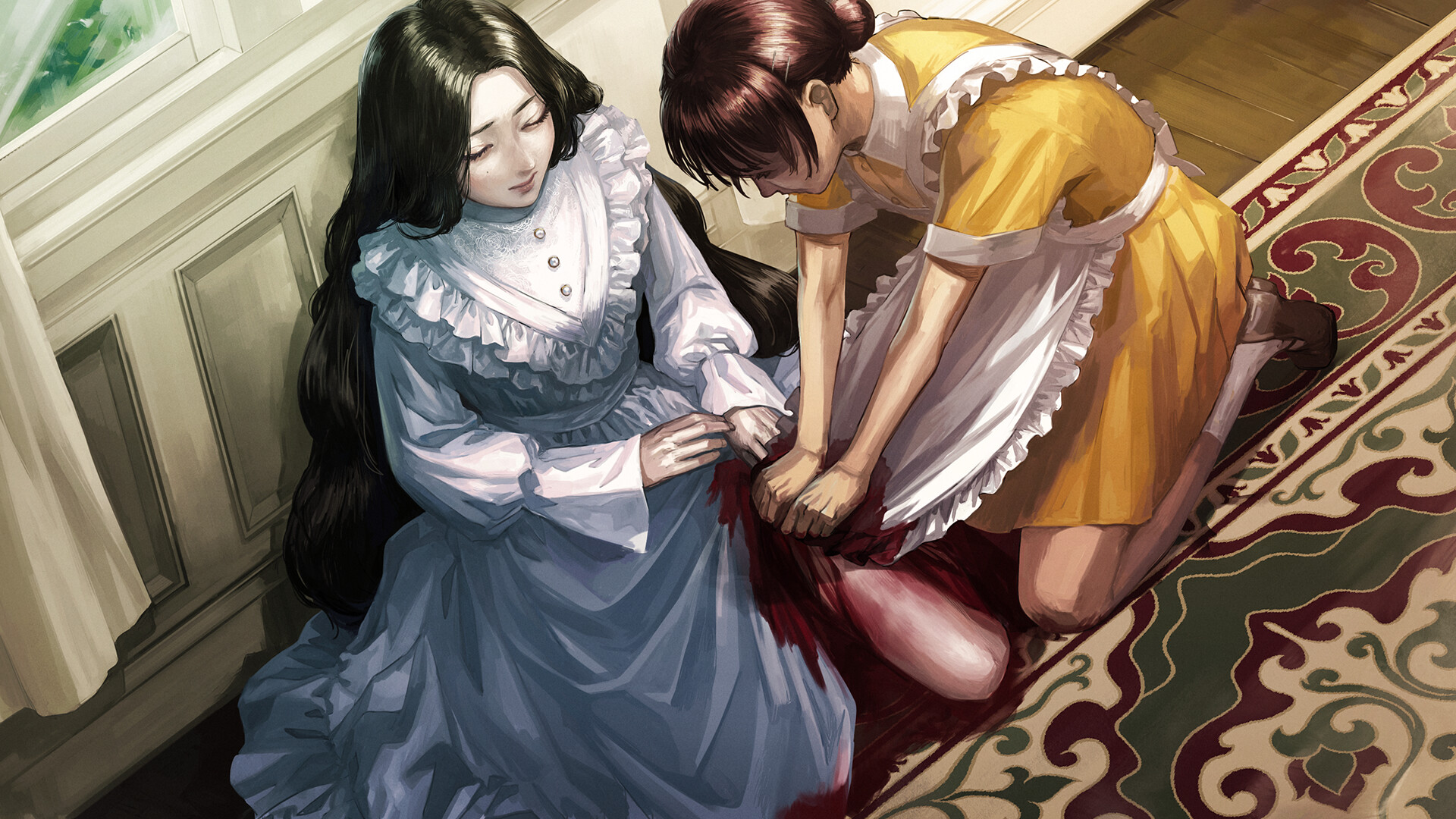
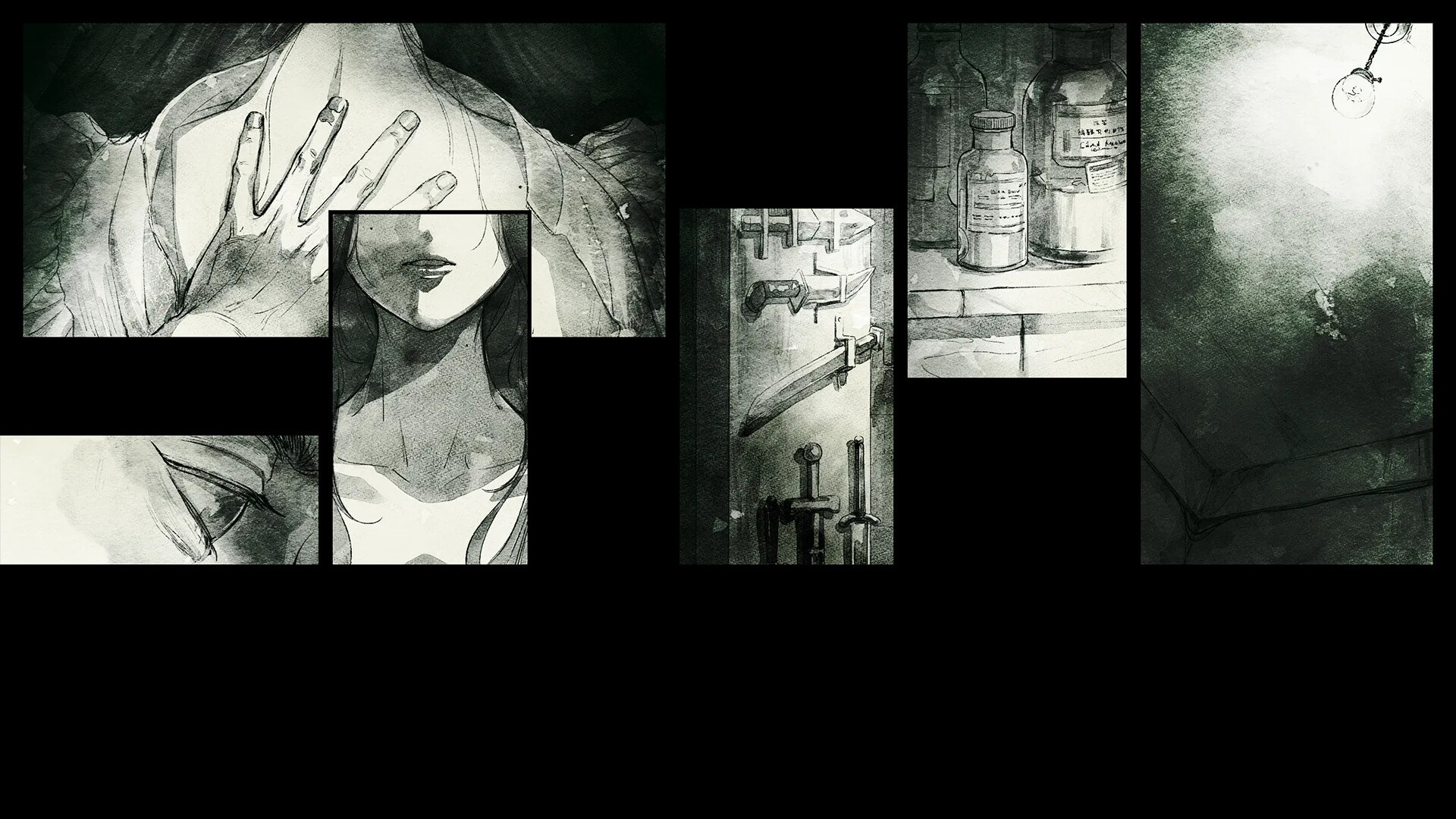
It is possible that Iwakura Aria was developed a little too quickly on too thin a budget for us to have the full creative vision of writer, Gogo Nemuru, however. The biggest hint here is the art. There are only four characters that are given sprites to visualise them, despite there being several more characters that play enough of a role that the lack of a visual depiction is jarring. Meanwhile, while there are several CG art pieces (and they are gorgeous when they show up), the developer also opted for a series of manga-style black-and-white panels to depict many critical moments in the story. While these are nicely drawn in their own right, they do lack for the breathtaking beauty of the CGs and sprites, and were clearly done far more quickly. Perhaps the developer would defend this “panel approach” as a way of depicting the game’s more extreme moments in a way that a single CG would struggle to, but my sense is this came down to budget.
The other big missed opportunity is in the map system. Periodically, you’ll be presented with a map of one of the floors of the mansion that the story is set in. There, you can select which rooms you’d like to visit. Several of the rooms will be marked in red, and you’re required to visit those to progress the narrative. Other rooms are not marked and optional, but visiting them will generally provide you with a few more sentences of detail or a chance “bonus” encounter with a character.
The developers could have done so much with this system. Given players some mysteries to piece together for themselves. Introduced side stories to run in parallel with the main plot. Added puzzles or unlockables or some other reason to properly explore – or alternatively perhaps even punished players for being nosey. This could have very easily been a memorable gameplay mechanic, but instead, perhaps again because of budgetary limitations, it ends up just sitting there, barely utilised.
All of this might sound critical of Iwakura Aria, and I guess in one way I am disappointed in this, but only because it could have very easily been another House in Fata Morgana. The intensity of the themes are there. The art is right up there with the best VN art I’ve ever had the pleasure to see. The writing is beautifully eloquent, and this is a rare visual novel that I would happily pick up as a proper novel, where it would stand strong on any bookshop’s shelves against any of the literature on there. Even as it is, Iwakura Aria is better than 99% of the other visual novels out there. It’s essential as-is, and right on the cusp of being a masterpiece, and that’s ultimately why I’m disappointed that it doesn’t quite get there.