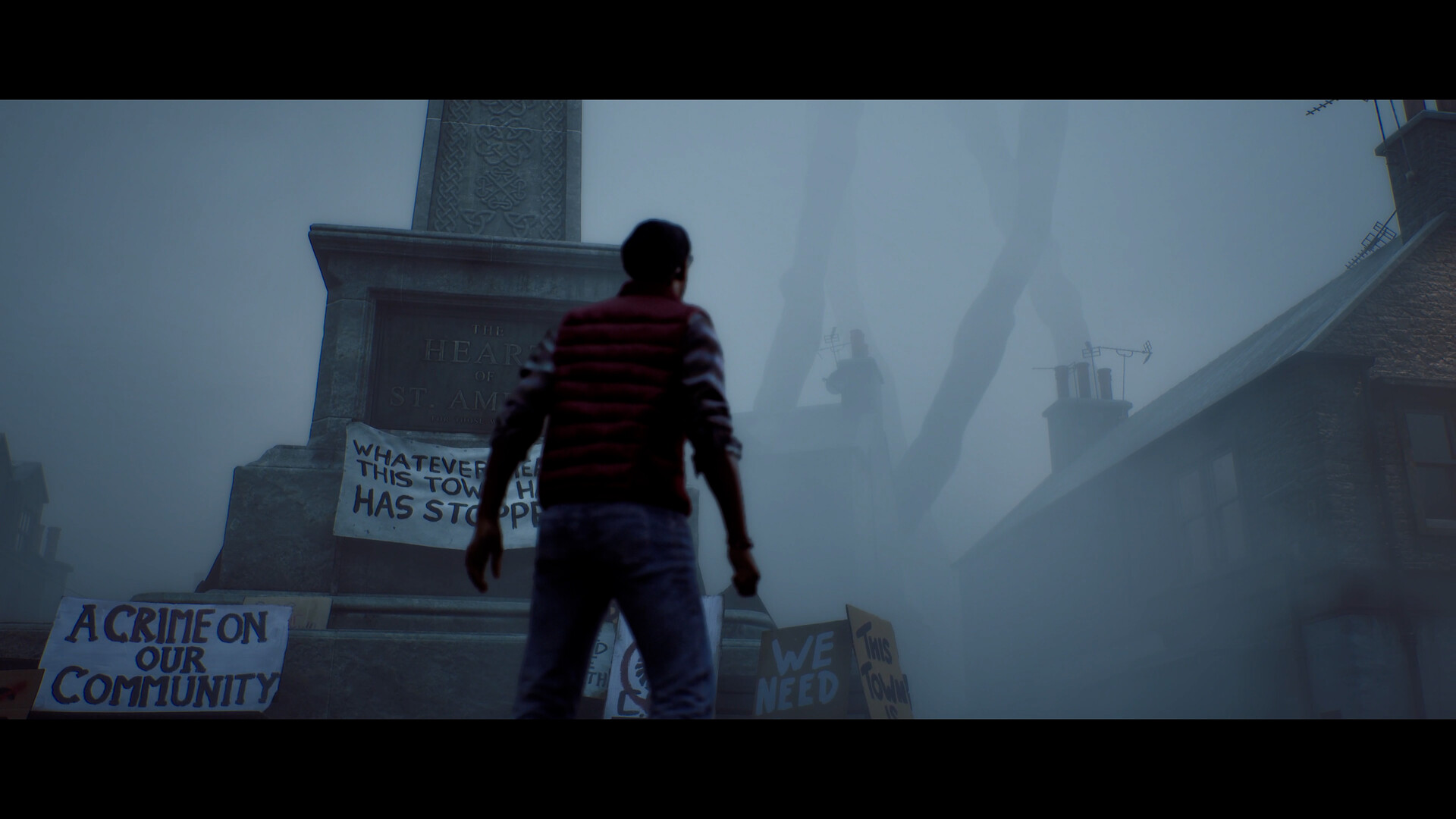


The smartest decision they made in Silent Hill: Townfall was to have it play out in first person, something that the series doesn’t typically do. But a first-person perspective makes the horror more immediate, direct and, ultimately, intense. Townfall is downright visceral in its horror atmosphere trappings, which is just as well because in other ways doesn’t quite live up to the standards for the series.
Without beating around the bush, after Silent Hill 2 Remake reminded us of what an intelligent horror story was, and Silent Hill f achieved layer after layer of psychological depth in its script, Silent Hill: Townfall reverts to a more straightforward, surface-level style of storytelling. Oh, it has its twists and turns, of course. You play as a guy that washes up in the fog-enshrouded St. Amelia, not really understanding what’s going on, but being led on by a guy named “Richard.” You need to explore the town and piece together what happened, both to it, and to you, and as you can expect that setup allows for plenty of surprises and revelations. Enough of them that a review can’t fully explore the plot without people getting furious about “spoilers”. That is, of course, modern video game “best practice” storytelling. Give them a well-performed protagonist (or protagonists, in this case, as the game jumps between a few different perspectives) with an emotional hook, and then keep the audience guessing about what will happen next, and as long as the “twists” are entertaining and set up the next twist, you’ll get a positive write-up for the quality of your story.
Dig beneath that surface, and you’ve got a familiar set of Silent Hill tropes – the characters are wracked with guilt – and there’s a wet tissue commentary about the potential for capitalism to corrupt and destroy at the heart of the tragedy that has dragged the town of St. Amelia into the Silent Hill purgatory. And, like, yeah. In 2026, with all those AI datacentres going up, that is, technically, a good point to make. It’s also just such a basic truth at this point that the observation comes across as very mundane.

To be clear, I do think Townfall has a good story. The characters are painted vividly, the performances are emotionally engaging, and the twists and turns did have me pushing through the terror. The atmosphere and setting are exceptional. It is fundamentally well-written by people who really understand the craft of storytelling.
But I also remember that back in my university days, half my new media class in literature studies wrote essays on the trauma, psychosexual themes, and existentialism of, specifically, Silent Hill 2. That game is downright literary, and with its philosophical depth, it really held itself with gravitas as not just a story, but also a narrative. I can see Silent Hill f getting the same treatment in the decades to come, but I can’t see Townfall quite getting there. I could be wrong, but “corporations are forces for dehumanisation,” and “the tension between acceptance and a desire for change” don’t quite inspire the same “these are deep insights, maaaaaan” response.
Like with all other Silent Hill games, the monsters of Silent Hill: Townfall represent the fears and guilt of the protagonists. What I did like about Townfall is that the developers really doubled down on the idea that they’re not really there to be fought so much as survived. As a series, Silent Hill has always had a love-hate relationship with combat, and that manifests in Townfall as a game that weighs more towards stealth, wherever it can. You do acquire a couple of weapons, but ammo is truly scarce, and the combat is never that satisfying in the first place, which I suspect is by design. Instead, you’re guided to make use of a portable television, which works as a kind of radar for letting you know where the enemy monsters are, and track how they’re moving. Then you need to creep your way around them. This portable TV doesn’t do a great job of showing the environment around the monsters, but rather just showing the blip on the radar and helping you locate the direction it has come in from.
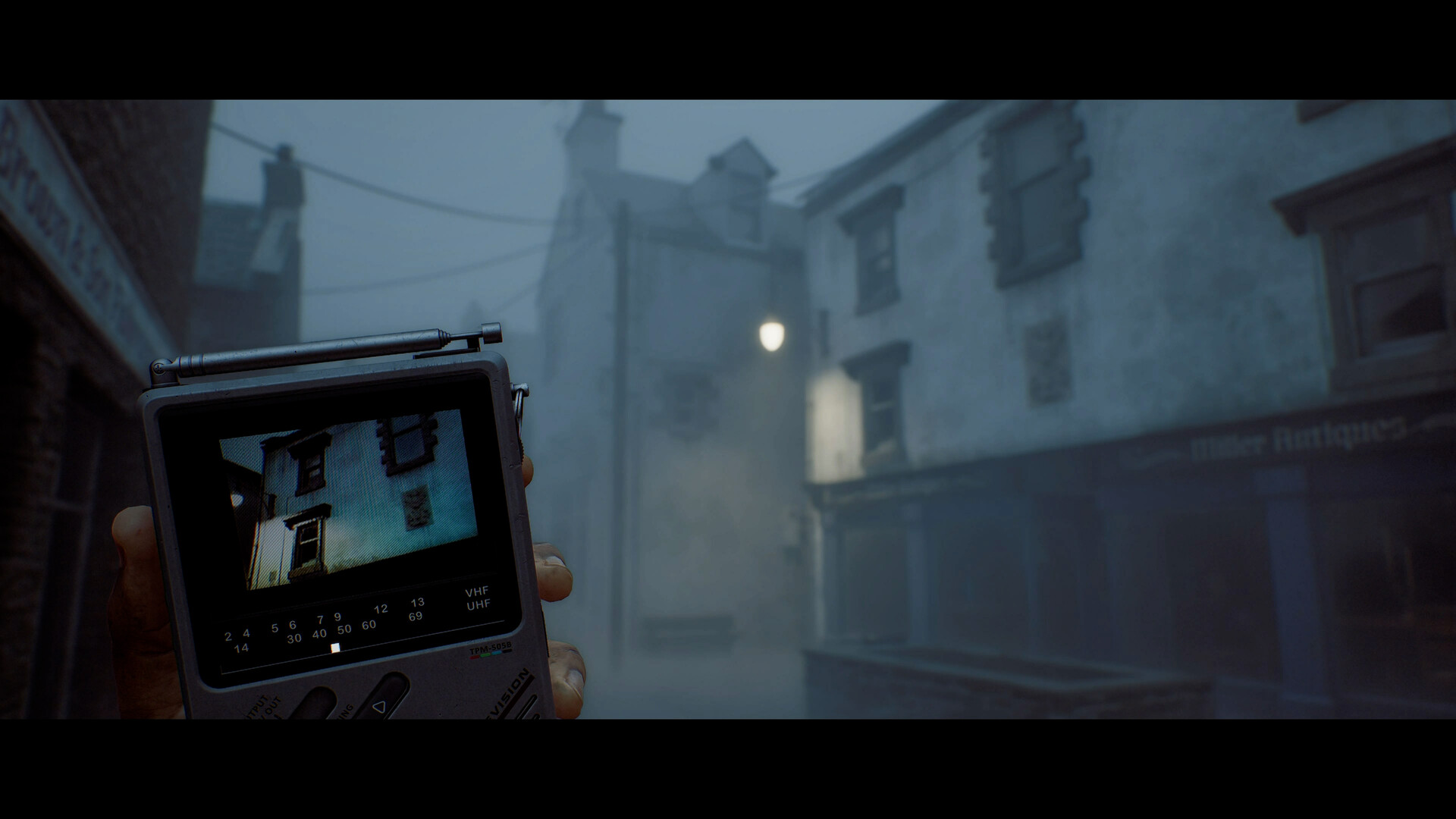
In the interest of transparency: I’m not a fan of stealth gameplay. I see its value in Townfall, and do think it’s generally well designed to suit the game’s mood and ambience. I’m just not a fan of the pacing of stealth-focused gameplay, or the fact that I’m bad at stealth mechanics and therefore have to restart sections too often). Those moments where you do get to do some fighting (including one section where the game developers decided to have fun and let Townfall be, briefly, an outright action game) demonstrate that the game could have too easily become an inferior pastiche of the first-person Resident Evil titles, so bravo to the developers for mostly side-stepping that, too.
What I found really elevated Townfall, and made it an utterly compelling, intense experience, is actually the soundscape. Like all Silent Hill titles, the game loves to embrace the industrial aesthetic for its most horrific moments, and the sheer unease of everything that you’ll hear then deserves awards for being truly visionary. But Townfall’s soundscape also thrives in the moments of stillness, where you’re drawn to really hear, and pay attention to, every individual sound with such pristine clarity that it will feel portentous. This is especially true of the puzzles. Just like all Silent Hill titles, Townfall loves its puzzles, and while they’re not necessarily auditory in nature, the soundscape really lends them context that makes them feel properly part of the experience. This is an enormously positive contrast to Silent Hill f where the puzzles sometimes felt disconnected to the rest of the game, and arbitrarily added because the series required puzzles. The atmosphere provided by Townfall’s soundscape never lets you step out of the setting while working on those puzzles. We all love to say that a good horror game should be played in the darkness with the best set of headphones you can get your hands on. Townfall, through its truly masterful use of ambience, sets the new standard for that throwaway statement.
So if we consider that the last couple of years has given us an informal Silent Hill “trilogy” with the remake of 2, Silent Hill f, and now Silent Hill: Townfall, it’s fair to say that in some ways Townfall is the most limited of the three. But you could argue that in other, important ways it’s the most well-produced and experimental, too. A few times in the past, Konami has tapped Western developers to build on the Silent Hill franchise with a new entry (as opposed to a remake or re-envisioning). I would argue that Townfall is the first time a Western developer has at least equalled the efforts that have come out of Asia.