

Ace Combat 8: Wings of Theve offers 30-odd missions of explosive aerial acrobatics that you won’t soon forget about. Bandai Namco has, over so many years and titles now, achieved something really rare for this particular genre: action that doesn’t feel like it’s condescending towards the players with overly simplistic “arcade” action, but at the same time sidestepping the risk of overwhelming them.
Because military flight combat games do have the potential to be really overwhelming. Fighter jets are complex machines, and when you combine the way that they move in the sky with issues such as the need to aim the guns well ahead of the target (because fighter planes move so quickly that you need to aim for where they’ll be a few moments after firing), mastering them takes a lot of practice. Serious simulations of fighter jets can be enormously rewarding when you do master them, but very few people would have the patience for that.
Ace Combat 8 straddles the middle ground. The default control scheme allows you to move around the skies with straightforward pushes of the control stick. But of course once battle is joined you’ll need to find ways to manoeuvre around, avoiding and dodging enemy missiles while getting your own hits in. Then there’s an advanced control system for people that watch to challenge themselves with yaw and other more technical elements to fighter flight. Either way, you’re not going to have to learn a 100-page manual (as I’ve seen in more than a few realistic flight simulators, but the action also feels more authentic to real-world physics and dogfighting than, say, Star Fox.

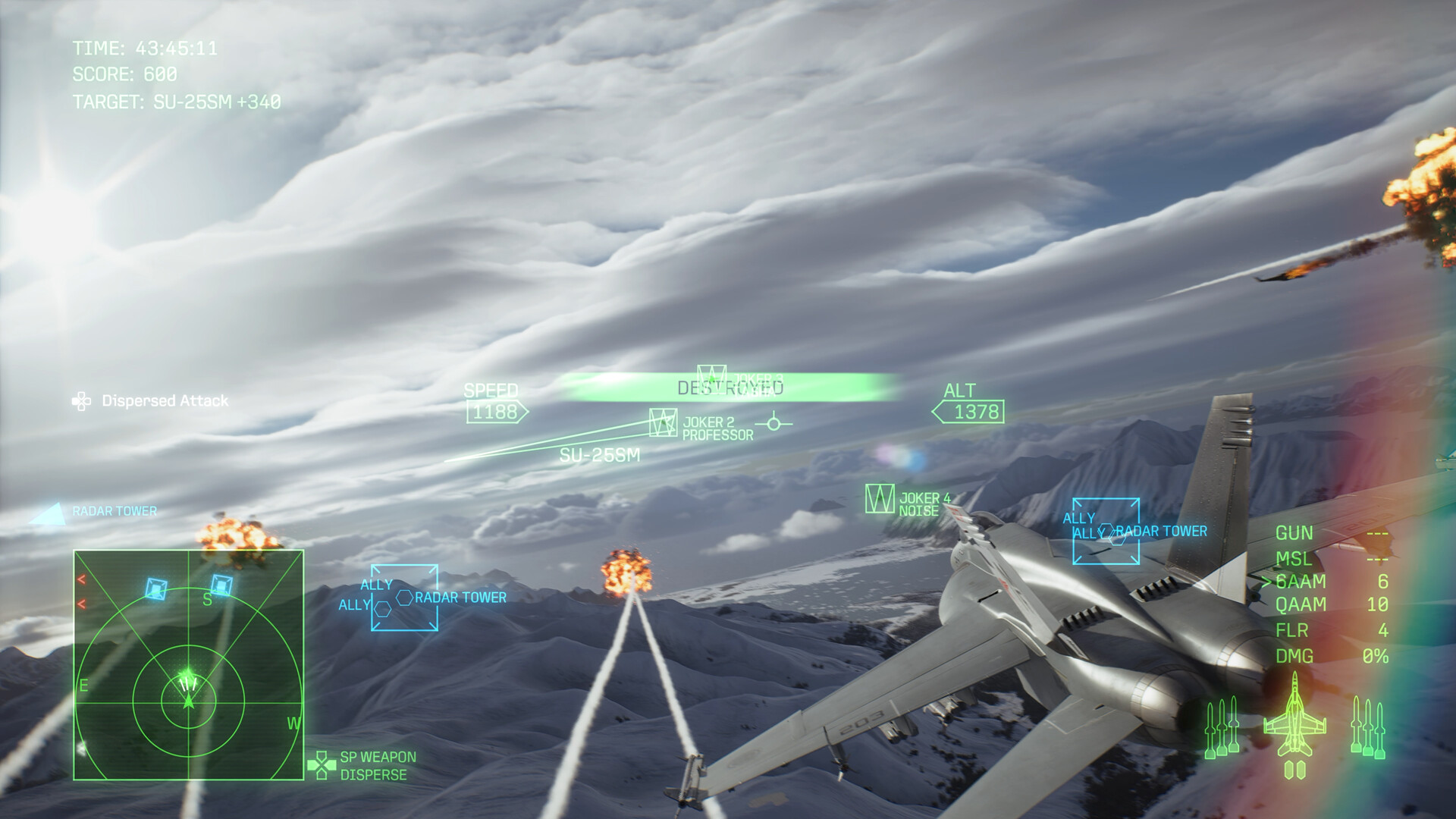
Your guns are only going to be minimally valuable, as it really is difficult to line up enemy planes to take them down that way (though it’s the kind of challenge that the really hardcore fans will embrace). For most of us, it’s making good use of the missiles that will be key to success, and that means taking the right missiles into combat, locking onto the enemies effectively, and then letting loose. Once missiles from both sides start flying around, the entire Ace Combat experience becomes a whirling maelstrom of explosions, rapid-fire radio chatter, and swirling, undulating movement.
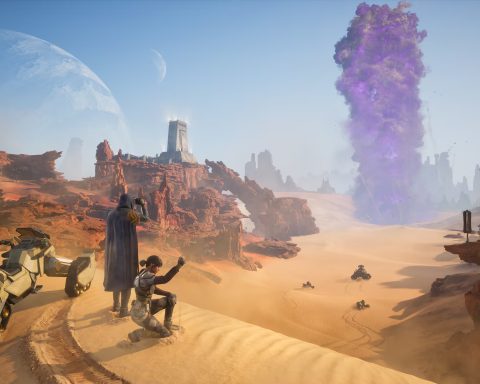
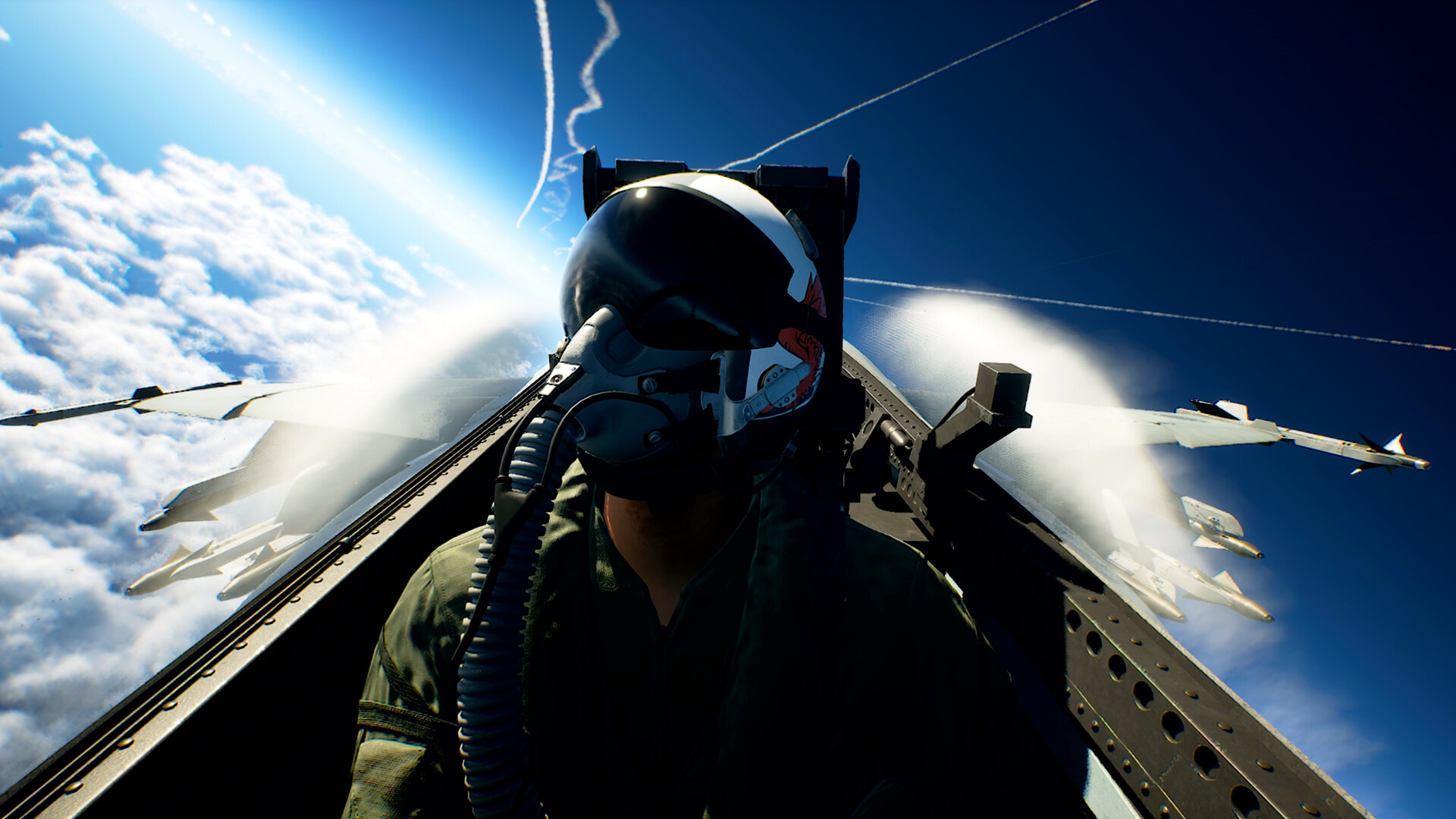
This is helped by some truly spectacular art direction. The level of detail on the planes is incredible, and while you might not think that the skies are a particularly interesting setting for flight simulators, you fly through a storming cloud, and your plane shakes from the intense change in air pressure as your plane’s windows get covered in moisture. And then you emerge from the cloud to see a grand landscape sweeping out in front of you. Diving down to get a close look at ships and ground forces, you then attack enemy planes from below (while watching out that you don’t accidentally stall out the engine). This is what a Top Gun game would feel like to play.
Minus the terrible politics of Top Gun… and it makes a point of that. Perhaps the most impressive thing about Ace Combat is its willingness to take a serious look at how the stories of war are told, and particularly how propaganda is used to manufacture consent among the population for that war. There’s the usual camaraderie between soldiers present, particularly in the banter before and after combat breaks out, and Ace Combat isn’t willing to be quite as scathing as, say, Spec Ops: The Line, but I appreciate any war game story that’s willing to be self-aware of how war stories are told, given that the world is currently suffering through yet another manifestation of domestic nationalistic jingoism being exploited in the no longer subtle promotion of the very fascist principle of manifest destiny. The Japanese do know how this propaganda works. It would behove certain groups in Western culture to listen to them.
Ace Combat takes place in a fictional universe with fictional nations, and just enough layers of abstraction and allegory that those so inclined can put their fingers in their ears and pretend they’re not being asked to think for a moment about anything important. For the rest of us, Ace Combat isn’t much more subtle than Starship Troopers (the film) in the way it tells the story of a protagonist being forced to act in the role of a symbol – the Wings of Theve – to conduct heroic exploits and maintain morale back at home. But then perhaps we’re in an era of such disinformation and a tech-driven dark ages that subtle is no longer going to cut it. In short, we need more media willing to be critical of things that have become far too easy for states and information sources to fabricate, even if it is hitting us over the head with a sledgehammer rather than letting us figure out the message for ourselves.
With 30 missions to play through (around 15 or so hours itself), that additional difficulty setting and the potential for online multiplayer to drag even more out of you, Ace Combat 8 is somewhat surprising in the sense that I didn’t necessarily expect it to be a “AAA” game, but the only thing that distinguishes most blockbusters from this one is that the developers don’t assume their players are total idiots.
Most importantly of all, there’s always an assumption with flight combat games that you’re in for something pretty inaccessible. Either it’ll be an arcade game that will require twitch reflexes to be enjoyable on any level, or it’ll be something that may as well be a training simulation for the real air force for what it demands you learn. Ace Combat is not like that at all. It can certainly be challenging, but it is also clearly aware that, with its production values, it may well be the first dogfighting simulation for many players, and it does a brilliant job of giving them a game they can love.