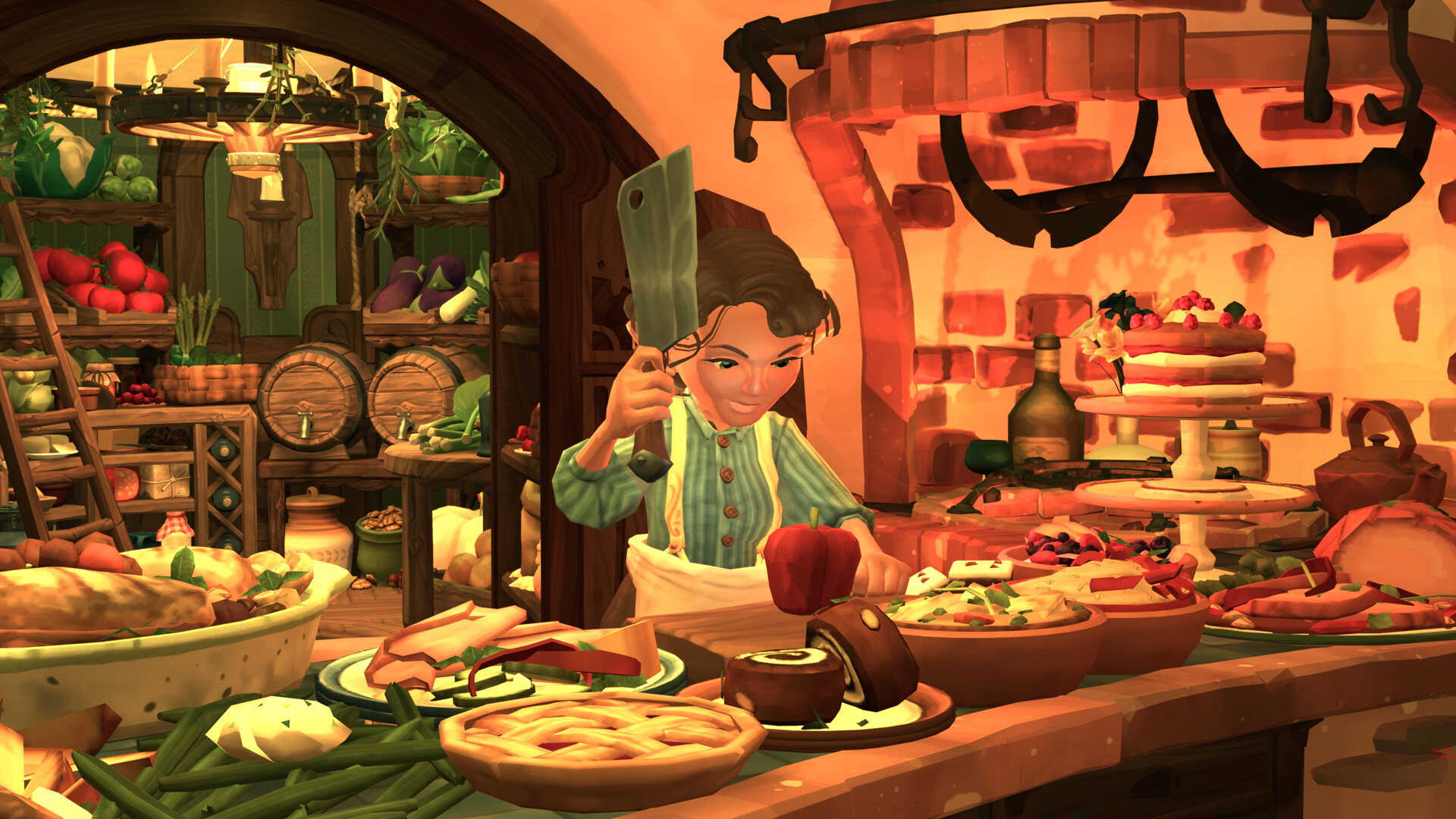


One of the things about J. R. R. Tolkien’s vision of Middle-Earth that people often overlook is that he was seeking to create an entire history, right down to forgotten lore and evolving cultures, languages, storytelling traditions, and legends. We often forget that to instead fixate on the fantasy adventure and wars that were at the centre of his major novels, and I suppose that does make sense, given that this is where all the excitement is at. And indeed, real history does more or less mirror that too. We tend to overlook all the cultural development of the Romans because the political conflict and expansion of the empire tell a more exciting story. The point is, though, that Tales of the Shire: A The Lord of the Rings Game is actually a brilliant idea, because it gives us a rare opportunity to see Tolkien’s vision separated from the violence and conflict.
Unfortunately, it also largely fails.
The premise of the game is something akin to a Story of Seasons title. You play as a hobbit, newly arrived in a tiny little village, and your job is to make friends and help to grow the village as a community. You’ll do that by doing a bit of light farming and fishing, helping locals out with their little day-to-day concerns, and also cooking. You’re a hobbit, so you’re going to be doing a lot of cooking.

The idea is sound, and initial impressions are pretty solid. The art direction is charming, and very appropriate to the pastoral ideal of hobbits. Tolkien’s work is so often associated with a very dark kind of fantasy, it’s nice to see a more twee interpretation of it. Impressively, it does still feel very Tolkienesque, and you can easily get a sense that the developers cared about the authenticity of the project.
There’s also some initial joy in meeting the various inhabitants of this little village. They range from the friendly to crotchety, the innocent to the dodgy. I’ve always been intrigued by Tolkien’s vivid yet (relatively) brief descriptions of the lives of hobbits and their towns and territories, and in those initial few hours, it really seemed like the developers were going to build on this.
Then the monotony hits, and you realise that that initial setup is really all you get for the entire game. Characters end up being little more than breadcrumb-style quest givers, forcing you to constantly wander all around the environment to complete their little tasks, and are never really developed beyond a caricature that can be described in a sentence. Those quests are almost universally fetch-quest busywork, as though the developers had no idea what else to do without combat breaking up the boredom. The fishing minigame gets dull after about three casts of the line, and the farming mechanics somehow have even less depth than in the Story of Seasons series. You can also decorate your little home, but that’s only ever a very distant pastiche of the delightful way you could horde stuff in Animal Crossing.

The only bright spot is the cooking minigame. It’s not that the cooking itself is particularly engaging – whether it’s the alchemy of Atelier or even the very niche Fate/Stay Night spinoff visual novel with a cooking mechanic, we’ve seen better than what Tales of the Shire has to offer. However, there is something appealing about the massive catalogue of recipes you will eventually end up with, and the way that you can use various cooking techniques, items, seasonings and ingredients to tailor the dish. You’ll need to do that because you’ll also be inviting other hobbits from town to your place for feasts, and each hobbit has their own flavour and dish preferences. If they like it, your relationship with that hobbit will grow more quickly. Given that Tolkien went to great lengths to describe how important food culture was to the hobbits, this mechanic is both enjoyable as a gameplay feature and thematically spot-on. Once again, however questionable the game itself is, the developers clearly cared about authenticity.
The other big problem with Tales of the Shire is that the game world never really feels like a space to inhabit. Where Animal Crossing or Story of Seasons titles are brimming with colourful charm and it can be cathartic just spending a couple of in-game days wandering around, watching the virtual world go by, Tales of the Shire comes across as being devoid of interest. It’s pretty, but uninteresting. Even now, sitting to write the review having just put the console down, I’m struggling to think of any part of the world that delighted me, or that I’ll remember once I put the game down.
Part of the problem is likely that I’ve been playing it in handheld mode, and the Switch 2’s screen just isn’t up to what the engine wants to display. Where an Animal Crossing or Story of Seasons uses a limited level of detail to instead focus on bold colours and clean lines, Tales of the Shire has a lot more detail going for it, and a lot of that gets lost and blurred together on the smaller screen. I’m not sure I’d find the visual construction of the game to be ideal in docked mode either, as I suspect the pop-in would become disruptive on a larger screen, but the art style was definitely designed around a bigger screen than the Switch 2’s.

Tales of the Shire: A The Lord of the Rings Game is such a great idea, but it becomes way too apparent, far too quickly, that the developers either didn’t have the budget to fully explore their idea, or simply had no idea how to turn the great idea into a compelling game. It’ll leave such a warm impression on you, but once that’s worn off, the game sours more quickly than a poorly cooked rhubarb pie. Hobbits like that for some reason. I do not.