

“If a little is good, more must be better.” That’s how the saying goes, right? That certainly seems to be the approach that the developers have taken with Hatsune Miku Logic Paint S+, in that they’ve taken the previous quality take on the Picross formula (itself an already big game), and added so much more to it. A ridiculous amount more.
While that popular saying is actually a fallacy (after all, a pinch of salt being a good addition of flavour doesn’t mean a bucket load will be), in this case, it does pan out. This is a ridiculously big package made with a lot of heart and love for Miku and her Vocaloid pals.
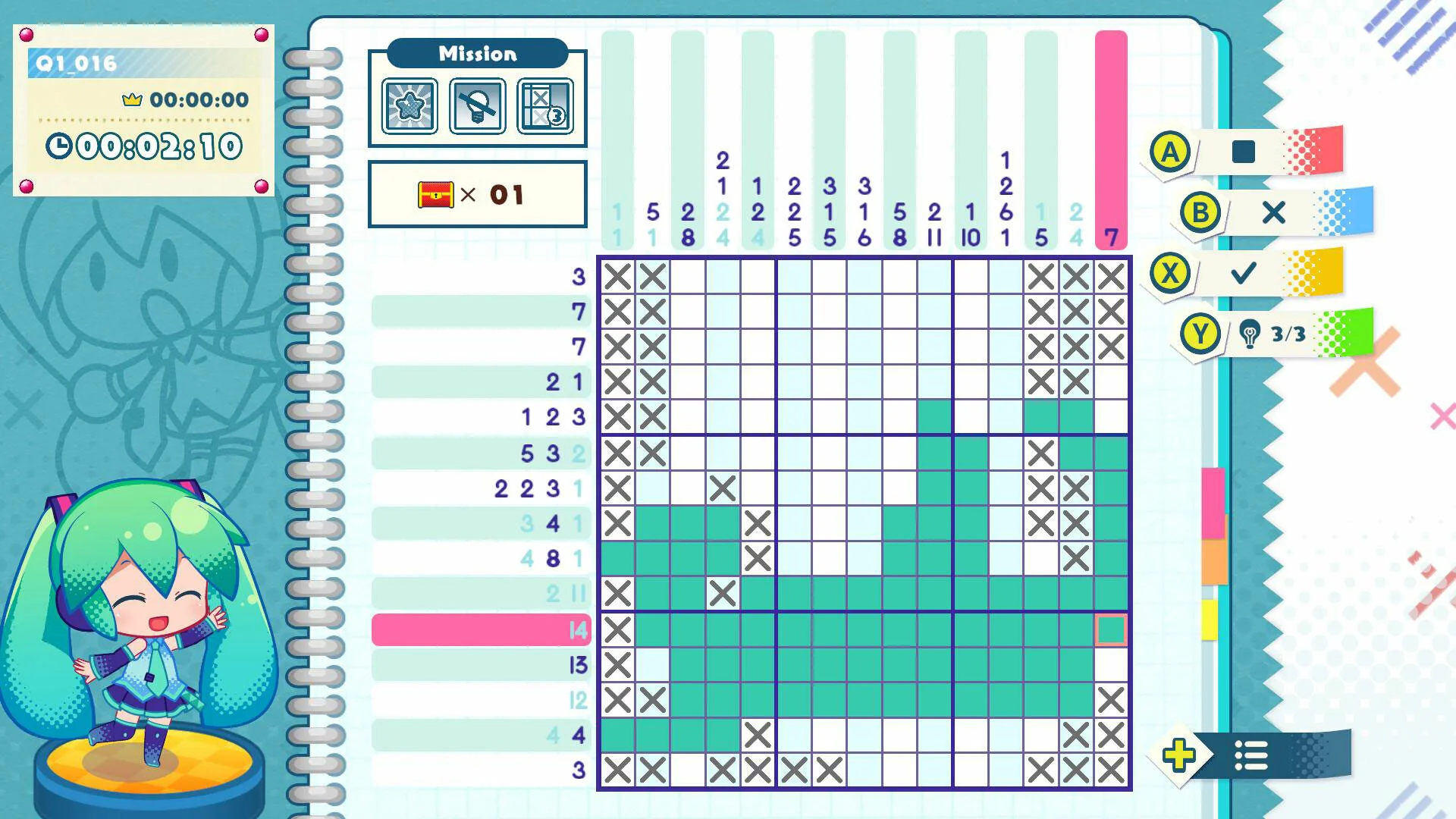
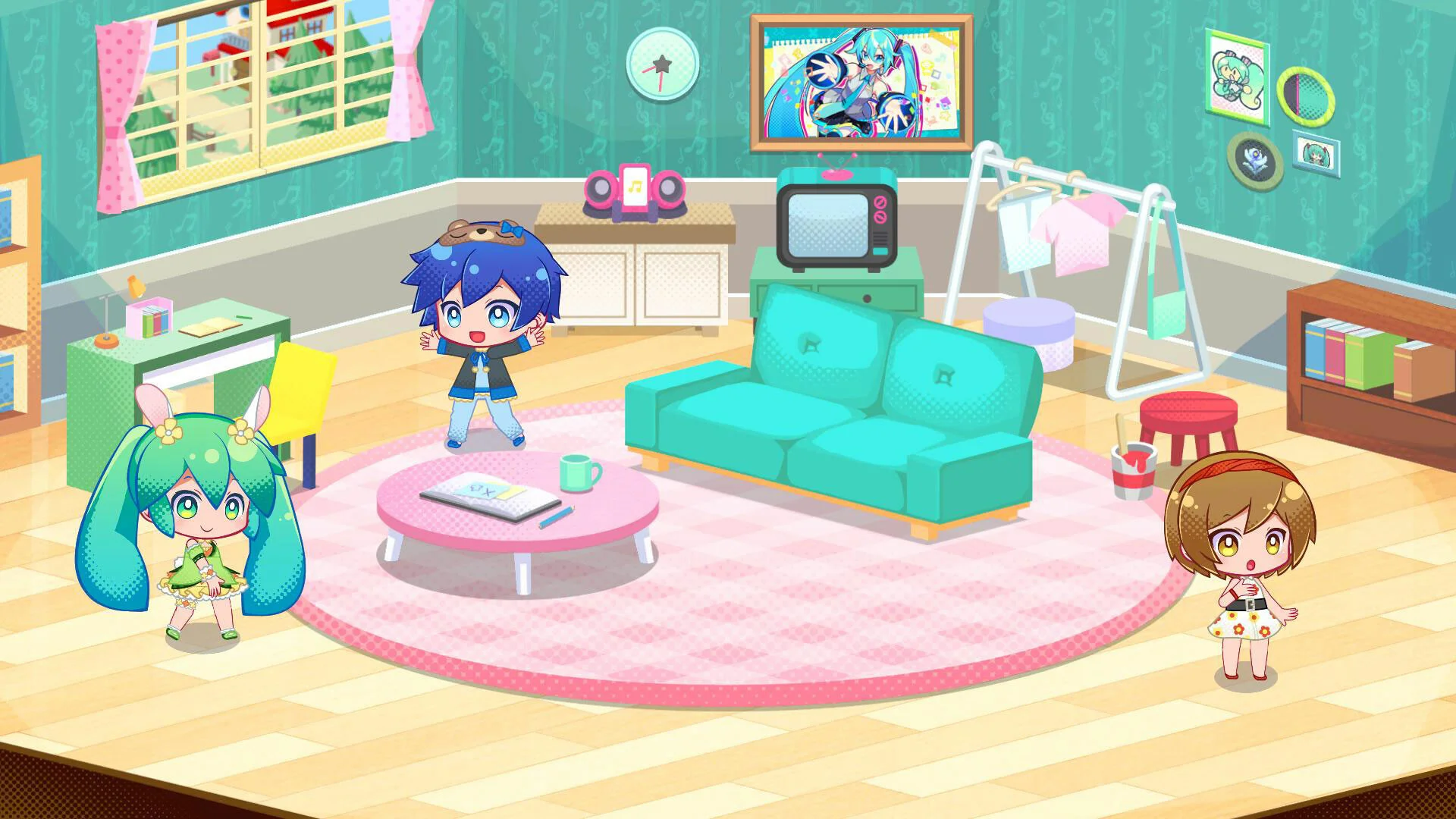
There are more than 1,000 puzzles in it, for a start. No, that is not a typo. Puzzles go all the way from 10×10 to 100×100, and as you complete puzzles, you earn a veritable deluge of unlockable stuff, with everything from new costumes right through to music and room decorations (rather than a conventional menu, you select puzzles and options from a “room hub” that all the characters are hanging around in). Otherwise, however, it plays out just like the previous Miku Logic Paint S, so because I’m lazy (actually very sick with a migraine), here’s what I wrote about it:

The number of puzzles in this package is obscene. Furthermore, rather than just relying on standard nonogram play, the developers have even come up with a neat way to expand on the basic idea of filling in puzzles to complete a picture. In Logic Paint S there’s a special “giant picture” mode, where you need to complete a grid of 5 x 5 (so, 25 total) separate nonograms to complete one giant picture. MikuLogi on the iPhone had a tiny few of those, but here there are nine individual sets, each with 25 puzzles alone, and completing each and every one of those is a joy. A little like a jigsaw puzzle becomes cathartic as the picture starts to take form, really.
Overall mileage will naturally depend on how quickly you can solve puzzles. The first dozen or so are mindlessly easy and can be solved in seconds, but the more complex puzzles should challenge even veterans. If you assume a 10-15 minute average for the majority of them, overall, then completing all of these puzzles will take you something like 200 hours. There won’t be much to do once you’ve finished that final puzzle, but if you’re baulking at 200 hours of top-quality puzzling, then your expectations for video games are seriously skewed.
More than the quality of the puzzling and the presentation, however, the thing I love most about Logic Paint S is how effectively it plays into the grand communal experiment that is Hatsune Miku. Crypton has always been careful to make it clear that a “canon” Miku doesn’t really exist. The community defines her. Beyond that, Crypton actively works with a wide range of artists, musicians, and creators to produce Miku stuff, and you see that play out as you complete puzzles and unlock elements in the gallery. There’s no consistency in the art, because the artists aren’t working to a brief. They’re creating their personal vision of Miku, and Crypton embraces and supports that. It’s the most feel-good use of intellectual property that we’ve ever seen come out of Japan, and because of it, Hatsune Miku is arguably the largest community-driven art project in history.
Really, the question of whether this game is going to be worthwhile to you is ridiculously simple: Do you enjoy nonograms? If you do, then you don’t really need to be a Miku fan to get value out of this. You’re getting 1000 puzzles, and most of them are very well-designed nonograms. That is, by default incredible value. If you don’t like nonograms, then… well, I just don’t know you.