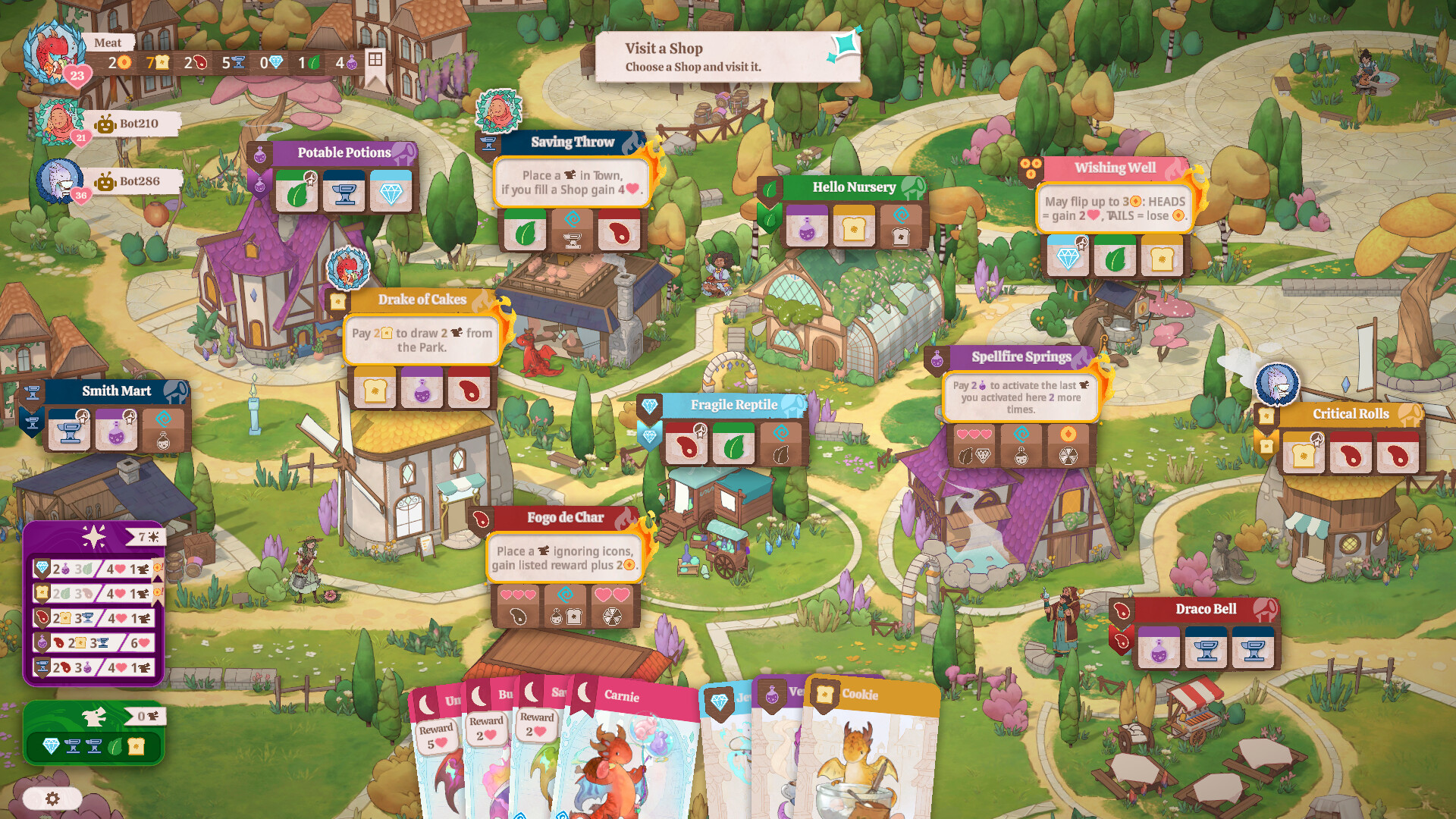


Monster Couch developed the digital adaptation of Wingspan, a game that I’ve spent more than 1000 hours playing at this point. So I was naturally interested in seeing what the team could do with Flamecraft, another digital board game adaptation and remarkably similar to Wingspan in that it’s a relatively light and breezy game, designed to be as open and welcoming to players of all levels of board game skill as possible. I was not disappointed.
Flamecraft is wholesome and cozy, and just like many other popular board games these days, your ability to directly affect other players’ games is really limited. It’s still a competitive game, in the sense that there’s a winner and loser at the end of it, but rather than directly attack your opponents or try to undermine them on your turn, you each do your own thing and then simply tally points at the end of the game. This way there are no hard feelings and no people walking away from the game feeling like they were hard done by. The winner gets their win, and everyone else has a good time.
It’s remarkably simple to learn Flamecraft. The basic idea is that there’s a town with a series of buildings in it, and your goal is to draw dragon cards from the deck, and then play those dragons to the buildings. Each dragon and building has different abilities that you can access on your turn, ranging from drawing more dragons, collecting different resources, and similar.

Then you need to use those resources to collect special dragons and pay for special cards that give you points. The person who has the most of these points when one of the decks of cards is empty is the winner.
This game is taught over the course of five tutorials, and exach of these tutoriasl is only going to take you a couple of moments to pay though. One full game later is enough to have a basic understanding of how Flamecraft works… though of course actually mastering it is going to be a process.
It is, however, more limited than many other board games with a similar vibe. I like to call it a gateway drug to Agricola or Caverna, in the sense that on your turn, just like in those board game classics, you get to activate a single ability from a board full of them, but there are far fewer boards, and only six types of actions provided by the six different types of normal dragons. Each dragon comes from one colour that is aligned to one type of resource, and all dragons of the same colour have the same ability. So there are real limitations there that have to be noted.
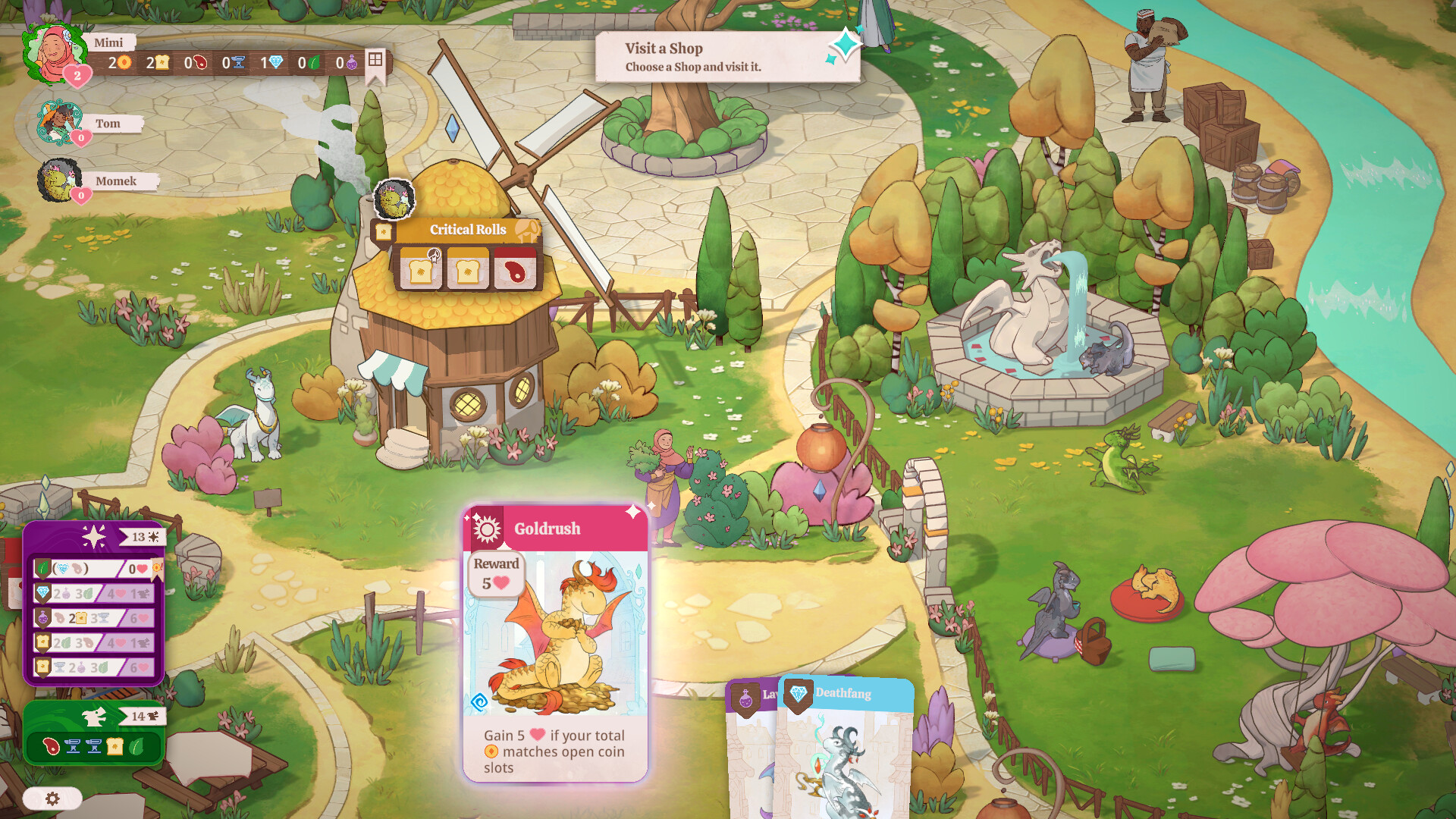
Monster Couch’s own Wingspan adaptation, meanwhile, has 300 different cards with all the expansions, and every card has a different ability, resulting in an effectively unlimited range of ways to play. There are still plenty of tactics at play in Flamecraft, but you do definitely feel like you’ve got fewer options in terms of what you’ll do on any given turn. Does that mean that my little gaming group will effectively “solve” Flamecraft after we spend enough time playing it? Possibly, but the process of getting to that point will be fun.
Mastering the game will be a delightful journey in part thanks to the presentation because, just like with Wingspan, Monster Couch’s visual and music teams have crafted something warm and welcoming. Cards and the board are all animated, and the dragons that show up everywhere have charm and personality in abundance. The music is relaxing and exactly the kind of wind-down soundtrack that will make a round or two of Flamecraft ideal after a particularly stressful and taxing day.
Flamecraft games also play nicely and quickly, with a standard game taking around an hour or so to get to the final score. So it’s a good game to have sitting around as filler between other, more substantial board games, or for those times where you really just want something easy to play before you head off to bed. More than a few times my little gaming group has had to abandon a game of Wingspan or Caverna because someone fell asleep three-quarters of the way through, so having Flamecraft sitting there as an option for a lightning game will be valuable.
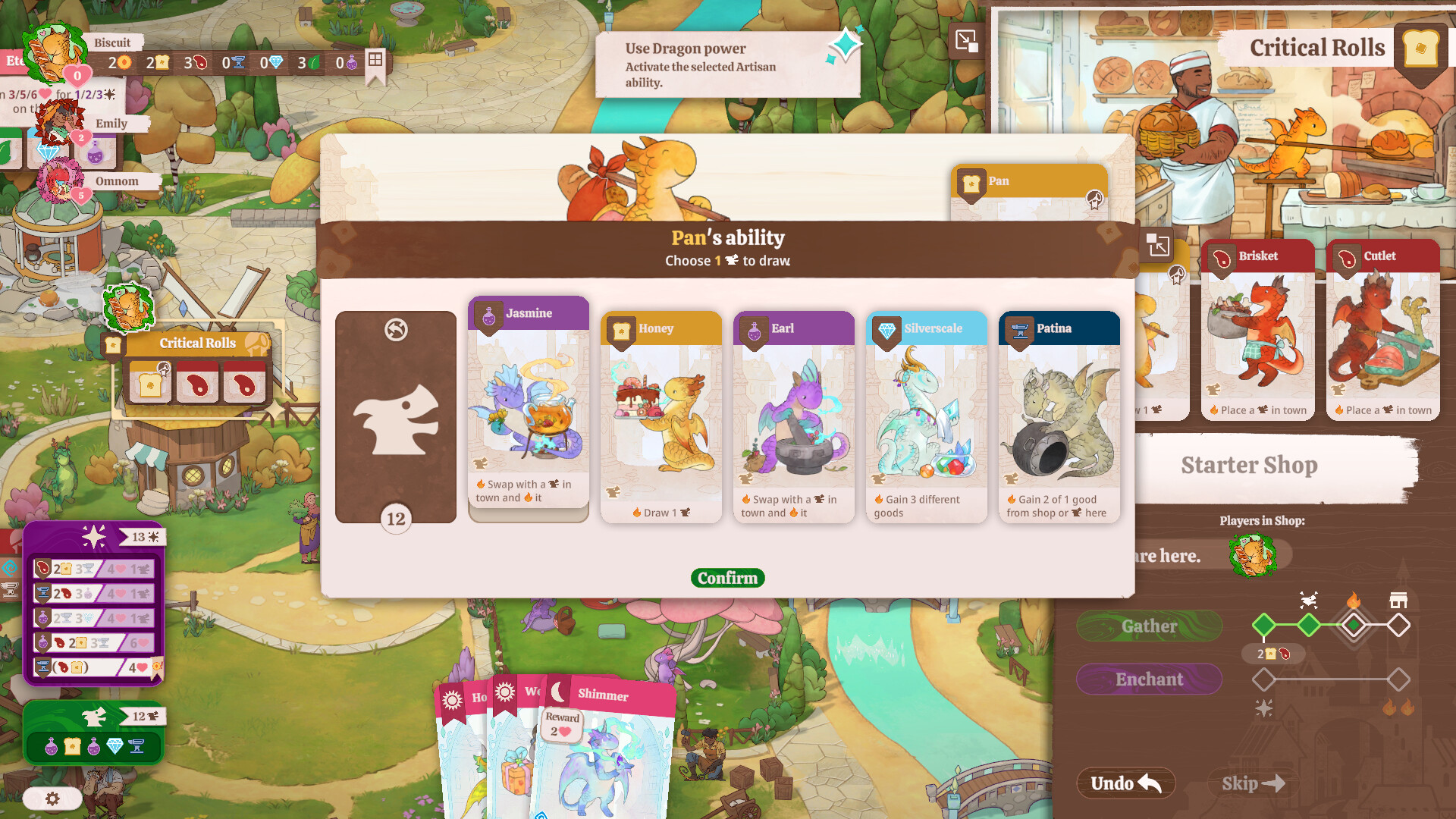
Meanwhile, there is a “story” mode for single-player play, which I am unlikely to ever spend time with as I’ll be focused on the multiplayer. If you can’t get a full group together, there are AI opponents available, with three difficulty levels. Like with Wingspan, though, the AI is not overly inspired in how it plays, even on the most difficult setting, so once you’re comfortable with the game and its strategies, you’ll find that the AI is useful filler in the absence of real players but never really a threat to win a game.
Really, though, the most disappointing thing about Flamecraft at this stage is that it lacks a mobile version. The game is fully cross-play compatible between PC, TV consoles, and Switch, but without a mobile version it’s not quite as versatile for gaming groups as Monster Couch’s other title, Wingspan. I’m sure that will change though.
I love digital board games that are presented with love and care, and Monster Couch could never be accused of not loving their work. The team goes truly above and beyond to make its adaptations beautiful, character-filled, and warm to play, and Flamecraft delivers this in spades. It’s going to be part of my multiplayer roster for some time to come.