
People who play board games are familiar with Dominion. It is considered the “gateway drug” to deckbuilding card games (and was indeed the first example of one), being both light and accessible and very good at showcasing the basic mechanics of this particular genre. It has sold millions and millions of copies, and there are now more expansions than you could possibly count. Heart of Crown takes the basic mechanics of Dominion and gives them an anime coat of paint. It’s hard to complain about that.
For those who haven’t played a deckbuilding game before, the basics work like this: You start with a basic hand that has minimal resources in it. On your turn, you can play those resources to buy cards from a common “market” in the middle of the table that all players have access to. These cards might have special abilities, or they might just be better quality resources -a card that gives you two or three coins rather than one, for example. Once you buy those cards, they get shuffled into your deck and can be used when you draw them.
Eventually, you’ll build up enough resources to be able to start buying and playing victory cards, and this is the one area where Heart of Crown diverges from Dominion. In Dominion, you just draft the victory point cards into your deck, and when the common market gets bought up, the person with the most points wins. In Heart of Crown, you spend a lot of resources in one turn to “appoint” a princess from a list of seven. That princess has some powerful special abilities of her own, and from there, you start recruiting special court cards, which are worth victory points. The first person to 20 victory points wins.

It’s a simple premise that you can learn by playing, and within a game or two, you’ll be comfortable with the flow and basic thought behind it. Thanks to the substantial variety in cards that you can purchase from the common market, there’s a fair amount of tactics involved, and this game can become very competitive. In Heart of Crown, your ability to directly mess with your opponent’s games is really limited (there are a couple of “attack” cards that have small effects, but are more a nuisance than an opportunity to undermine an opponent’s strategy). However, speed is the name of this game, and a player who efficiently buys and plays the cards they need to quickly accelerate resources, recruit the princess and start accumulating victory points is going to pressure opponents to try and play quickly, which may well result in them making mistakes.
Overall, it’s a good and highly playable deckbuilding card game, and the physical edition has its fans for a good reason. The digital adaptation has been handled decently, too. Heart of Crown takes up a fair amount of table real estate, so one issue is that on the Switch screen, the cards are difficult to see, and the controller interface is a little clumsy to navigate initially. However, soon enough you’ll be comfortable with zooming in to see cards closely and as you start to recognise their patterns and the layout of the board, you won’t even need to do that. I’d give it about two hours of play to become comfortable with the UI and design, and from there it’s simply enjoyable to play.
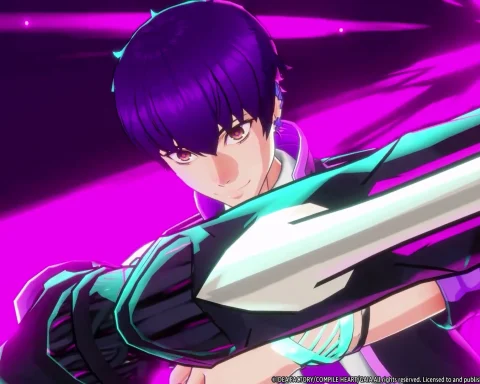
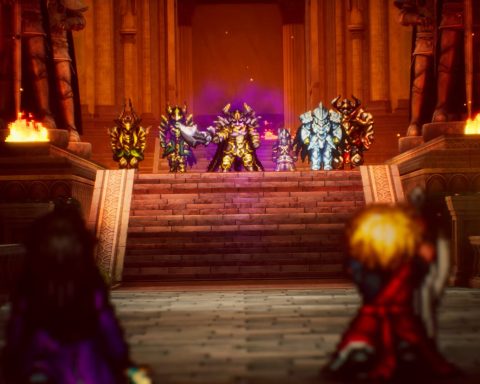
In addition to online crossplay (complete with online rankings) and being able to play standard matches with the AI, there’s also a story mode, which gives you the opportunity to get a brief sense of the personalities of each of the princesses. The story sequences play out like little visual novel vignettes, and while it’s not the best-written story I’ve ever encountered, there are special cards that are introduced to the game in this mode, which help to spice up the gameplay and further test your skills with the mechanics. For this reason, I actually really appreciated what this mode added to the overall package.
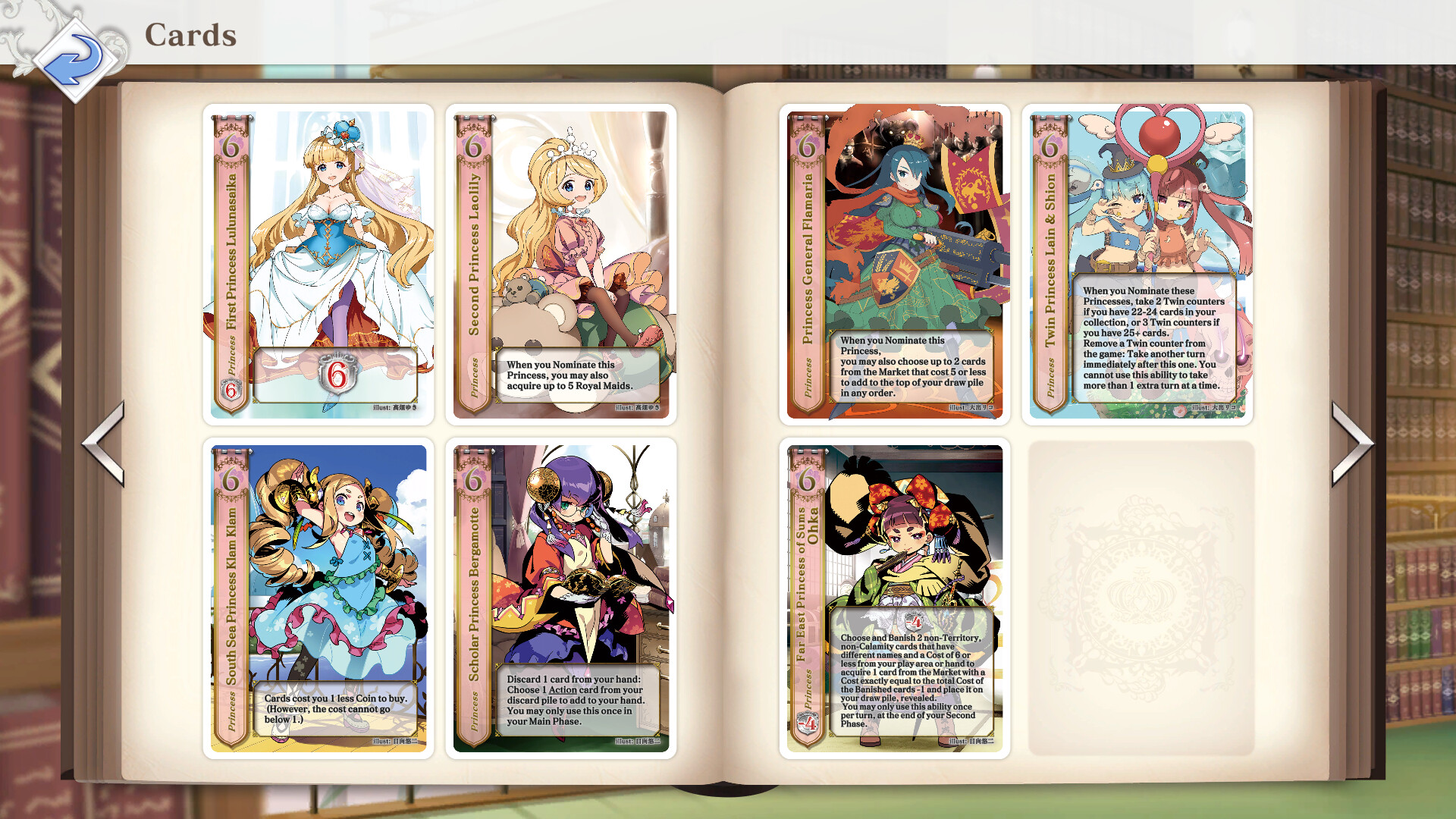
Speaking of spicy, however, the big problem with Heart of Crown is its aesthetics. To be blunt, the designs of the seven princesses are detailed and objectively well-drawn, with plenty of lavish animation to really make them pop as visual highlights. They’re also quite fanservicey, and a couple of them veer headlong into loli territory. Now, I personally don’t have an issue with fan service (just wait for The Last Waltz to come out, you’ll see), and I enjoy the designs of most of these characters myself. Lolis aren’t my thing, but even then, their presence is not enough to prevent me from playing the game. However, these things do mean that my friends in my board game group, who are less engaged with anime aesthetics, will find the art direction of Heart of Crown to be off-putting. Enough so that I can’t see this game being added to our rotation of board games for Friday night/weekend gaming sessions.
That sucks, because multiplayer with friends is the natural best state of board games. There’s no reason, mechanically, that Heart of Crown couldn’t sit alongside Wingspan, Ticket To Ride, Demeo and Oink Games (our current core rotation). It’s also not really the developer’s fault that the game looks like this, as the physical board game uses the same aesthetics, so all they’ve done is faithfully port the game as it was designed.
I just suspect that in the world of board games, anime fan service aesthetics are something that heavily limits the number of gaming groups that are going to be willing to play. Not everyone likes fan service, and if even one person is put off by Heart of Crown’s characters (particularly the lolis), then that’s a group that’s never going to vote to play it on game night. Therefore, as I’m not a fan of playing randoms online, Heart of Crown is likely to be a single-player only experience for me, and that’s a disappointing way for an otherwise excellent game to fall short.